Education and Generative AI: How AI Is Reshaping Curriculum, Assessment, and Tutoring
 Feb, 15 2026
Generative AI isn’t just another tech trend in education-it’s rewiring how we design what students learn, how we measure their progress, and how they get help when they’re stuck. By 2026, 86% of education organizations are using generative AI tools, more than any other industry. That’s not because it’s flashy. It’s because it works. Teachers are saving hours. Students are understanding more. And learning is becoming something that adapts-not the other way around.
Curriculum Design: From Blank Page to Personalized Path
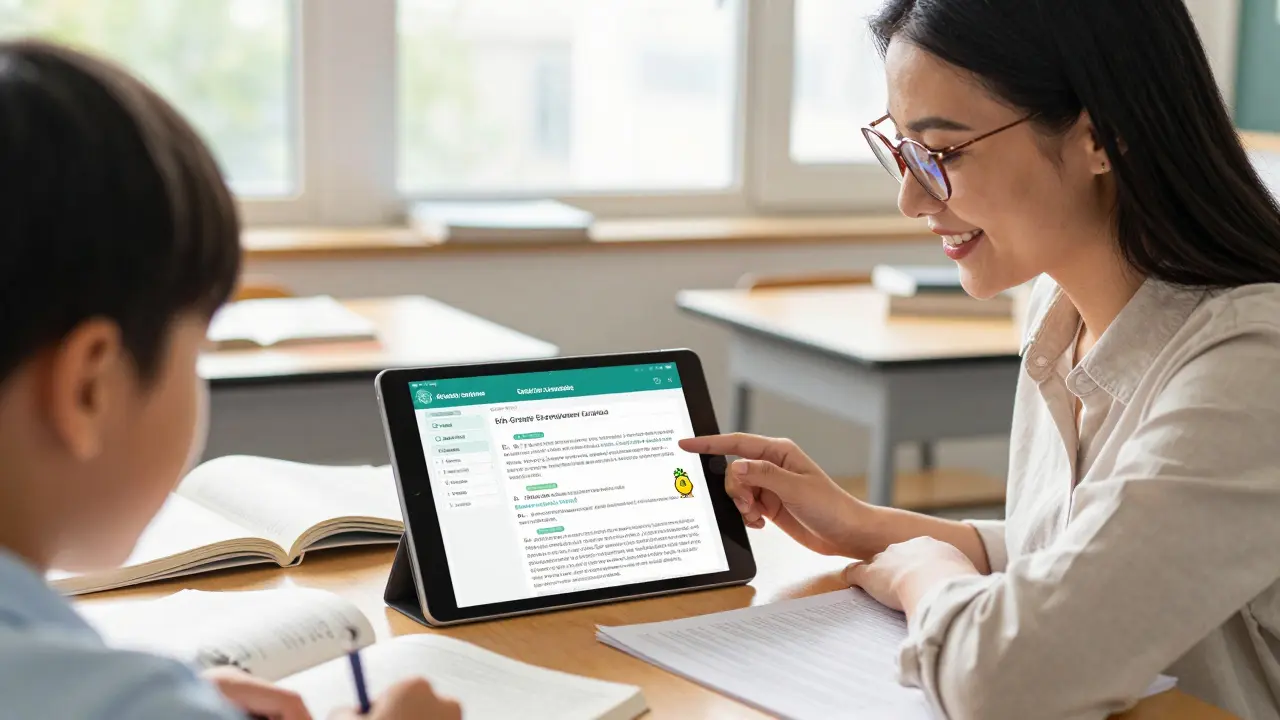
Creating a curriculum used to mean weeks of research, aligning standards, and drafting lesson plans by hand. Now, teachers type a prompt like, "Create a 6th-grade science unit on ecosystems with quizzes and hands-on activities," and get a full draft in seconds. Tools like Magic School and School AI don’t just pull from templates-they learn from your school’s past lessons, student performance data, and even district standards. The result? A curriculum that’s not just aligned, but tailored.
It’s not about replacing teachers. It’s about giving them back time. One district in Texas started using AI to draft syllabi, IEPs, and unit outlines during summer 2024. Teachers didn’t have to start from scratch. They edited, refined, and added their own voice. The human touch stayed-just shifted from copy-paste work to deeper planning.
And it’s not just for teachers. Students are using AI too. When a student asks, "Explain photosynthesis like I’m 10," or "Show me real-world examples of food chains," AI generates analogies, visuals, and scenarios that stick. This isn’t just content delivery-it’s co-creation.
Assessment: Beyond Multiple Choice
Tests used to be a one-size-fits-all event. Now, assessment is ongoing, adaptive, and personal. Imagine a quiz that changes based on how you answer. Get a question right? The next one gets harder. Struggle? The system drops back to reinforce the foundation. That’s what AI-powered formative assessments do.
Platforms like Langua and Canva for Education now let teachers build quizzes with images, audio clips, and interactive diagrams. A history lesson might include a video clip of a speech, then ask students to analyze tone and intent. A math problem might show a real-life budget spreadsheet and ask students to spot errors. These aren’t just fancy slides-they’re assessments that mirror real-world thinking.
And grading? AI can auto-grade short answers, essays, and even coding projects with surprising accuracy. One study showed teachers saved 5-7 hours per week on grading alone. That’s time they can now spend in one-on-one conversations or small group interventions.
Here’s the real shift: 59% of students say the way they’re being assessed has changed because of AI. They’re no longer memorizing for a single test. They’re building skills through constant, low-stakes feedback. And that’s how real learning happens.
Tutoring: Your 24/7 Learning Partner
Think of the student who stays quiet in class but types, "Why doesn’t this equation work?" at 10 p.m. That student now has an answer-no waiting, no embarrassment, no judgment.
AI tutors don’t just give answers. They guide. Langua’s system, for example, doesn’t just correct grammar in a language learner’s essay. It asks, "What did you mean here?" and offers three ways to rephrase. It remembers past mistakes and brings them up again in spaced repetition cycles-exactly how memory science works.
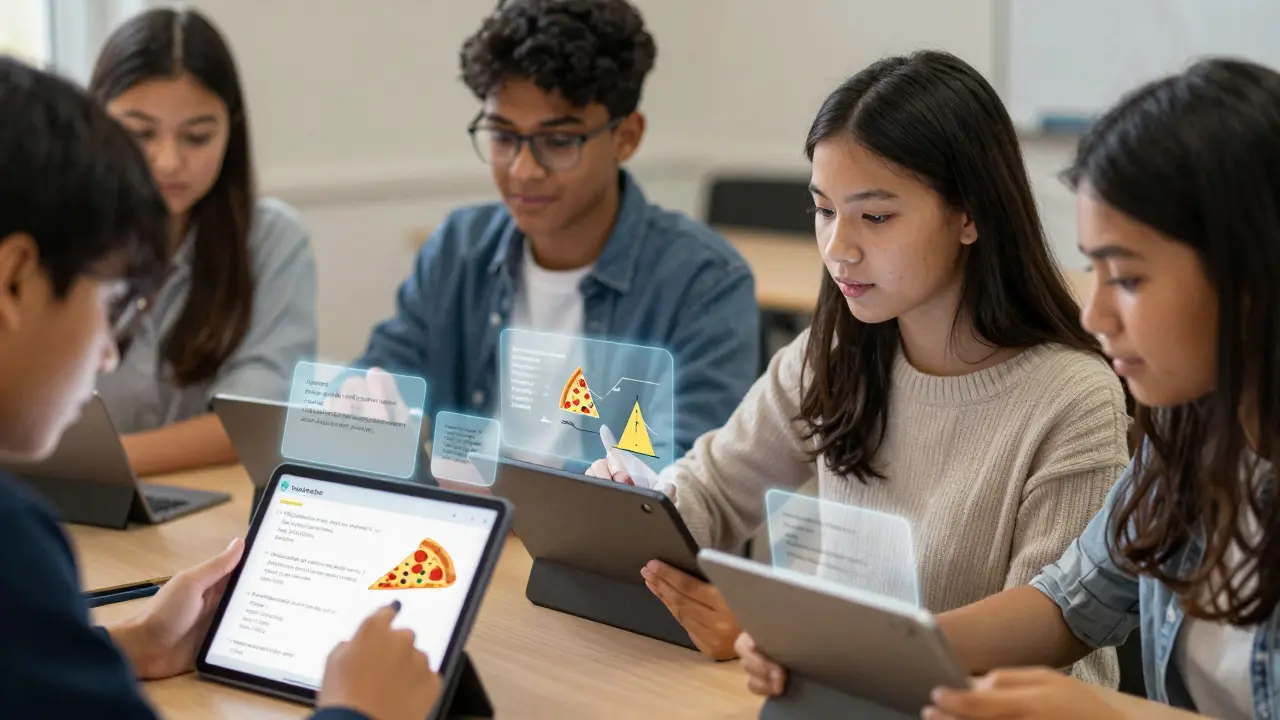
And it’s not just for language. A student struggling with quadratic equations can ask an AI tutor to explain it using pizza slices, video games, or sports stats. The AI adapts to their world. A 2026 AIPRM report found students using AI-powered tutoring systems improved test scores by 62%. Why? Because gaps are caught early. Confusion is addressed before it becomes frustration.
Interactive role-playing is another game-changer. Students practice debates with an AI that argues the opposite side. They simulate job interviews. They role-play historical figures. These aren’t games-they’re low-risk practice spaces where failure leads to growth, not a grade.
Tools That Turn Lessons into Experiences
Deck.Toys turns a PowerPoint slide into a clickable, animated learning journey. Students drag and drop answers, watch embedded videos, and unlock new sections only after mastering the last one. Gamification isn’t just points and badges-it’s structured progression that keeps students engaged.
Sendsteps.ai lets teachers run live polls during a lecture. Students answer questions on their phones. Instant results show who’s confused, who’s ahead, and who needs a different explanation. Teachers adjust on the fly. No more guessing.
And Canva for Education? It’s not just about making posters. It’s about teaching digital literacy. Students design infographics, podcasts, and presentations using AI-powered templates. They learn how to communicate ideas visually-something no textbook can teach.
These tools don’t just deliver content. They build skills: critical thinking, creativity, collaboration, and communication. The same skills employers want. The same skills life demands.
What Teachers Are Really Doing With AI
Teachers aren’t being replaced. They’re being amplified. AI handles the routine: generating quiz banks, drafting parent emails, organizing lesson materials. That frees them to do what no algorithm can: build relationships.
One high school in Ohio started an "AI Champion" program. Teachers trained for 4 weeks on how to use, question, and improve AI tools. They learned to spot when AI gave a biased answer. They taught students to check AI outputs for accuracy. They didn’t just use AI-they taught students how to use it responsibly.
And the results? Teachers reported higher student engagement, fewer behavior issues, and more meaningful classroom discussions. Why? Because they had time to listen. To ask follow-up questions. To connect.
AI doesn’t make teaching easier. It makes it more human.
The Big Questions: Who Controls the Learning?
But it’s not all smooth sailing. Only 7% of schools worldwide have formal AI policies. That means most classrooms are using these tools without clear rules. Is it okay for a student to use AI to write their essay? What if they don’t cite it? What if the AI gets it wrong?
These aren’t hypotheticals. They’re happening daily. The real challenge isn’t the tech-it’s the mindset. Are we using AI to make old systems faster? Or are we redesigning learning from the ground up?
Some schools are choosing the latter. They’re shifting to competency-based education, where students move forward only after mastering skills-not after completing a set number of weeks. AI helps track progress in real time. It shows when a student understands fractions, not just when they finished Chapter 3.
And students? They’re asking for more control. "Can I choose my own project?" "Can I use AI to explore my question?" "Can I learn at my own pace?" The answer is yes-and AI makes it possible.
What Comes Next
The next phase won’t be about more tools. It’ll be about better integration. AI will become part of the fabric-not a separate app you open. Imagine a student submitting a draft, and AI highlights not just grammar, but logic gaps, emotional tone, and real-world relevance. Imagine a teacher getting a weekly report: "Student A struggles with abstract math concepts. Try visual analogies. Student B is ready for advanced challenges. Suggest this project."
AI literacy will be mandatory-not as a tech class, but woven into every subject. Students will learn to question AI outputs. To trace bias. To understand training data. Because if they can’t do that, they’ll believe anything the machine says.
By 2027, we won’t ask, "Should we use AI in school?" We’ll ask, "How do we make sure every student gets the right kind of AI support?" The answer won’t be one-size-fits-all. It’ll be personalized. Adaptive. Human-led.
Can generative AI replace teachers?
No. Generative AI doesn’t replace teachers-it frees them. AI handles repetitive tasks like grading, drafting lesson plans, and generating quizzes. That gives teachers more time to build relationships, lead deep discussions, and offer personalized support. The most effective classrooms now use AI as a co-pilot, not a replacement. Human connection, empathy, and critical thinking are still the heart of learning-and only humans can provide them.
Is AI-generated content reliable for student assignments?
AI can generate accurate content, but it’s not infallible. It often mixes facts with plausible fiction, misses context, or reflects biases in its training data. Students should use AI as a starting point-not a final answer. The best practice is to cross-check AI output with trusted sources and always cite it. Schools are now teaching "AI verification" as part of research skills: How do you know what’s true? Who made this? What’s missing? These are critical thinking skills more important than any single fact.
Do students rely too much on AI for writing?
Some do-but the solution isn’t banning AI, it’s teaching better use. Instead of writing full essays, students now use AI to brainstorm, restructure, or clarify ideas. Teachers are shifting assignments to focus on process: drafts, revisions, reflections. A student might use AI to improve clarity, then explain in writing why they made each change. This turns AI from a shortcut into a learning tool. The goal isn’t perfect writing-it’s understanding how to think and communicate better.
How do AI tutors know what a student needs?
AI tutors track patterns over time. If a student keeps missing questions about fractions, the system identifies it as a recurring gap. It then adjusts future questions, offers simpler explanations, or suggests visual aids. It uses spaced repetition-reviewing material at optimal intervals based on memory science. It doesn’t guess. It learns from every interaction. That’s why students using AI tutors see up to 62% improvement in test scores: they get help exactly when and how they need it.
Are there equity concerns with AI in education?
Yes. Not all students have equal access to devices, internet, or training. Schools using AI must ensure tools are accessible on low-bandwidth devices, offer offline modes, and provide training for families. Platforms like Canva for Education and Magic School offer free access to verified educators and students, helping reduce barriers. But access alone isn’t enough. Students also need guidance on how to use AI ethically and effectively. Equity means not just having the tool-but knowing how to use it well.
Next Steps for Schools
If your school is starting with AI, begin small. Pick one area: lesson planning, quizzes, or tutoring. Train teachers to use it. Let them experiment. Then expand. Don’t rush. The goal isn’t to use AI everywhere. It’s to use it where it adds real human value.
And always ask: Who benefits? Is this making learning deeper-or just faster? Is it giving students more control-or more pressure? The best AI in education doesn’t just respond. It empowers.
Abert Canada
February 15, 2026 AT 14:27Been using Magic School for my grade 9 class this semester. Honestly? It cut my planning time in half. I used to spend weekends just formatting worksheets. Now I tweak AI drafts with my own examples-like local wildlife in Ontario-and it feels way more personal. Kids notice. They ask better questions. Not because the AI did the work, but because I had time to listen.
Also, one kid wrote a whole essay on climate change using AI to brainstorm, then spent three days revising it with me. We talked about tone, evidence, even cultural context. That’s the real win-not the tool, but the conversation it freed up.
Xavier Lévesque
February 16, 2026 AT 03:36AI drafts lesson plans? Cool. But let’s be real-half the teachers I know just copy-paste the output and call it a day. No editing. No soul. You don’t get to ‘add your voice’ if you never open the damn thing. I’ve seen kids turn in essays that sound like a Wikipedia article written by a robot who read too many TED Talks. It’s not personalized learning. It’s lazy teaching with a shiny label.
Thabo mangena
February 17, 2026 AT 21:41As an educator from South Africa, I find this discussion both timely and profoundly necessary. The digital divide remains stark; many of our learners lack consistent access to devices or bandwidth. While AI tools offer remarkable potential, their implementation without equitable infrastructure risks deepening systemic inequities. We must prioritize access, training, and ethical pedagogy-not merely adoption. The goal is not technological advancement for its own sake, but educational justice for all learners, regardless of geography or socioeconomic status.
Karl Fisher
February 18, 2026 AT 18:22Okay, but have you seen what happens when you ask an AI to explain quantum physics to a 7-year-old? It literally says ‘it’s like magic, but with numbers.’ And then the kid goes home and tells his mom he’s going to be a wizard. That’s not learning. That’s a Pixar movie. I’m not saying AI is bad-I’m saying we need to stop pretending it’s not a glorified autocomplete with delusions of grandeur.
Bill Castanier
February 19, 2026 AT 03:48Ian Maggs
February 20, 2026 AT 15:48Consider, then: the very architecture of curriculum-linear, age-segregated, standardized-is a relic of the industrial age. AI, in its capacity to adapt, to personalize, to respond in real-time, does not merely augment this system-it exposes its fundamental inadequacy. We are not merely integrating a tool; we are being forced, by its very logic, to reimagine pedagogy itself. Is this evolution-or merely automation dressed as revolution? The answer lies not in the algorithm, but in the human will to redefine purpose.
Michael Gradwell
February 22, 2026 AT 08:51Flannery Smail
February 22, 2026 AT 17:09Emmanuel Sadi
February 24, 2026 AT 08:04Let’s cut the PR fluff. AI in education is a corporate cash grab wrapped in woke buzzwords. Teachers aren’t ‘amplified’-they’re being replaced by cheaper, scalable bots while administrators pat themselves on the back. And don’t get me started on ‘AI literacy.’ You’re teaching kids to use tools they don’t understand, while the companies behind them harvest their data, their learning patterns, their cognitive fingerprints. This isn’t innovation. It’s surveillance with a lesson plan.
And yes, I’ve seen the ‘AI Champion’ programs. They’re just training teachers to be tech support for vendors who don’t care if kids learn. They care about contracts.