Fine-Tuning LLMs: API-Hosted vs Open-Source Models Compared
 Jan, 16 2026
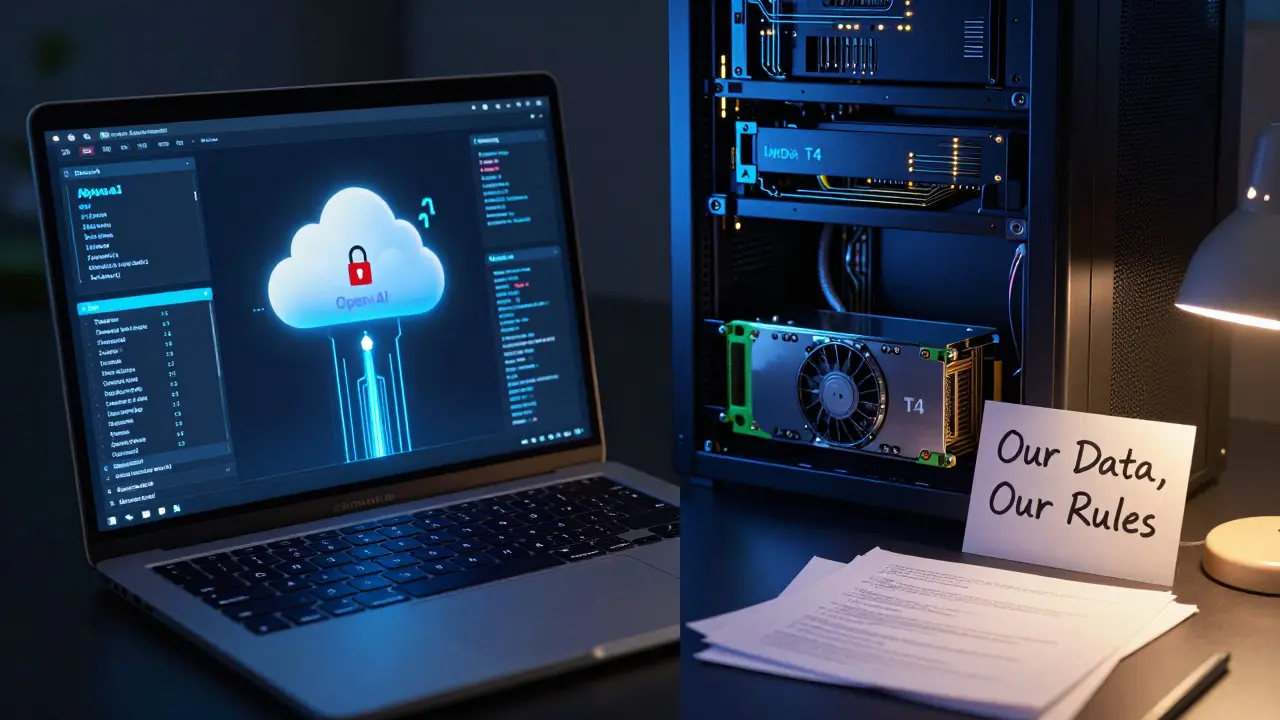
Choosing between API-hosted and open-source large language models for fine-tuning isn’t just a technical decision-it’s a business one. If you’re running a startup or a mid-sized company, you might think the answer is simple: use OpenAI’s API because it’s easy. But what if your data is sensitive? What if you’re processing tens of thousands of queries a day? What if you need to tweak the model to understand your internal jargon, your customer service logs, or your compliance rules? That’s where the real trade-offs kick in.
It’s Not Just About Cost-It’s About Control
API-hosted models like GPT-4 and Claude are plug-and-play. You send a request, you get a response. No servers to manage, no GPU drivers to debug. For many teams, that’s a lifesaver. A marketing team can build a chatbot in a weekend using just a few lines of Python and OpenAI’s documentation. But here’s the catch: you don’t own the model. You don’t own the data. And you don’t own the output. Open-source models like Llama 2, Mistral, and Vicuna flip that script. You download the weights, fine-tune them on your own data, and host them on your own infrastructure. You control everything. That’s why 78% of healthcare and financial firms in a 2023 Microsoft survey chose open-source-regulations like HIPAA and GDPR don’t allow them to send patient records or transaction data to third-party servers. If your business handles sensitive information, this isn’t a luxury-it’s a requirement.How Much Does It Actually Cost?
Let’s talk numbers. OpenAI charges $0.01 per 1,000 input tokens and $0.03 per 1,000 output tokens for GPT-3.5-turbo. That sounds cheap-until you scale. If your application handles 500,000 tokens a day, you’re spending $15 a day, or $450 a month. At 2 million tokens daily, you’re over $1,800 a month. And that’s before any fine-tuning, which often requires additional API calls to generate training data. Now consider self-hosting a 7B-parameter Llama 2 model. You’ll need a single NVIDIA T4 GPU (14GB VRAM), which costs about $1.25/hour on AWS. If you run it 24/7, that’s $900/month. But here’s the kicker: once you hit 50% utilization, you’re already cheaper than the API. At 80% utilization? You’re saving 40-60%. And if you’re processing 20,000+ queries a day, the math flips hard in favor of self-hosting. The catch? You need someone who knows how to manage it. Hiring a full-time ML engineer costs $150,000-$200,000 a year. That’s a big investment for a small team. But if you’re already running a data-heavy operation, that engineer can do way more than just host a model-they can build pipelines, optimize inference, and integrate with your existing systems.Performance: Does Open-Source Really Keep Up?
A common myth is that open-source models are “worse.” They’re not. In a 2024 Sarus study, a fine-tuned Llama 2 7B model matched 90% of ChatGPT’s performance on general tasks. But here’s where it gets interesting: on domain-specific tasks, it often beats GPT-3.5. Infocepts tested both models on a dataset of engineering support tickets. After training on 10,000 labeled examples, the Llama 2 model achieved 15% higher accuracy than GPT-3.5. Why? Because it learned your language-not the internet’s. If your customers say “the widget won’t sync,” and GPT-3.5 doesn’t know what a “widget” is in your context, it guesses. Your fine-tuned model knows exactly what you mean. GPT-4 still wins on raw knowledge, creativity, and reasoning. But if you’re building a customer service bot for your SaaS product, or a legal document analyzer for your firm, you don’t need GPT-4. You need a model that understands your world.
Latency, Uptime, and Reliability
APIs promise 99.9% uptime. But in March 2023, ChatGPT went down for four hours due to a DDoS attack. No warning. No fallback. Just silence. For businesses that rely on AI for customer interactions, that’s catastrophic. Self-hosted models don’t have that problem-if you set them up right. With dedicated hardware and proper load balancing, you can consistently hit sub-200ms response times. No spikes. No throttling. No surprise outages. You control the infrastructure, so you control the reliability. Of course, that means you need to monitor it, scale it, and patch it. That’s not trivial. But it’s also not magic. Tools like Hugging Face Inference Endpoints and Baseten let you host open-source models with API-like interfaces. You get the control of self-hosting without the full DevOps burden.Implementation: The Hidden Time Sink
APIs take hours to integrate. Open-source takes weeks. A developer on GitHub spent three weeks just getting CUDA drivers working on a 13B model. Another team spent two months debugging quantization issues before their model ran efficiently on a single GPU. These aren’t edge cases-they’re the norm. Open-source models require skills most software engineers don’t have: CUDA, model quantization (like GGML), inference optimization, and MLOps. Documentation varies wildly. Llama 2 has solid guides (rated 4.3/5 on Hugging Face). Mistral? Not so much (3.1/5). If you’re a small team, this is a dealbreaker. But if you’re already investing in AI, this is where you level up. The first few weeks are painful. The next six months? You’re building something no API can replicate.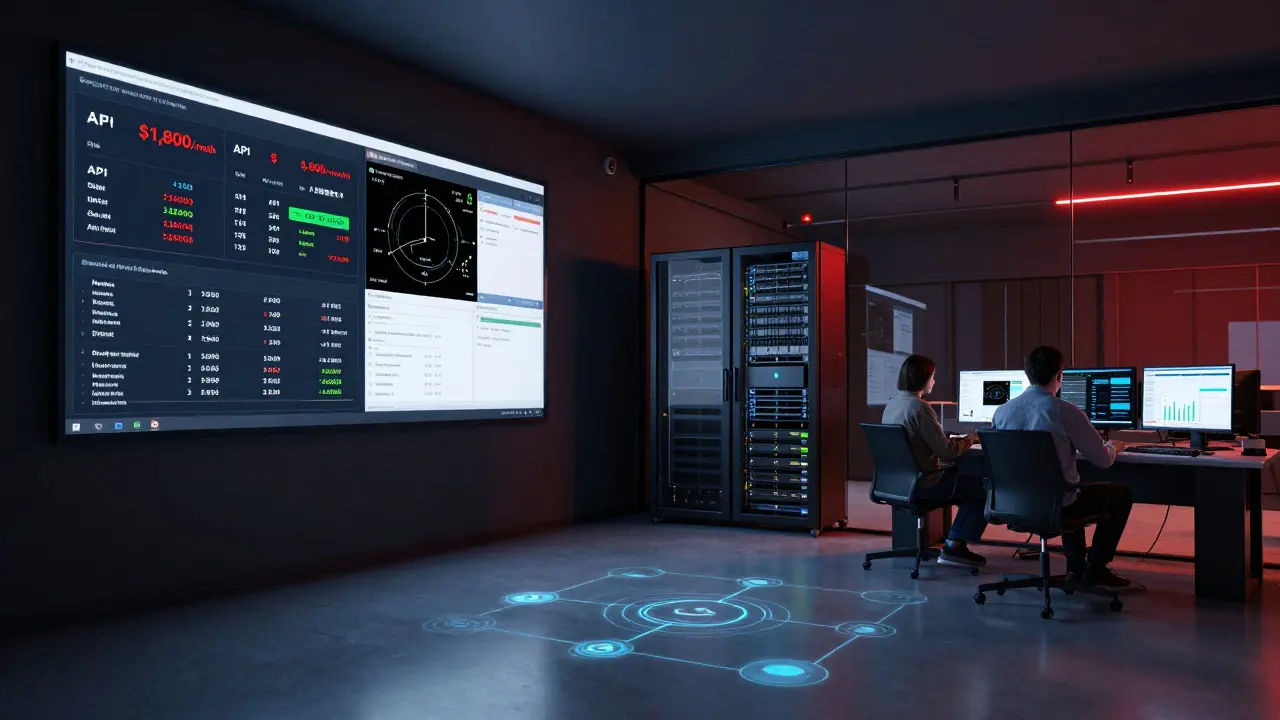
Who Should Use What?
Here’s the practical breakdown:- Use API-hosted models if: You’re testing ideas, have under 5,000 queries/day, lack ML expertise, or need rapid prototyping. Great for startups, marketers, educators.
- Use open-source models if: You’re processing over 20,000 queries/day, handle regulated data, need custom behavior, or plan to scale long-term. Ideal for finance, healthcare, enterprise SaaS, legal tech.
The Future Is Hybrid
By 2027, Gartner predicts most enterprises won’t choose between API and open-source-they’ll use both. Imagine a system that routes simple queries to a cheap, fast API model, and sends complex, sensitive ones to your fine-tuned Llama 2 instance. That’s the future: dynamic model routing based on cost, latency, and data sensitivity. OpenAI’s Ilya Sutskever says proprietary models will always lead because they need billions to train. But Meta’s Yann LeCun argues community-driven innovation will eventually outpace them in niche areas. Both are right. The winner isn’t the API or the open-source model-it’s the team that knows when to use each. If you’re just starting out, use an API. But if you’re serious about AI in your business, don’t wait until you’re locked in. Start planning your open-source migration now. The cost savings, control, and performance gains aren’t theoretical-they’re happening right now in companies just like yours.Can I fine-tune GPT-4 using my own data?
No, OpenAI doesn’t allow users to fine-tune GPT-4 or GPT-3.5 with custom data anymore. Their last fine-tuning API was discontinued in 2023. You can only use their models via API with prompt engineering. If you need true customization, you need to switch to open-source models like Llama 2 or Mistral.
How much VRAM do I need to run Llama 2?
It depends on the model size. A 7B parameter model needs at least 14GB VRAM (like an NVIDIA T4). A 13B model requires 24GB+ (A10G or better). A 70B model needs multiple high-end GPUs with NVLink-think 4x A100s. Most teams start with 7B or 13B models on cloud instances like AWS g5.xlarge for testing.
Is open-source really cheaper than using an API?
Yes, but only after you hit a usage threshold. For under 5,000 daily queries, APIs are cheaper. Beyond 20,000 queries, self-hosted open-source models save 40-60% on cost. The catch: you need upfront investment in hardware and engineering talent. The break-even point is usually 6-12 months in.
What’s the biggest mistake companies make when switching to open-source?
Underestimating the ramp-up time. Stanford HAI found most teams take 8-12 weeks to build a working fine-tuning pipeline. During that time, they’re still paying for API usage-so total cost can be higher initially. Plan for that delay. Don’t expect immediate savings.
Can I use open-source models in regulated industries like healthcare?
Yes-and many already do. HIPAA and GDPR require data to stay within your infrastructure. That’s why 76% of financial institutions and 82% of healthcare providers use self-hosted LLMs. You control the data flow, audit trails, and access logs. APIs can’t offer that.
Are there managed services for open-source LLMs?
Absolutely. Platforms like Baseten, Modal, and Anyscale let you deploy and scale open-source models without managing servers. They offer API endpoints, auto-scaling, and monitoring-like a managed version of self-hosting. They’re growing fast and now make up 15% of the open-source LLM market.
What’s the best way to start if I’m new to fine-tuning?
Start with Hugging Face’s AutoTrain. Upload your dataset (1,000-10,000 examples), pick Llama 2 7B, and let it handle the fine-tuning. Then deploy it to a free-tier GPU instance. You’ll learn the basics without writing a single line of CUDA code. Once you’re comfortable, move to full self-hosting.
Rubina Jadhav
January 18, 2026 AT 05:35I just started using Hugging Face's AutoTrain last week. Uploaded 2000 customer tickets, picked Llama 2 7B, and boom-my chatbot actually understands our jargon now. No coding. No headaches. Just works.
sumraa hussain
January 19, 2026 AT 13:56Okay but let’s be real-APIs are like ordering pizza. Open-source is like baking your own damn bread. You spend hours kneading, burning the first three loaves, crying in the kitchen… and then? You eat the BEST BREAD OF YOUR LIFE. Worth it. 10/10. No regrets. Even if my GPU sounds like a jet engine.
Raji viji
January 21, 2026 AT 07:53LMAO you people think you’re saving money? You’re just masochists with NVIDIA cards. You’re spending 3 months debugging CUDA drivers while your competitors are already scaling to 50k queries with GPT-4. Stop pretending you’re a hacker. You’re just a sysadmin with delusions of grandeur. And don’t even get me started on Mistral’s docs-those are written by a sleep-deprived intern who hates humans.
Rajashree Iyer
January 22, 2026 AT 14:50Is it not profound that we’ve outsourced our cognition to machines-and now we’re debating whether to rent or own the soul of those machines? The API is the temple of convenience. The open-source model? It’s the monastery. You enter with nothing but your data and your will. You emerge… changed. Or broke. But either way-transformed.
Parth Haz
January 23, 2026 AT 06:21While the cost analysis presented is largely accurate, I would caution against overlooking the intangible value of developer morale and team capability-building. Investing in open-source infrastructure, even at higher initial cost, fosters long-term technical resilience. It is not merely a tool decision-it is a strategic talent investment.
Vishal Bharadwaj
January 25, 2026 AT 04:43Wait so you’re telling me that after spending 6 months on this, you’re only saving 40%? That’s not saving-that’s just avoiding bankruptcy. And you didn’t mention that 70% of open-source models crash during peak hours because someone forgot to set up auto-restart. Also, GPT-4 is still 3x better at reasoning. You’re all just delusional. Also, typo in your table: 20,000 queries should be 200,000. I know because I’ve done this.
anoushka singh
January 26, 2026 AT 05:52So… you’re saying if I have a small team, I should just give up and use the API? But what if I’m just trying to build something for my grandma’s book club? Do I really need a 7B model to explain poetry? Like… can’t we just chill? 😅
Jitendra Singh
January 26, 2026 AT 06:26I’ve used both. Started with OpenAI. Hit 25k queries/month. Switched to Llama 2 on a single T4. Saved $1200/month. Took 8 weeks to get stable. Worth every second. The key? Don’t try to do it alone. Find a community. Hugging Face forums saved me. You’re not alone in this.
Madhuri Pujari
January 27, 2026 AT 00:32Ohhh so you’re telling me that after spending $200k on an engineer, you’re finally cheaper than OpenAI? Congrats. You just turned your startup into a data center. And you still can’t get it to stop hallucinating about ‘widget sync’ like it’s a religious ritual. Meanwhile, GPT-4 just says ‘I don’t know’ and doesn’t pretend to be your domain expert. You’re not clever-you’re stubborn. And your documentation is a crime scene.
Sandeepan Gupta
January 27, 2026 AT 07:25For anyone starting out: don’t skip the basics. Learn how to use quantization with GGUF. Use vLLM for inference-it’s 3x faster than Hugging Face’s default. Test on a free-tier A10G before committing. And yes, it’s painful at first. But every time you fix a latency issue, you’re building a muscle. This isn’t a sprint-it’s a marathon. And you’re already ahead of 90% of teams who just keep throwing money at OpenAI.