Future Trajectories and Emerging Trends in AI-Assisted Development in 2026
 Feb, 10 2026
By early 2026, AI-assisted development is no longer a flashy add-on-it’s the new normal. Companies that still treat it as optional are falling behind. The tools that once helped developers write a line of code faster now manage entire modules, auto-generate tests, and even suggest architecture changes based on real-time system behavior. This isn’t science fiction. It’s what’s happening in engineering teams across finance, healthcare, and manufacturing right now.
AI Is No Longer Just a Helper-It’s a Team Member
Five years ago, AI coding assistants were mostly autocomplete tools. Today, they’re autonomous agents. You don’t just ask them to finish a function-you assign them a task: "Build a secure API endpoint for patient records, write unit tests, and integrate it with our existing auth service." And they do it. Not perfectly, but often well enough to cut your review time in half.
Platforms like IBM’s WatsonX Developer and Microsoft’s Project Symphony now let multiple AI agents collaborate. One handles logic, another checks compliance, a third writes documentation. The human role shifts from coder to conductor. You set the goals, you validate the output, and you fix what breaks. This shift is why 78% of Fortune 500 companies now have AI-assisted development as core infrastructure, according to Capgemini’s January 2026 report.
Specialized Models Are Beating Giant Ones
The era of one-size-fits-all AI models is over. Companies aren’t using the biggest models anymore-they’re using the smartest ones. A model trained specifically on healthcare data outperforms a general-purpose model by 43% when writing HIPAA-compliant code. The same goes for financial systems, automotive software, or industrial control systems.
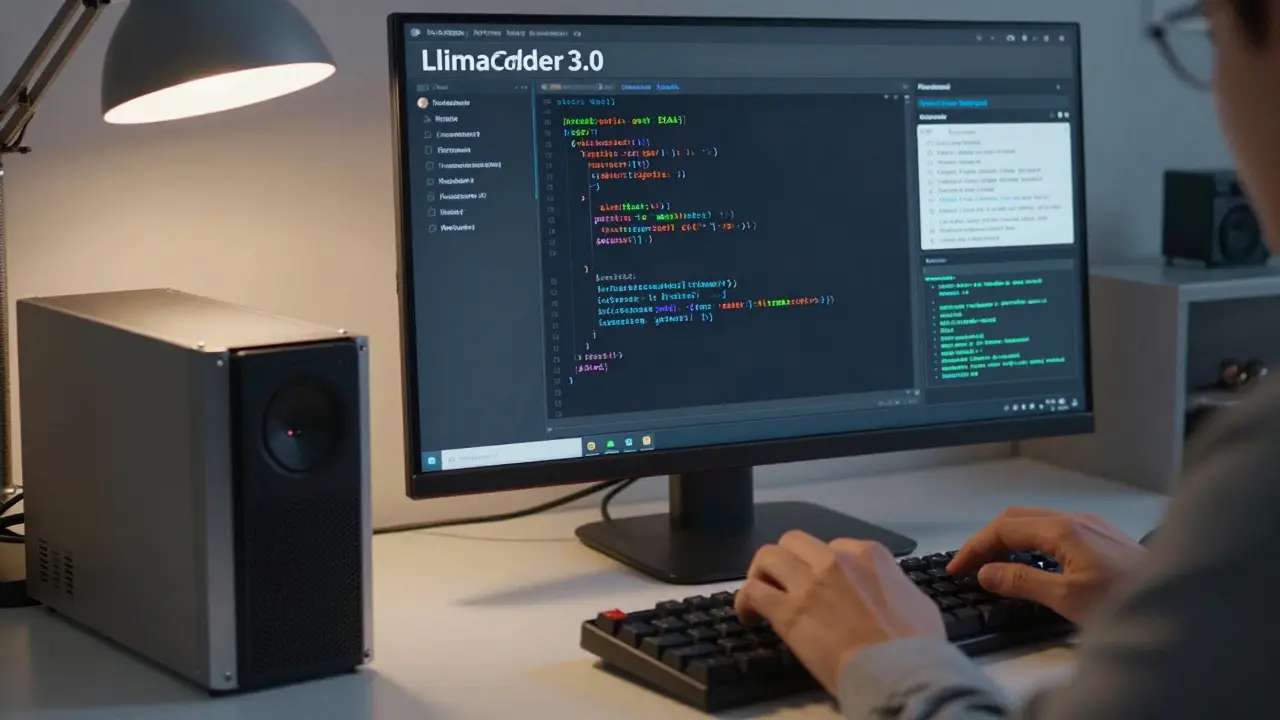
Meta’s LlamaCoder 3.0 and NVIDIA’s Clara are proof. LlamaCoder is free, open-source, and runs efficiently on local hardware. Clara, tuned for medical device development, costs more but reduces regulatory compliance errors by 61%. Why? Because it understands not just code, but context: FDA submission formats, audit trails, and failure mode analysis. Smaller, focused models are now 92% as accurate as massive ones, at just 37% of the computational cost, according to IBM’s Peter Staar.
Hardware Is Changing Too-Edge AI Is Everywhere
Running AI in the cloud sounds powerful, but it’s risky. Data privacy, latency, and cost are killing cloud-only approaches. That’s why 62% of enterprise AI development setups now run on edge devices-laptops, local servers, or even embedded systems.
Imagine a developer in a hospital IT department working on a pacemaker firmware update. They can’t send sensitive patient data to a cloud server. So their AI assistant runs locally, analyzes the code, suggests optimizations, and flags compliance gaps-all in under 80 milliseconds. That’s the new standard. IBM’s January 2026 assessment shows edge AI cuts response times to sub-100ms, which matters when you’re iterating on safety-critical code.
Language Support Still Has Gaps
Not all programming languages are created equal in AI-assisted environments. JavaScript and Python? AI tools are incredibly accurate-developers give them 4.6 out of 5 satisfaction scores. But C++, Rust, and embedded C? Those lag at 3.2 out of 5.
Why? Because those languages are complex, low-level, and full of edge cases. AI struggles with manual memory management, pointer arithmetic, or hardware register mapping. GitHub’s January 2026 survey of 43,000 developers confirms this gap. The tools are getting better, but they’re not yet reliable for systems programming. That means teams using these languages still need strong human oversight. Don’t expect AI to replace your embedded engineer anytime soon.
Costs, Training, and Hidden Expenses
Adopting AI-assisted development isn’t just about buying software. It’s about retraining your team. On average, it takes 40 to 60 hours per developer to become proficient. That’s not a weekend workshop. That’s weeks of focused learning.
Organizations now need three new roles:
- AI Prompt Engineers-people who know how to structure tasks for AI agents. They earn $155,000-$195,000 in 2026.
- AI-Integrated Developers-traditional coders who’ve learned to work alongside AI. Their salary range is $135,000-$175,000.
- Domain Experts-doctors, engineers, or compliance officers who train AI models on industry-specific rules. They make $145,000-$185,000.
And don’t forget setup time. Deloitte’s case studies show 8-12 weeks just to integrate AI tools into existing CI/CD pipelines. Many companies underestimate this. They think it’s a plug-and-play tool. It’s not. It’s a transformation.

Security, Ownership, and Regulation Are Real Concerns
Who owns the code AI writes? If it’s based on public repositories, is it licensed? Can you use it in a commercial product? These aren’t theoretical questions. The EU AI Act went live on January 1, 2026, and it requires full traceability for AI-generated code in safety-critical systems.
Companies in healthcare and automotive are now required to log every AI suggestion, who approved it, and why. 92% of affected organizations have added new verification layers. Meanwhile, 68% of enterprises report security concerns-especially around code that leaks into public repositories or gets trained on proprietary data.
And then there’s vendor lock-in. Gartner’s December 2025 survey found that 68% of companies struggle to switch platforms. If you invest in IBM WatsonX, you’re tied to its APIs, its training data, its workflows. Switching means rebuilding your entire AI-assisted pipeline. That’s a huge risk.
The Future: AI Meets Physical Systems
The biggest trend isn’t in code-it’s in robots. Deloitte calls it "AI going physical." AI-assisted development is no longer just about building apps. It’s about building self-driving cars, surgical robots, smart factory systems, and autonomous drones.
These systems need code that talks to sensors, adjusts in real time, and fails safely. That’s 37% more complex than traditional software. The tools are adapting. IBM’s quantum-assisted optimization, launched in January 2026, reduces computational complexity by up to 67% for pathfinding algorithms in robotics. NVIDIA’s Clara now helps design control logic for autonomous surgical tools. This convergence is growing at 47% per year.
By 2027, Gartner predicts 90% of enterprises will use AI-assisted development in some form. But the real winners will be those who use it not just to write code faster-but to build things that interact with the real world.
What Doesn’t Work Yet
AI is powerful, but it’s not magic. Here’s where it still fails:
- Complex architecture design-AI can’t yet design a scalable, fault-tolerant distributed system from scratch. Human architects still lead.
- Legacy system integration-connecting AI tools to 20-year-old COBOL systems? Only 28-35% effective, according to MIT Sloan.
- Documentation quality-open-source tools generate documentation that’s confusing 68% of the time. Enterprise tools do better, but still average just 4.1/5.
- Algorithm innovation-if you need a novel optimization or a new data structure, AI won’t invent it. It can refine, but not create.
If your team thinks AI will replace senior engineers, you’re setting yourself up for failure. It’s not a replacement. It’s a force multiplier.
Is AI-assisted development replacing software developers?
No. It’s changing the role. Developers now spend less time writing boilerplate code and more time designing systems, reviewing AI output, and solving edge cases. The most valuable developers in 2026 are those who can guide AI, not just code alongside it.
What’s the best AI tool for a small startup?
LlamaCoder 3.0 by Meta is the top choice. It’s free, runs locally, and works well with Python and JavaScript. It doesn’t have enterprise support built-in, so you’ll need a senior engineer to manage it-but for a small team, that’s manageable. Avoid expensive enterprise platforms unless you’re scaling fast.
Can AI-generated code be legally used in commercial products?
Yes-but only if you trace its origin. The EU AI Act requires full audit trails: which AI model generated it, what training data it used, and who reviewed it. Tools like IBM WatsonX and Microsoft’s Project Symphony now include built-in compliance logs. Open-source tools often don’t. If you’re in healthcare, finance, or automotive, don’t skip documentation.
How long does it take to train a team on AI-assisted development?
Most teams need 40-60 hours of structured training over 6-8 weeks. This includes learning how to prompt effectively, interpret AI suggestions, and validate outputs. Rushing this leads to over-reliance and poor code quality. Treat it like adopting a new programming language.
Will AI-assisted development become standard by 2027?
Yes. Gartner predicts 90% of enterprises will use some form of AI-assisted development by 2027. The real question isn’t whether you’ll adopt it-it’s whether you’ll adopt it well. Companies that treat it as a tool will get average results. Those that redesign workflows around it will lead their industries.
Kieran Danagher
February 10, 2026 AT 16:23Sheila Alston
February 11, 2026 AT 09:49Natasha Madison
February 11, 2026 AT 22:47sampa Karjee
February 13, 2026 AT 13:04Patrick Sieber
February 14, 2026 AT 03:43