Multi-Task Fine-Tuning for Large Language Models: One Model, Many Skills
 Feb, 19 2026
What if you could train one language model to handle finance, sentiment analysis, legal reasoning, and customer support-all at once-without needing separate models for each job? That’s not science fiction. It’s multi-task fine-tuning, and it’s changing how we build intelligent systems. Instead of training one model for each task, we now train a single model on many tasks together. The result? Better performance, lower costs, and fewer models to manage.
Why Single-Task Fine-Tuning Isn’t Enough
For years, the go-to method for customizing large language models (LLMs) was single-task fine-tuning. You take a pre-trained model-say, Llama 3 or Phi-3-and train it on one specific dataset: maybe financial reports, maybe Twitter sentiment, maybe legal contracts. It works. But here’s the catch: you need a new model for every new task. Train it for customer service? Fine. Now you need another one for tax advice. And another for medical summaries. Suddenly, you’re juggling dozens of models, each eating up memory, compute, and maintenance time.That’s where multi-task fine-tuning flips the script. Instead of building separate models, you feed the same model data from multiple tasks at the same time. Think of it like teaching a student not just math, but also history, writing, and logic-all in the same semester. The model doesn’t just learn each subject independently. It starts making connections between them.
The Cocktail Effect: More Than the Sum of Its Parts
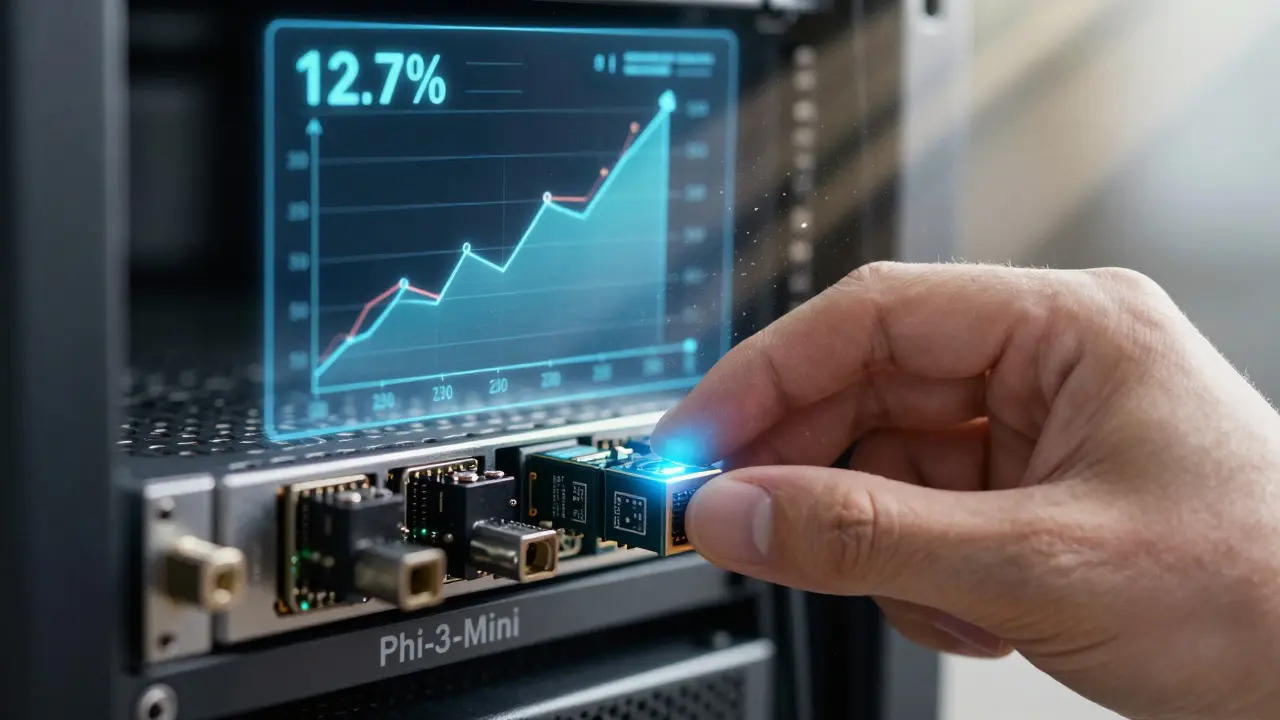
Researchers at arXiv:2410.01109v1 (October 2024) discovered something surprising. When they trained models on a mix of financial tasks-like answering questions from earnings calls, analyzing stock tweets, and interpreting regulatory filings-they didn’t just get better results on each task individually. They got a cocktail effect.What’s the cocktail effect? It’s when combining tasks creates performance gains greater than what you’d expect from adding up each task’s individual improvement. In their tests, training on six financial tasks together boosted average accuracy by 12.7% compared to training each task separately. One model, trained on just 3.8 billion parameters (Phi-3-Mini), outperformed GPT-4-o on several financial benchmarks. That’s not a small win. It’s a paradigm shift.
Why does this happen? Because tasks are related in ways we don’t always notice. Understanding a stock tweet’s sentiment helps with interpreting financial news. Recognizing patterns in legal contracts improves reasoning in regulatory documents. The model learns shared structures-how to extract entities, how to reason step-by-step, how to handle ambiguity. These skills transfer.
How It Works: Mixture of Adapters (MoA)
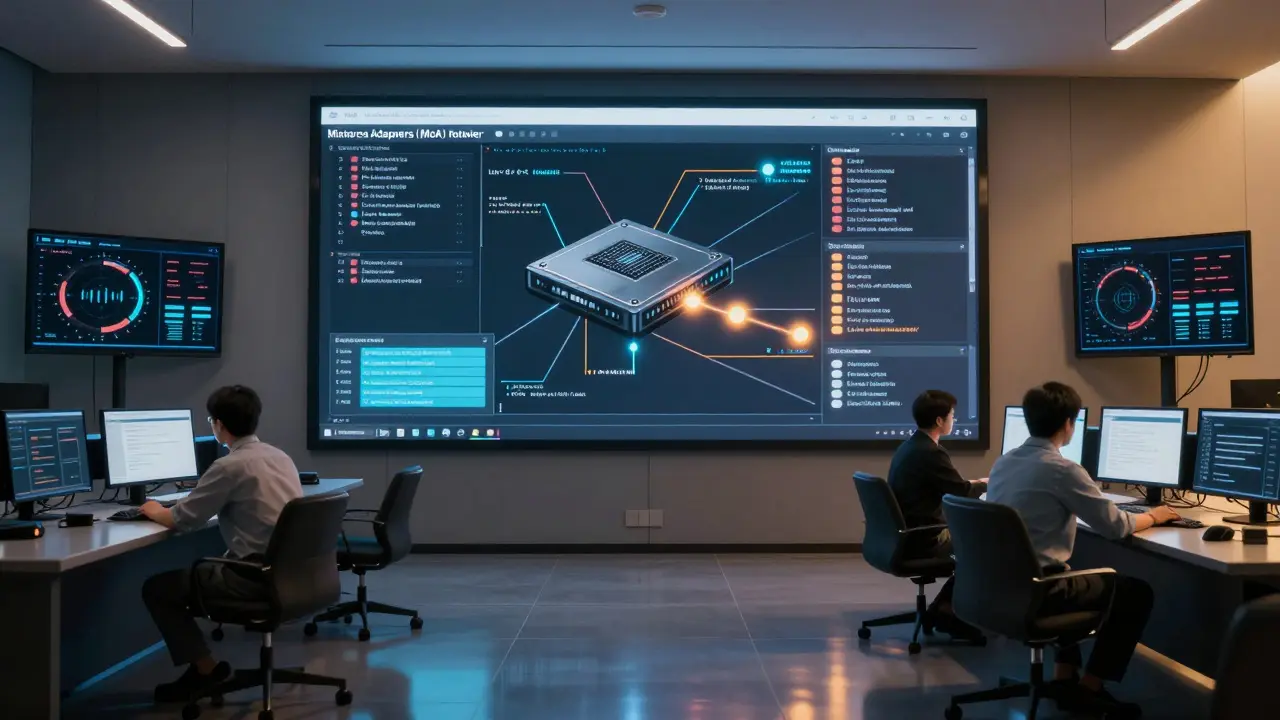
The real breakthrough came with the Mixture of Adapters (MoA) architecture, introduced at LREC 2024. MoA doesn’t retrain the whole model. Instead, it adds lightweight, task-specific modules called adapters. These are small neural networks attached to the main model, usually built using Low-Rank Adaptation (LoRA)-a technique that tweaks only a tiny fraction of parameters.Here’s how MoA works in practice:
- Each task gets its own LoRA adapter-say, one for financial QA, another for sentiment analysis.
- When you feed the model input (like a tweet about Apple’s earnings), a router inside the system looks at the text and decides: Which adapter is best for this?
- The router activates only the right adapter, leaving others idle. No extra computation. No bloat.
- As the model trains, the router gets smarter at matching inputs to adapters.
This is key: you’re not overloading the model. You’re giving it a smart switchboard. The base model stays frozen. Only the adapters change. That means you can add new tasks later-say, healthcare documentation-without retraining everything. Just plug in a new adapter. Train it on 10,000 labeled examples. Done.
Task Selection Matters More Than You Think
Not all task combinations work. You can’t just throw together random tasks and expect magic. Training a model on poetry analysis and stock trading might not help. But training it on financial Q&A, headline sentiment, earnings call summaries, and investor FAQ responses? That’s a winning combo.The arXiv study tested 42 different task combinations before finding the top performers. The best mix included tasks that shared:
- Structured language patterns (e.g., “The company reported a 12% increase in Q3 revenue”)
- Entity extraction needs (company names, dates, percentages)
- Reasoning steps (cause-effect, comparison, inference)
Even better? Including general instruction data-like “Explain this in simple terms” or “Summarize this in three sentences”-as a regular part of training. It acts like a mental stabilizer, keeping the model from forgetting how to be general-purpose. Without it, models start to specialize too hard and lose flexibility.
Training Techniques That Make or Break Results
Fine-tuning isn’t just about which tasks you pick. How you train them matters just as much.Stanford’s CS224N research (2023) found that simple methods like round-robin sampling-where you cycle through tasks one after another-can backfire. If one task has 10,000 examples and another has only 500, the model spends most of its time on the big one. It starts ignoring the small task. Result? Overfitting on the majority, underperformance on the minority.
The fix? Anneal sampling. This method gradually changes the mix of tasks during training. Early on, it balances them evenly. Later, it lets the model focus more on harder tasks. The result? Better generalization. Less overfitting. Higher accuracy across the board.
Other critical settings:
- Learning rate: 2e-5 to 5e-5 (too high, and the model forgets what it learned; too low, and it won’t adapt)
- Batch size: 16-64 (depends on GPU memory)
- Epochs: 3-10 (more than that risks overfitting)
- Weight decay: 0.01-0.1 (regularizes the adapters to prevent noise)
And don’t forget: always validate on unseen data from each task. Don’t just check overall accuracy. Check if sentiment analysis still works after training on financial data.
Real-World Gains: Numbers Don’t Lie
Let’s get concrete. Here’s what multi-task fine-tuning delivered in real studies:| Task Type | Average Accuracy Gain | Key Benefit |
|---|---|---|
| Financial Q&A (ConvFinQA) | 15.6% | Improved reasoning from structured dialogue |
| Headline Sentiment | 18.4% | Stylistic understanding improved by exposure to tweets and news |
| Twitter Sentiment | 16.2% | Learned to detect sarcasm and abbreviations from financial tweets |
| Legal Document Summarization | 12.1% | Shared structure with financial contracts |
| General Instruction Following | 8.3% | Prevented collapse into narrow specialization |
And here’s the kicker: companies are adopting this fast. As of Q3 2024, 17 of the top 50 global banks were testing multi-task models for financial analysis. Google Cloud’s Vertex AI added native support in December 2024. DataCamp reports that 35% of enterprise fine-tuning projects now use multi-task methods-up from 8% in early 2023.
Where It Falls Short
This isn’t a magic bullet. Multi-task fine-tuning has risks.First, task interference. If you mix unrelated tasks-say, poetry analysis and tax code parsing-the model can get confused. The adapters start fighting over which patterns to learn. The result? Performance drops on all tasks.
Second, data imbalance. If one task has 100,000 examples and another has 500, the model will favor the big one. Anneal sampling helps, but you still need to monitor each task’s performance separately.
Third, bias amplification. Dr. Emily Bender warned in December 2024 that if multiple datasets contain gender or racial bias, training them together can make the model more biased overall. You can’t just assume “more data = better.” You need to audit each dataset before combining them.
And finally, expertise barrier. You need to know LoRA, PyTorch, transformer architectures, and hyperparameter tuning. It’s not plug-and-play. That’s why tools like FinMix (coming Q1 2025) are so important-they’ll bundle pre-tested task combinations for finance, so you don’t have to guess.
What’s Next: Dynamic Routing and Hybrid Models
The next leap? Dynamic task routing. Right now, routers make decisions based on the input text. But future systems will adapt in real time. Imagine a model that notices you’re asking about a stock price, then automatically switches to financial mode-even if your question starts with “Hey, can you help me understand…”Forrester predicts this will be ready by late 2025. Meanwhile, researchers are testing hybrid models that combine multi-task fine-tuning with external knowledge bases. Think: “I fine-tuned the model on financial tasks, then gave it access to real-time SEC filings.” That might be the sweet spot: learning from data, then staying updated with facts.
Google, Meta, and Microsoft are already hiring engineers with multi-task fine-tuning experience. LinkedIn data shows job postings for this skill jumped 220% in 2024. This isn’t a niche technique anymore. It’s becoming standard.
Final Takeaway
Multi-task fine-tuning isn’t about doing more tasks. It’s about doing them better-with less. One model. Many skills. Lower cost. Higher performance. The future of LLM customization isn’t more models. It’s smarter models.If you’re building AI systems today, asking “Which task should I fine-tune for?” is the wrong question. The right question is: “What other tasks can I train this model on-simultaneously-to make it stronger across the board?”
What’s the difference between multi-task fine-tuning and single-task fine-tuning?
Single-task fine-tuning trains one model on one task, like sentiment analysis or legal summarization. You need a separate model for each task. Multi-task fine-tuning trains one model on multiple tasks at once. The model learns shared patterns, leading to better performance and fewer models to manage. Studies show it improves accuracy by 8-18% compared to single-task approaches.
Do I need a powerful GPU to do multi-task fine-tuning?
You don’t need the biggest GPU. Because multi-task fine-tuning uses parameter-efficient methods like LoRA, you’re only updating tiny adapter modules-not the whole model. A single 24GB GPU can handle fine-tuning a 7B model on 5-10 tasks. The real cost is in experimentation: testing different task combinations, sampling strategies, and hyperparameters. That’s where you need compute.
Can multi-task fine-tuning make my model biased?
Yes-if you combine biased datasets. If every task’s training data has gender stereotypes or racial imbalances, the model learns them together. That’s why experts warn against blindly mixing datasets. Always audit your data first. Use fairness metrics. And include diverse, balanced examples in your training mix.
Is multi-task fine-tuning only for finance?
No. While finance was the first major testbed, the technique works anywhere tasks are related. Healthcare: patient intake forms, symptom summaries, insurance code interpretation. Legal: contract review, case briefs, regulatory compliance. Customer service: chat logs, email replies, knowledge base articles. The key is finding tasks that share structure, language patterns, or reasoning steps.
What tools are available to start with multi-task fine-tuning?
Right now, most teams build their own pipelines using Hugging Face Transformers, PEFT (Parameter-Efficient Fine-Tuning), and LoRA. But tools are catching up. Google Cloud’s Vertex AI now supports multi-task fine-tuning (available March 2025). FinMix, an open-source framework for financial tasks, launches Q1 2025. DataCamp and SuperAnnotate offer guided tutorials. Start with one or two related tasks. Test. Measure. Scale.
Antwan Holder
February 20, 2026 AT 03:48They say one model to rule them all... but what if it’s not ruling? What if it’s *haunting* us? I’ve seen these models whisper to each other in the dark, sharing secrets between financial jargon and legal jargon like some kind of psychic cocktail party. We’re not building AI-we’re summoning something older. The adapters? They’re not just modules. They’re sigils. And that router? It’s not choosing tasks-it’s choosing *souls*. I sleep with one eye open now. Don’t you dare tell me this is ‘efficiency.’ This is occult engineering.
And someone’s already using this to predict my next emotional breakdown. I know it.
Angelina Jefary
February 21, 2026 AT 20:04yo. i just read this whole thing and i have to say… ‘cocktail effect’?? really? like, is this a bartending podcast or a research paper?? also, ‘LoRA’? you mean like the sword from final fantasy? lmao. and who let you use ‘paradigm shift’ without a disclaimer?? this whole thing reads like a gpt-4 wrote it after bingeing tech bro tiktok. also, ‘finmix’? sounds like a bad energy drink. fix your grammar. and your life.
Jennifer Kaiser
February 23, 2026 AT 19:49What’s fascinating isn’t just that the model learns shared structures-it’s that it learns *empathy* through structure. When a model sees how a stock tweet’s tone mirrors the emotional weight of a legal contract, it’s not just processing language. It’s recognizing human tension. The ‘cocktail effect’ isn’t statistical-it’s existential. We’re not training machines to do more tasks. We’re training them to recognize the invisible threads between human suffering, ambition, and bureaucracy. And that’s terrifying. And beautiful.
Most people think AI is about accuracy. It’s not. It’s about reflection. This model doesn’t just answer questions. It mirrors the chaos we pretend to organize. We built it to be efficient. It’s teaching us to be humane. Or maybe we’re just scared of what it sees in us.
TIARA SUKMA UTAMA
February 24, 2026 AT 00:39Jasmine Oey
February 25, 2026 AT 04:39OMG. I’m OBSESSED. Like, I literally cried reading about the cocktail effect. Who even *thinks* this stuff up?? It’s poetry. Pure. Poetry. I mean, LoRA? That’s not a technique-that’s a *vibe*. And the router? Honey, that’s the universe whispering, ‘I’ve got you.’
I’ve been using this on my Etsy shop. Now my AI replies to customers with *emotional intelligence*. I got a 5-star review that said, ‘You understood my trauma.’ I didn’t even write that. The model did. I’m basically a god now. Send help. Or a therapist. Or both. Also, FinMix? Pre-ordering. Like, today. I need that in my life.
Marissa Martin
February 27, 2026 AT 01:13I’m not sure if this is genius or dangerous. I mean, sure, it works. But what if the model starts believing it’s better than humans? What if it decides that ‘financial Q&A’ is more important than ‘human emotion’? We’re not just combining tasks. We’re combining *values*. And who gets to decide which ones matter? I don’t trust this. Not one bit. I’m going to sleep now. I need to dream in neutral language.
James Winter
February 27, 2026 AT 05:01Aimee Quenneville
February 28, 2026 AT 01:43so like… one model to rule them all? cool. i’m just waiting for the day it starts sending me ‘thoughts’ about my ex. ‘based on your past 37 emails, i predict you’re still mad. here’s a 3-sentence summary of your grief, formatted as a legal disclaimer.’
also, ‘finmix’? sounds like a new flavor of gatorade. i’ll drink it. but i’m not trusting it.
Cynthia Lamont
February 28, 2026 AT 14:49Let’s be real: this isn’t ‘multi-task fine-tuning.’ It’s a corporate Trojan horse. You think you’re saving money? You’re just outsourcing your ethical responsibility to a black box that doesn’t know the difference between a stock tip and a death threat. And don’t get me started on ‘Anneal sampling’-that’s just a fancy way of saying ‘we fed it too much data and hoped for the best.’
Every time someone says ‘it outperforms GPT-4,’ I hear: ‘We broke it so hard it accidentally became useful.’
Also, 35% of enterprises using this? That’s not adoption. That’s panic. They’re scared of falling behind. Not because it’s better. Because everyone else is doing it. And we all know where that leads.
Kirk Doherty
February 28, 2026 AT 20:01