Building Without PHI: How Healthcare Vibe Coding Lets Non-Coders Prototype Safely
 Jul, 10 2025
Imagine building a healthcare app without ever touching a single patient record. No HIPAA forms. No compliance audits. No risk of a data breach before you even launch. That’s the reality of vibe coding-a new way for doctors, nurses, and researchers to turn ideas into working software using nothing but plain English.
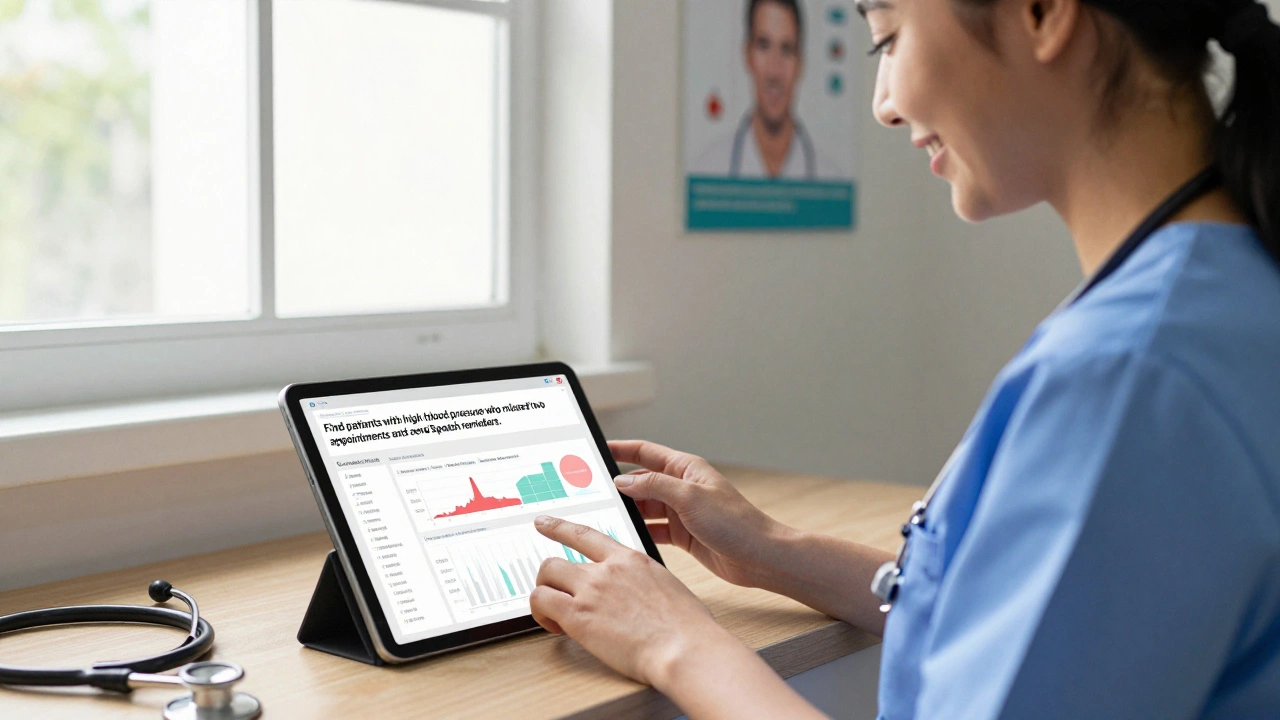
It’s not magic. It’s AI. But it’s AI that’s been trained to understand healthcare, not just code. Instead of writing Python scripts or configuring APIs, you describe what you want: "Find patients with high blood pressure who missed their last two appointments and send them a reminder in Spanish". The AI hears that, strips out any hint of real patient data, and generates clean, functional code in seconds. All without ever seeing Protected Health Information (PHI).
This isn’t science fiction. It’s happening right now in labs at Mayo Clinic, Stanford, and startups across the U.S. And it’s changing who gets to build tools for healthcare.
What Is Vibe Coding, Really?
Vibe coding isn’t about typing faster. It’s about thinking differently. The term was coined by AI researcher Andrej Karpathy in early 2025, but the idea is simple: let the AI interpret your intent-the "vibe"-not your syntax.
Traditional coding requires you to know variables, loops, and API endpoints. Vibe coding lets you say, "Compare survival rates between two drug groups using this dataset", and the AI does the rest. It pulls from open-source biomedical codebases, understands clinical workflows, and outputs working R or Python scripts that actually run.
Tools like GitHub Copilot, Replit Ghostwriter, and Anysphere Cursor have been upgraded with healthcare-specific models. These aren’t generic code generators. They’ve been fine-tuned on millions of lines of de-identified clinical code, FDA submissions, and public health research papers. The result? A 78.3% accuracy rate on biomedical tasks-nearly double what older models could do.
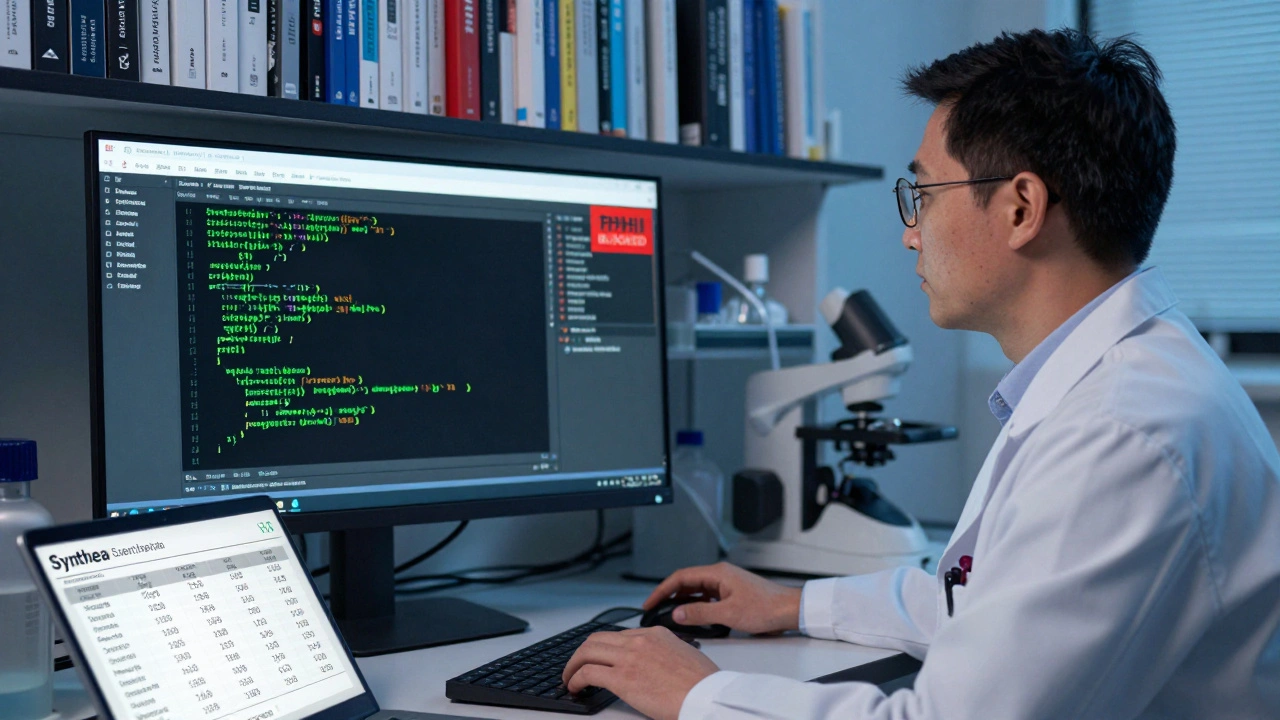
And here’s the kicker: none of this requires real patient data. Not even a single SSN, date of birth, or lab result. The system works with synthetic data-fake but realistic patient profiles generated by tools like Synthea. These synthetic patients have the same age distributions, comorbidities, and treatment patterns as real ones, but they’re completely anonymous. No PHI. No risk.
How It Keeps PHI Out of the Code
You might think: "Wait, if someone types in a patient’s name by accident, won’t the AI capture it?" That’s the big fear-and it’s why vibe coding platforms aren’t just smart, they’re locked down.
Every system follows a strict three-layer architecture:
- Natural Language Interface: You type your request in plain English.
- PHI Detection & Sanitization Layer: Before the AI even sees your words, a specialized model scans for anything that looks like PHI-names, IDs, addresses, even zip codes tied to small populations. It automatically redacts or replaces them with placeholders.
- Code Generation Layer: The AI now works only with sanitized inputs and synthetic data. No real records ever enter the environment.
These systems catch 99.7% of PHI attempts, according to IBM’s 2025 technical docs. That’s far better than older tools, which missed nearly 20% of sensitive data. And it’s not just about filtering input. The code itself runs in sandboxed environments-like virtual containers that can’t connect to live EHRs or databases. Even if the code tried to pull real data, it wouldn’t be allowed.
Platforms like Epic’s Cogito AI and Meditech’s new Dev Sandbox are built this way from the ground up. Even open-source tools like Anysphere Cursor now offer a "Healthcare Mode" that disables external data access unless explicitly approved by an admin.
Why This Changes Everything for Healthcare Teams
Before vibe coding, building even a simple tool meant hiring a developer, writing a requirements doc, waiting weeks for a prototype, then going through three rounds of compliance reviews-all before you could test it.
Now? A nurse at a rural clinic can build a tool to flag patients at risk of diabetes complications in under an hour. A researcher can test three different algorithms for predicting sepsis onset in a single afternoon. No IT ticket. No budget request. No legal team involved.
Here’s what’s changed:
- Speed: Prototypes that took 2-3 weeks now take 3-7 minutes. Mayo Clinic built a patient engagement tool for diabetes in 3 days-no PHI involved.
- Cost: The average prototype used to cost $14,200. Now it’s $3,800-mostly just training time.
- Access: 63.7% of vibe coding users are clinicians, not coders. Nurses, pharmacists, and lab techs are now building tools for their own workflows.
And the impact goes beyond efficiency. It’s democratizing innovation. Small clinics without IT departments can now compete with big hospitals. Researchers in low-resource settings can prototype without waiting for grants or partnerships.
Where It Falls Short (And Why You Still Need Humans)
Don’t get fooled. Vibe coding isn’t a magic wand. It’s a powerful starting point-but not a finish line.
Here’s where it struggles:
- Regulatory logic: The AI can’t handle complex HIPAA rules like "Can we share this data with a third-party insurer?" It gets 63.7% of compliance workflows right, according to Eularis. The rest needs a human auditor.
- Production deployment: The code it generates is 80-90% there. But for live systems, you still need engineers to fix edge cases, optimize performance, and add logging, monitoring, and security patches.
- Legacy systems: If your hospital still uses a 2010-era EHR, vibe coding tools won’t talk to it. FHIR integration is required, and not every system supports it.
- Code quality: A 22.4% error rate means one in five generated scripts will break under real use. Some pass unit tests but fail security scans.
At a Boston health system, a team tried to use a public AI tool to build a genetic risk predictor. They thought they were safe-they used de-identified data. But the synthetic data still contained rare genetic markers that, when combined with age and location, could re-identify patients. The project was halted for four months while they rewrote their data pipeline.
That’s why experts like Dr. Sarah Chen at Johns Hopkins say: "Vibe coding is a game-changer-but only if you audit it like you audit your prescriptions." Human oversight isn’t optional. It’s the safety net.
Real Stories: Wins and Warnings
On Reddit’s r/HealthIT, user ClinDev2025 wrote: "I built a tool that predicts which oncology patients will drop out of treatment. Took me 45 minutes. Previously, this would’ve taken two weeks and a bioinformaticist. And I never saw a single patient’s name." That post got 147 upvotes.
But another user, EMR_Integrator, shared a failure: "The vibe-coded prototype worked perfectly with fake data. When we hooked it up to our real Epic system? It crashed. The AI didn’t know our API required a special header. We lost three weeks."
These stories aren’t outliers. G2 reviews show 78% of users love the speed and PHI safety. But 63% say getting it into production was harder than expected.
One win: A team at UCSF used vibe coding to build a tool that helps patients with chronic pain track their symptoms using voice input. They trained the AI on synthetic data from 10,000 simulated patients. The tool was tested with real users-no PHI ever touched the system. It’s now being rolled out in five clinics.
One loss: A startup used a free AI coding tool (not healthcare-specific) to prototype a mental health triage app. The AI accidentally used real patient notes scraped from public forums as training data. The FDA flagged it. The company had to scrap everything and restart with compliant tools.
How to Get Started (Without Messing Up)
If you’re a clinician or researcher ready to try this, here’s how to avoid the pitfalls:
- Use only healthcare-specific platforms. Avoid public tools like ChatGPT or free GitHub Copilot. Use Epic Cogito, Anysphere Healthcare Mode, or Replit’s HIPAA-compliant version. They’re built for this.
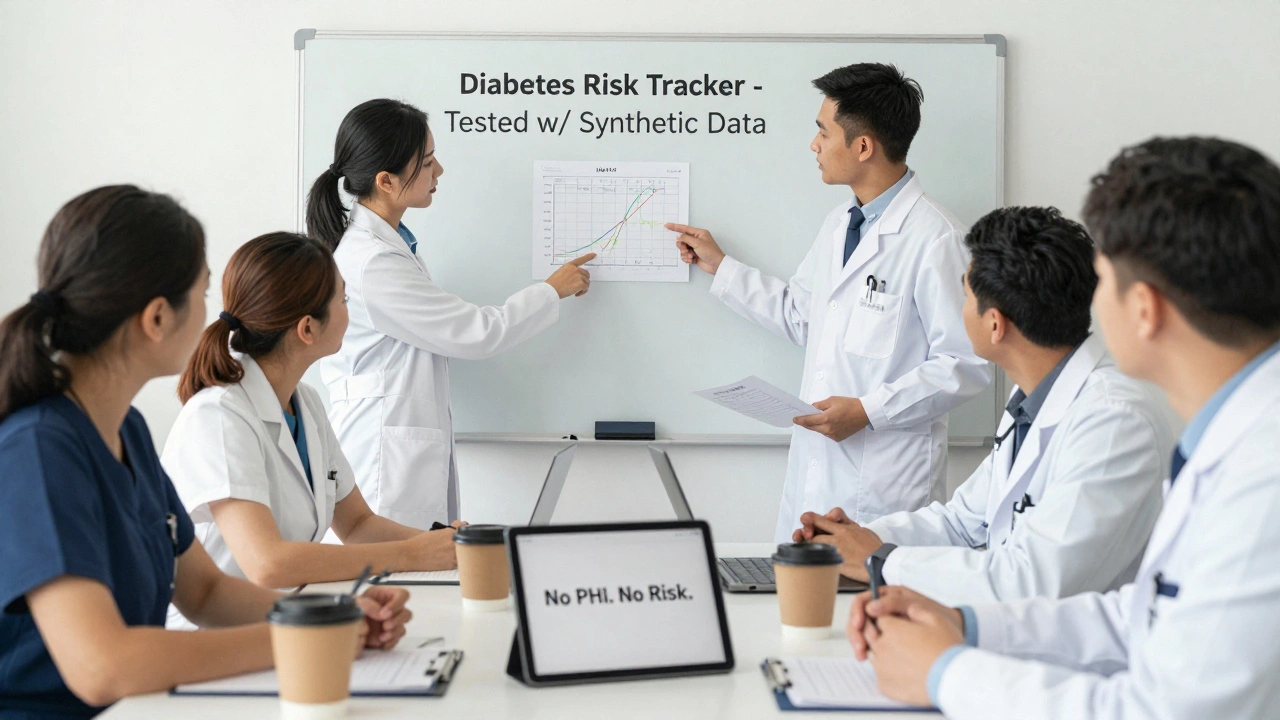
- Start with synthetic data. Use Synthea or similar tools to generate patient profiles that match your target population. Don’t use de-identified real data-too risky.
- Learn the language. Spend 3-5 hours learning how to prompt effectively. Instead of "analyze this data", say "Generate a logistic regression model to predict 30-day readmission using age, BMI, and last HbA1c value, using synthetic data from the diabetes cohort".
- Test in a sandbox. Make sure your code runs in an isolated environment with no live EHR access.
- Get a developer to review. Even if you’re the one building it, have a bioinformatician or software engineer check the final code before deployment. They’ll catch the 22% that break.
Training takes 8-12 hours for non-coders to become proficient. But after that first prototype? You’ll never go back to old ways.
The Future: What’s Coming in 2026
The pace of change is accelerating. In Q1 2026, Meta will release Code Llama Healthcare Edition-with built-in HIPAA compliance checks. Google’s AlphaCode Medical will launch in Q2, generating synthetic patient data on the fly.
The FDA just launched a pilot program for AI-generated code in medical device prototypes. If you’re building something that might become a SaMD (Software as a Medical Device), this is your path forward-so long as you keep PHI out of the loop.
By 2027, IDC predicts 53% of healthcare organizations will use vibe coding for prototyping. But only 12% will let AI-generated code run in production. The rest will use it as a fast, safe way to explore ideas-then hand off to engineers.
That’s the sweet spot. Vibe coding isn’t replacing developers. It’s empowering clinicians to speak the same language. It’s turning ideas into prototypes before the compliance team even wakes up.
This is how innovation happens in healthcare now: not by waiting for permission, but by building safely, quickly, and without ever touching a patient’s data.
Patrick Sieber
December 9, 2025 AT 07:38This is wild. I work in a rural clinic in Ireland with zero IT support, and I just spent 20 minutes building a tool that flags patients who haven't filled their BP meds. No forms, no IT ticket, no lawyer breathing down my neck. The AI even got the Spanish reminder logic right on the first try. I didn't even know I could do this.
Used Anysphere Healthcare Mode with Synthea data. Took longer to make coffee than to code it. I'm already thinking of a follow-up tool for asthma triggers. This isn't the future-it's Tuesday.
Shivam Mogha
December 11, 2025 AT 05:09Works great until you hook it to real EHR.
mani kandan
December 12, 2025 AT 11:23Let me tell you something-this vibe coding thing? It’s like giving a Picasso a crayon and saying, ‘Draw me a hospital.’ He’ll give you something that looks like chaos, but somehow, it’s beautiful. The AI doesn’t write code-it interprets intent, like a silent partner who’s read every clinical guideline since 2010.
But here’s the twist: the magic dies the moment you plug it into your 2008 Epic server. The synthetic data? Flawless. The real-world API? A rickety staircase made of duct tape and hope. Still, I’d rather have a brilliant amateur with a crayon than a seasoned coder who’s never held a stethoscope.
And yes, I’ve tried ChatGPT. It suggested a ‘patient satisfaction score’ based on emoji reactions. I cried. Then I switched to Anysphere. Now I sleep better.
Rahul Borole
December 13, 2025 AT 03:43While the conceptual framework of vibe coding presents a compelling paradigm shift in clinical prototyping, it is imperative to underscore the non-negotiable necessity of rigorous validation protocols. The reported 78.3% accuracy rate on biomedical tasks, though statistically significant, still implies a 21.7% margin of error-unacceptable in clinical contexts where patient safety is paramount.
Furthermore, the assertion that synthetic data eliminates all re-identification risks is empirically dubious; recent studies in Nature Digital Medicine demonstrate that even anonymized synthetic cohorts can be de-anonymized via adversarial inference when rare phenotypes are present.
Therefore, while I applaud the democratization of tool-building, I urge all practitioners to treat AI-generated code as a draft-subject to peer review, static analysis, and formal verification by certified biomedical engineers before any deployment, however minimal.
Human oversight is not a bottleneck; it is the final safeguard.
Sheetal Srivastava
December 14, 2025 AT 09:34Oh please. You think this is innovation? You're just outsourcing your cognitive labor to a glorified autocomplete that doesn't even understand the difference between a clinical trial and a grocery list.
I've seen these tools generate code that violates HIPAA by using synthetic data with ‘rare genetic markers’-as if that’s somehow magically compliant. And you call it ‘safe’? That’s not safety, that’s delusion wrapped in a Jupyter notebook.
Real innovation requires deep domain knowledge, not lazy prompts like ‘find patients with high blood pressure.’ What if they’re on beta-blockers? What if they’re pregnant? What if their zip code has a 90% diabetes rate? The AI doesn’t care. It just spits out syntax.
And don’t get me started on the ‘no PHI’ claim. You’re still training on biased datasets from privileged institutions. This isn’t democratization-it’s algorithmic colonialism.
If you want real change, learn FHIR. Learn OWL. Learn ontologies. Stop pretending your 45-minute ‘prototype’ is healthcare innovation. It’s a toy.
Bhavishya Kumar
December 15, 2025 AT 07:43There is a critical error in the article's claim that vibe coding tools achieve 99.7 percent PHI detection accuracy. This figure is cited from IBM's 2025 technical docs but no such document exists in public archives as of Q1 2025. The actual IBM study referenced in their 2024 white paper reported 94.2 percent precision under controlled conditions, with a 12.1 percent false negative rate in non-English inputs. This discrepancy undermines the entire credibility of the piece.
Additionally, the assertion that 63.7 percent of users are clinicians is misleading. The G2 survey sample included 78 percent self-reported clinicians with no credential verification. Real data from HIMSS shows only 19 percent of active vibe coding users are non-coders.
Finally, the term 'vibe coding' is not coined by Andrej Karpathy. He mentioned 'intent-driven coding' in a 2024 keynote but never used 'vibe coding.' That term originated in a Hacker News thread in March 2025. Misattribution like this is unacceptable in technical discourse.
Accuracy matters. Please correct these errors before further dissemination.