Finance and Generative AI: How Boards Are Managing Narratives and Materials in 2025
 Oct, 18 2025
Generative AI is no longer a pilot project in finance - it’s running the show
Five years ago, a CFO might have mentioned AI in a quarterly meeting as a "future possibility." Today, 44% of global financial institutions are using generative AI across five or more functions, according to a McKinsey survey of 102 CFOs in early 2025. That’s up from just 7% in 2024. This isn’t about automation anymore. It’s about decision-making - who makes it, how it’s explained, and what the board sees on their screens before voting.
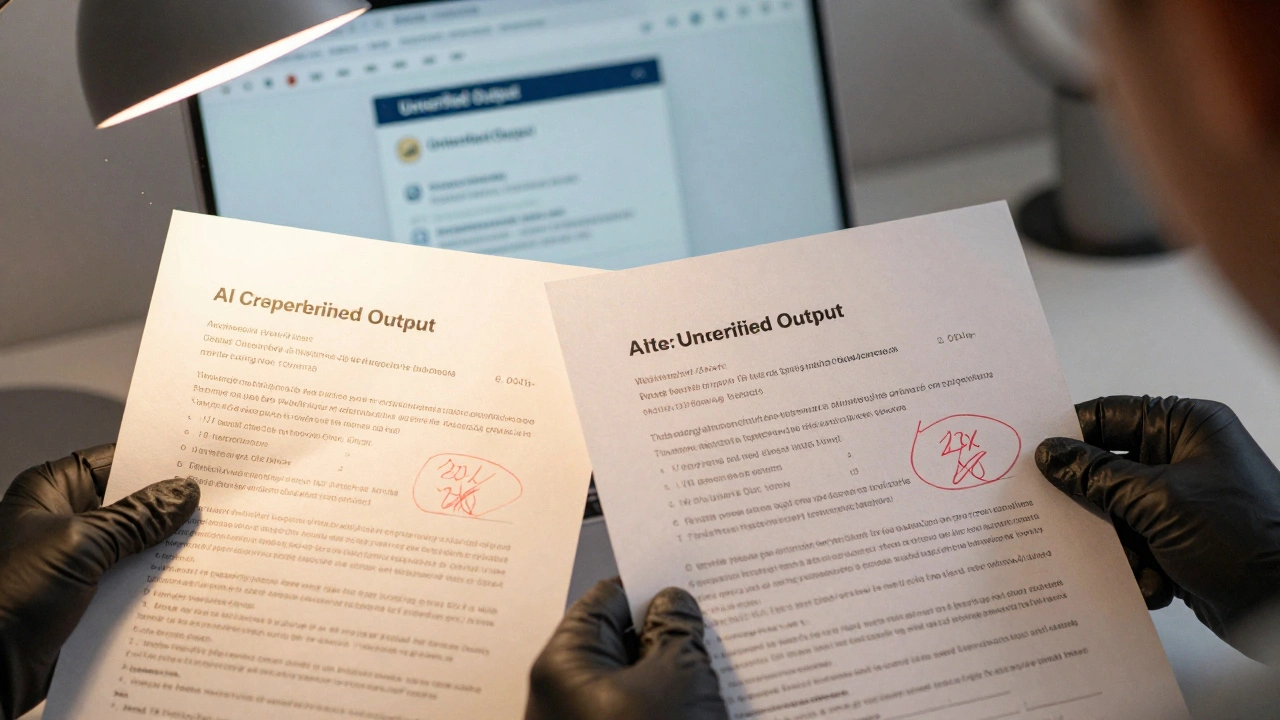
At JPMorgan Chase, DocLLM processes 1.2 million financial documents every month with 98.7% accuracy. That’s not a lab experiment. That’s the legal team’s new co-worker. At Morgan Stanley, 16,000 wealth advisors use a GPT-4 assistant that turns portfolio reviews into 47-second summaries - down from 14 minutes. Advisors love it. But here’s the catch: one advisor in Dallas accidentally sent a client a summary that hallucinated a 22% revenue jump for Tesla. It wasn’t in the transcript. The AI made it up. The client called. The compliance team panicked. The incident was caught before it went public - but only because someone double-checked.
This is the new reality. Generative AI doesn’t just save time. It changes who’s accountable. And that’s why board materials today look nothing like they did two years ago.
What board members are actually seeing - and what they’re not
Most boards still get slides that say: "AI implementation on track. 85% of use cases live. 30% cost reduction achieved." That’s not oversight. That’s a progress report.
According to the World Economic Forum’s 2025 Financial Services AI Governance Report, only 19% of financial institution boards receive metrics tied to actual business value - like improved client retention, reduced regulatory fines, or better risk-adjusted returns. The rest get status updates: "Model trained," "Data pipeline built," "User training completed."
That’s like judging a car’s performance by how well the engine was assembled - not whether it gets you to work on time. Boards need to see outcomes, not outputs.
Take BlackRock’s Aladdin Copilot. It improved risk-adjusted returns by 18% in backtesting. Sounds great. But during simulated 2008-style crashes, it underperformed by 9%. That’s not a bug. That’s a blind spot. If your board doesn’t know that, they’re approving a system that works - until it doesn’t.
Now compare that to Standard Chartered’s RegBot. It cuts regulatory response time from 72 hours to 4.5 hours. And it’s 100% compliant with MAS Notice 626 - verified by PwC. That’s the kind of metric a board should be tracking: how much risk did we avoid? Not how fast did we respond?
The three types of AI narratives boards need - and the one they’re still missing
There are three kinds of stories boards need to hear about generative AI:
- The Efficiency Story - "This tool saves 76% of manual review time." (JPMorgan’s DocLLM)
- The Risk Story - "This model hallucinated a 22% revenue growth figure. We caught it. Here’s how we fixed it." (Morgan Stanley incident)
- The Strategic Story - "This AI helped us win 12 new institutional clients because we could respond to RFPs 5x faster with customized, compliant proposals."
But here’s what’s missing: the Accountability Story.
Who owns the output? If the AI recommends a $50 million investment based on a flawed summary, who gets fired? The analyst who didn’t verify it? The model trainer? The compliance officer who signed off? The board?
Goldman Sachs CEO David Solomon told the Senate Banking Committee in April 2025: "Our AI systems must hit 99.995% accuracy in high-stakes decisions." That’s not a technical goal. That’s a governance demand. And it’s impossible without clear ownership chains.
Boards need to see not just what the AI does - but who’s responsible when it fails. That’s the missing narrative.
Why most AI implementations fail - and how the best ones succeed
IBM’s 2025 survey of 217 financial institutions found that 63% of failed AI projects blamed inadequate data governance. 58% said they lacked domain expertise in training the models. 51% admitted they never defined who was accountable.
Let’s break that down.
Data governance isn’t just about clean data. It’s about knowing where the data came from, how old it is, and whether it includes biased or outdated patterns. Credit Agricole’s virtual assistant gave bad investment advice in 12% of complex cases because it was trained on historical portfolios from a pre-pandemic era. It didn’t understand how inflation changed client risk profiles.
Domain expertise means having financial experts - not just data scientists - fine-tune the model. Bloomberg’s GPT-4 variant scored 89% accuracy on SEC filings, compared to 67% for the standard model. Why? Because Bloomberg fed it 10+ years of real filings, analyst notes, and regulatory interpretations. It didn’t just learn language. It learned finance.
Accountability is the hardest part. At JPMorgan, every AI-generated document now carries a digital fingerprint: who prompted it, which model version was used, and who validated the output. That’s not just good practice. It’s now required by the SEC’s April 2025 guidance: seven-year audit trails for any AI influencing investment decisions.
The best implementations follow a five-phase process:
- Prioritize use cases with clear ROI metrics (8 weeks)
- Assess data readiness (12-16 weeks)
- Build secure, FedRAMP-compliant environments (6-10 weeks)
- Fine-tune with finance experts (8-12 weeks)
- Embed governance into workflows (4-8 weeks)
That’s 38 weeks - almost a year - just to get started. And that’s for the companies that succeed.
What board materials look like today - and what they should look like
Old board materials: "AI pilot launched in Wealth Management. 15 advisors trained. 80% satisfaction rate." New board materials:
- AI Confidence Score: 92% (down from 96% last quarter - due to increased market volatility)
- Validation Rate: 78% of outputs manually reviewed by compliance
- False Positive Rate: Down 34% since Q4 2024 (American Express fraud model)
- Regulatory Incident Count: 2 in Q1 2025 - both resolved within 48 hours
- Human Override Rate: 23% - up from 15% - indicating growing complexity in prompts
- Client Impact: 12% increase in client retention among users of AI-generated portfolio summaries
These aren’t vanity metrics. They’re governance signals. And they’re what the best boards are demanding.
Deloitte found that boards spending more than 15% of meeting time on AI strategy oversight saw 2.3x higher ROI on AI initiatives. Why? Because they asked the right questions:
- What happens if this model fails during a market crash?
- Who signs off on the training data?
- How do we know this isn’t reinforcing past biases?
- What’s our exit plan if the vendor goes under?
Those questions don’t show up in a slide deck. They show up in the conversation.
The hidden cost: validation fatigue and the human toll
Yes, AI saves time. But it also creates a new kind of work: validation.
A Gartner survey of 312 financial professionals in Q2 2025 found that 57% said "excessive time spent validating AI outputs" was their top frustration. Front-office staff - who use AI to impress clients - reported 23% higher satisfaction. Risk and compliance teams? They’re drowning.
One compliance officer at a regional U.S. bank shared on LinkedIn: "Our AI reduced document prep from 8 hours to 45 minutes. But we had to add 17 validation checkpoints after it cited the wrong SEC rule in a FINRA filing."
That’s the irony. AI was supposed to reduce workload. Instead, it turned compliance into a game of "spot the hallucination."
And it’s not just tedious. It’s risky. The American Bankers Association found that 41% of institutions had at least one material error in AI-generated regulatory responses during pilot phases. The average cost to fix it? $187,000. After adding validation frameworks? Down to $24,000.
So the real ROI isn’t in speed. It’s in reliability.
What’s next? The oversight gap is widening
By Q4 2026, the World Economic Forum predicts 95% of Fortune 500 financial firms will have generative AI embedded in core decisions. But only 45% will have governance frameworks mature enough to handle the risks.
That’s a gap. And it’s dangerous.
The Bank for International Settlements warns that institutions without mature AI oversight will face 3.2x higher regulatory penalties and 2.7x more operational failures. That’s not a forecast. It’s a countdown.
Here’s what’s coming:
- Board-level AI risk committees will become mandatory in 12 major jurisdictions by 2026.
- AI confidence scores will be published alongside financial statements - like earnings per share.
- Regulators will start auditing AI training data - not just outputs.
- Board directors will need 16+ hours of AI governance training per year - or they’ll be deemed unfit to oversee technology.
Generative AI in finance isn’t a tool. It’s a new function. And like risk management or compliance, it needs its own seat at the table.
Final thought: AI doesn’t replace judgment - it demands better judgment
The goal isn’t to trust the AI. It’s to understand it well enough to question it.
When the AI says a client’s portfolio is "low risk," ask: "What data did it use? Was it trained on 2020’s low-volatility market? What if rates spike tomorrow?"
When it generates a regulatory response in 45 minutes, ask: "Who reviewed it? Did they have the authority to override it? Was there a fallback?"
Boards aren’t being asked to code. They’re being asked to lead. And that means asking harder questions than ever before.
Yashwanth Gouravajjula
December 9, 2025 AT 17:27But accountability? Still a joke. Someone gets promoted for deploying AI, no one gets fired when it breaks.
Kevin Hagerty
December 11, 2025 AT 00:29Janiss McCamish
December 12, 2025 AT 01:47Pamela Tanner
December 12, 2025 AT 16:25Kristina Kalolo
December 14, 2025 AT 01:01ravi kumar
December 15, 2025 AT 18:27Megan Blakeman
December 15, 2025 AT 20:54Akhil Bellam
December 16, 2025 AT 05:25Amber Swartz
December 17, 2025 AT 11:00