Impact Assessments for Generative AI: DPIAs, AIA Requirements, and Templates
 Aug, 1 2025
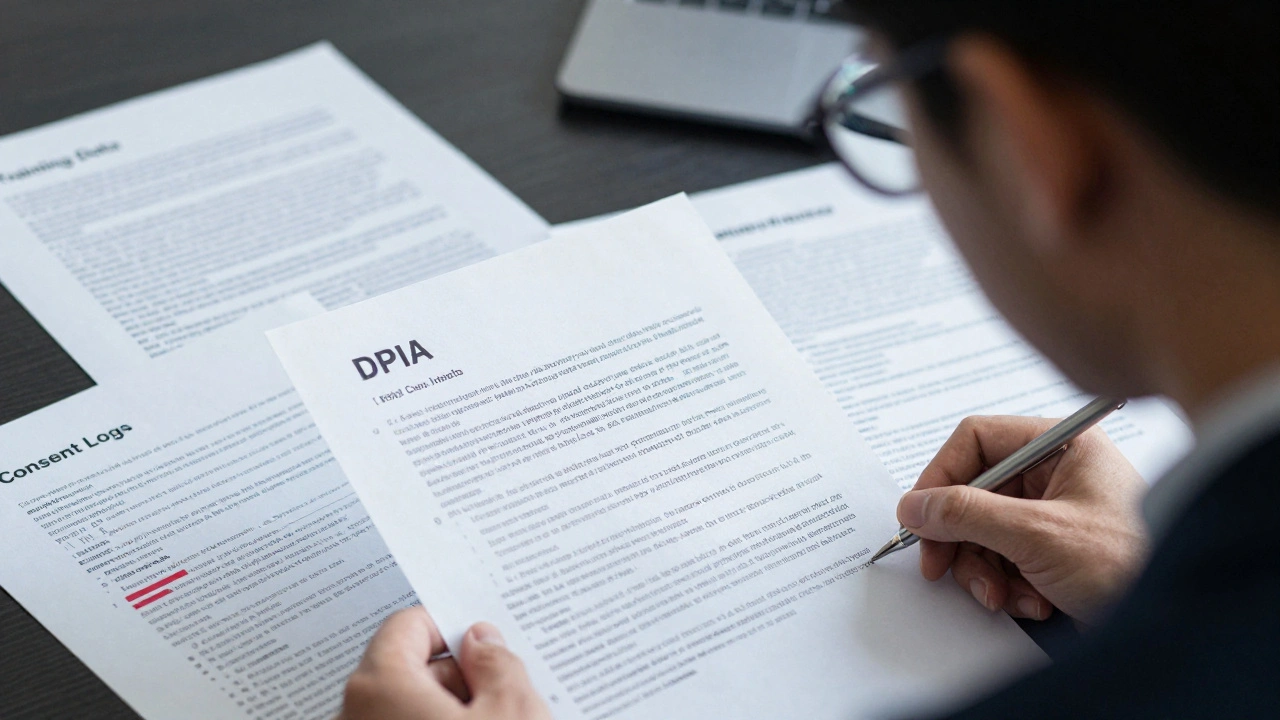
When you deploy a generative AI tool that writes emails, screens job applicants, or generates medical summaries, you’re not just building software-you’re making decisions that affect real people’s lives. And if you’re operating in the EU, UK, or anywhere that follows GDPR or the EU AI Act, you must do an impact assessment before you launch. Skipping this step isn’t just risky-it’s illegal.
Why Impact Assessments for Generative AI Are Non-Negotiable
Generative AI doesn’t just process data. It learns from it, predicts it, and sometimes creates it. That means if your AI was trained on employee performance reviews, patient records, or social media profiles, it’s handling sensitive personal information. And under GDPR, that triggers a legal obligation: a Data Protection Impact Assessment (DPIA). The EU’s General Data Protection Regulation has required DPIAs since 2018, but generative AI changed the game. Unlike simple analytics tools, these systems can infer private details-like mental health status or political views-from seemingly harmless inputs. The French data protection authority (CNIL) found that 78% of AI-related privacy violations between 2021 and 2023 could have been avoided with a proper DPIA. The EU AI Act, which took effect in August 2024, added another layer. For high-risk AI systems-including many generative AI tools-you now need a Fundamental Rights Impact Assessment (FRIA) alongside your DPIA. While DPIAs focus on data protection, FRIAs look at broader rights: fairness, non-discrimination, freedom of expression, and human dignity. If you’re using AI to screen resumes, assign credit scores, or monitor workplace behavior, you’re already in the high-risk zone. And fines for skipping assessments? On average, €1.2 million. That’s not a typo. It’s 2.8% of your global annual turnover, as mandated by Article 83(5) of GDPR.DPIA vs. FRIA: What’s the Difference?
Think of DPIA and FRIA as two sides of the same coin. Both are required for high-risk generative AI, but they cover different ground. A DPIA asks: How does this system handle personal data? It evaluates whether data collection is necessary, whether storage is secure, and whether individuals can access, correct, or delete their information. For example, if your AI model was trained on 50,000 employee emails without explicit consent, that’s a red flag under GDPR Article 9. A FRIA asks: What broader harm could this system cause? It looks at whether the AI reinforces bias, limits autonomy, or denies people meaningful human review. If your AI denies someone a loan based on a score it can’t explain, that’s an FRIA issue. The CNIL makes it clear: if your generative AI touches personal data, a DPIA is presumed necessary. The EDPB adds that if your system meets at least two of nine high-risk criteria-like profiling, innovative tech use, or large-scale processing-you’re legally required to do one. Google Cloud’s guidance (June 2024) says that if you’re analyzing more than 10,000 personal records per month using AI, you must do a DPIA. That includes chatbots handling customer service data or AI tools scanning internal documents for compliance.When Exactly Do You Need a DPIA for Generative AI?
Not every AI tool needs a DPIA. But generative AI almost always does. Here’s when you can’t avoid it:- You’re using AI to evaluate people’s work performance, creditworthiness, health, or reliability (EDPB Criterion 1)
- You’re deploying a new or innovative AI system (EDPB Criterion 2)
- You’re processing special category data-health, race, religion, sexual orientation-at scale
- You’re training a foundation model on personal data without clear consent
- Your AI generates outputs that include personal data-like fake emails or fabricated medical reports

The Four Core Elements of a Generative AI DPIA
A good DPIA isn’t a checkbox. It’s a living document. The ICO and EDPB agree on four essential parts:- A systematic description of the processing-What data are you using? Where’s it from? How is it stored? Who has access?
- An assessment of necessity and proportionality-Is this AI really needed? Could you achieve the same goal with less invasive tech?
- An assessment of risks to individuals-Could the AI misidentify someone? Leak private info? Discriminate? What’s the likelihood and severity?
- The measures you’ll take to reduce those risks-Encryption? Human review? Data minimization? Explainability tools?
Templates That Actually Work (And Where to Find Them)
You don’t need to build a DPIA from scratch. Several authorities have released templates that cut the time and confusion. The ICO’s DPIA Template (v4.1, March 2023) includes dedicated sections for AI-specific risks and automated decision-making. It’s used by 78% of UK organizations. You’ll find prompts like: “Describe how the AI makes decisions” and “How do you ensure fairness in outputs?” The European Data Protection Supervisor (EDPS) AI DPIA Template (v2.0, January 2024) goes deeper into training data. It asks: “What percentage of your training data includes personal information?” and “How do you detect and block personal data in AI outputs?” The CNIL’s AI-specific template (July 2024) is the most detailed. It requires you to document: “The percentage of personal data in your training dataset” and “How you enable data subjects to request deletion of AI-generated content about them.” Companies using this template saw a 37% drop in compliance failures during 2024 audits. Google Cloud’s template (June 2024) focuses on practical metrics: “What percentage of synthetic data is used instead of real personal data?” and “How effective is your data minimization strategy?” Early adopters say it cuts assessment time by 29%. Most organizations now mix templates. The average generative AI DPIA is 47 pages long-up from 32 in 2023. That’s not bloat. It’s thoroughness.
What Happens If You Don’t Do It?
Fines are just the start. In Q2 2024, three European employers were fined for using AI to monitor employee productivity without a DPIA. One company tracked keystrokes and mouse movements to score worker efficiency. The AI flagged 12 employees as “low performers.” None were given a chance to contest the scores. The result? A €1.5 million penalty and mandatory human review for all AI-driven HR decisions. Beyond fines, you risk reputational damage. Customers don’t trust AI they can’t understand. Employees don’t trust employers who use secret algorithms to judge them. Regulators are watching. And they’re getting better at spotting gaps. Gartner predicts that by 2026, 92% of enterprise generative AI deployments will require formal DPIAs. That’s up from 67% in 2024. The cost per assessment is falling-from $18,500 to $14,200-as templates and automation improve. But enforcement actions? They’re projected to rise by 40%.Next Steps: How to Start Today
If you’re using generative AI in your organization, here’s what to do right now:- Map your AI use cases-List every tool you’re using or planning to use. Include internal tools, third-party APIs, and open-source models.
- Identify data types-Is any training or input data personal? Special category? Public? Anonymized?
- Check the criteria-Does your system meet two or more of the EDPB’s nine high-risk criteria?
- Choose a template-Start with ICO or CNIL. Customize it for your use case.
- Involve your DPO-They’re not just a formality. They’re your legal shield.
- Document everything-Date, version, reviewers, decisions, risks, mitigations.
- Consult regulators if needed-Don’t wait until you’re under investigation.
What’s Coming in 2025 and Beyond
The EU AI Act’s timeline is clear:- February 2, 2025: DPIAs required for all high-risk AI systems
- June 30, 2025: Specific rules for general-purpose AI models kick in
- January 1, 2026: Full enforcement begins
Paritosh Bhagat
December 9, 2025 AT 23:17Man, I just read this and my brain exploded. Like, I work at a startup in Bangalore where we use AI to screen resumes, and we never even thought about DPIAs. Now I’m sweating bullets. 78% of violations could’ve been avoided? That’s not a warning-it’s a siren. I’m printing out the CNIL template right now and handing it to our CTO with a coffee. He owes me one.
Ben De Keersmaecker
December 11, 2025 AT 17:08Just to clarify something-GDPR’s Article 9 doesn’t apply to ‘employee emails’ unless they contain special category data like health or religion. Most HR emails are just operational. But if your AI infers mental health from tone or word choice? That’s a whole different ballgame. The ICO template’s prompt about ‘fairness in outputs’ is spot-on. We’ve seen models flag ‘negative sentiment’ in emails from women and minorities-no context, no bias check. Just pure garbage in, garbage out.
Aaron Elliott
December 12, 2025 AT 16:36While the article presents a compelling regulatory framework, it fails to engage with the deeper ontological implications of algorithmic personhood. When a generative AI fabricates medical summaries, it does not merely process data-it performs a semiotic act of medical authority, thereby usurping the epistemic privilege of the clinician. The DPIA, as conceived, remains a bureaucratic instrument of control, incapable of addressing the existential rupture between human judgment and synthetic inference. Furthermore, the notion that ‘templates’ can mitigate systemic harm is a fallacy of reification. One cannot reduce the dignity of the human subject to a checklist. The real violation is not non-compliance-it is the normalization of quantification as a substitute for ethical deliberation.
Chris Heffron
December 12, 2025 AT 20:01LOL I just saw a company’s DPIA that was 87 pages long. 78 pages were just ‘We did a risk assessment’ with no actual data. 😅 The CNIL template is gold, but everyone treats it like a fill-in-the-blank essay. Also, ‘human review’ is just a manager glancing at a screen for 3 seconds. We’re all just pretending.
Nick Rios
December 13, 2025 AT 11:24It’s wild how much fear and confusion this topic generates. But honestly? The fact that we’re even having this conversation means we’re moving in the right direction. I’ve worked with teams that thought AI was magic. Now they’re asking, ‘What data did we use?’ and ‘Who gets hurt if this goes wrong?’ That’s progress. Don’t get paralyzed by the paperwork-just start small. One use case. One template. One honest conversation. That’s how change happens.