Playbooks for Rolling Back Problematic AI-Generated Deployments
 Dec, 11 2025
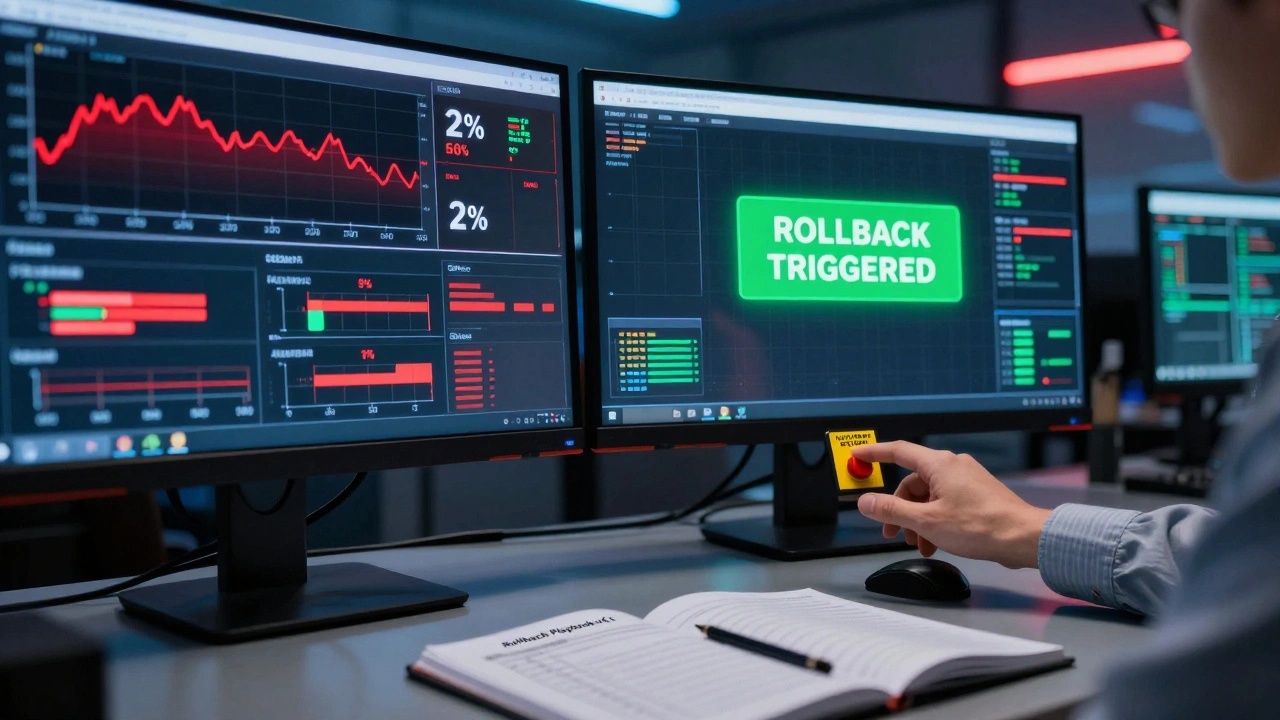
When an AI model starts recommending inappropriate products during Black Friday sales, or a medical diagnosis system begins misclassifying scans, there’s no time for panic. The difference between a minor hiccup and a full-blown crisis often comes down to one thing: rollback playbooks. These aren’t just backup plans-they’re the safety nets that keep AI systems from running wild in production.
Why Rollback Playbooks Are No Longer Optional
In 2024, 68% of enterprises experienced at least one major AI failure, according to Gartner. By 2025, that number hasn’t dropped-it’s just that fewer companies are getting burned. Why? Because 92% of Fortune 500 companies now have formal rollback procedures in place. This isn’t about being cautious. It’s about survival. Think about it: a single faulty AI deployment can cost e-commerce platforms over $2.1 million in lost revenue per incident. For banks, it’s regulatory fines. For healthcare apps, it’s patient safety. Rolling back manually takes 47 minutes on average. With a playbook, it’s under five minutes. That’s not a luxury-it’s the baseline for responsible AI use.How Rollback Playbooks Actually Work
A rollback playbook isn’t a single button. It’s a coordinated system of checks, triggers, and actions. Here’s how it breaks down in practice:- Canary deployments: New AI models roll out to just 1-5% of users. If error rates spike above 0.8% or latency exceeds 300ms for 95% of requests, the system auto-reverts to the last stable version. Spotify’s team used this to prevent a $750,000 revenue loss in a single day.
- Blue-green deployments: Two identical production environments run side-by-side. One serves live traffic. The other hosts the new model. If the new version fails, traffic instantly switches back. No downtime. But it costs twice as much in infrastructure.
- Feature flags: Instead of rolling out an entire model, you toggle specific features. If the new recommendation engine starts suggesting dangerous products, you flip a switch and disable just that feature-no full rollback needed. Companies like Netflix and Spotify use this heavily. But managing 200+ active flags? That’s where things get messy.
- Fallback models: Keep a simple, reliable model running in the background. If your complex Transformer-based model starts hallucinating, the system silently switches to a logistic regression model trained on clean historical data. It’s not as smart-but it’s never wrong in the same way.
What Makes a Rollback Playbook Fail
Most teams think they have a rollback plan because they’ve written a doc. But Gartner found that 41% of AI failures happen because success criteria were never clearly defined. Here are the top three reasons rollback playbooks collapse:- Undefined success metrics: Is a 1% drop in accuracy a problem? For a movie recommendation system, maybe not. For a loan approval model? Catastrophic. You need to tie every trigger to a business impact, not just a technical number.
- Missing monitoring: If you’re not tracking input drift (Kolmogorov-Smirnov statistic >0.15), output quality (accuracy drop >3%), or inference error rates (>2%), you’re flying blind. Tools like Prometheus and MLflow help-but only if configured right.
- Untested procedures: You wouldn’t launch a plane without checking the eject seats. Yet 22% of companies have never tested their rollback in a real scenario. Quarterly tabletop exercises simulating 12 failure modes are non-negotiable, says Microsoft’s Dr. Jane Chen.

Tools That Make Rollback Possible
You can’t build this from scratch without serious engineering. Here’s what teams actually use:- MLflow 3.2 and DVC 4.1: These track every version of your model, dataset, and code. NIST requires at least 90 days of immutable storage for production models. No exceptions.
- Flyway 10.21.0: For database rollbacks. If your model changes the schema, you need zero-downtime migration scripts that can reverse in under 100ms. Manual SQL scripts? That’s how you get 9-hour outages.
- ArgoCD and FluxCD: These GitOps tools let you treat deployment configs like code. Rollback? Just revert a Git commit. Kubernetes v1.32 now has built-in controllers that automate this.
- LaunchDarkly and Split.io: For feature flags. They handle consistency across 10,000+ concurrent users. If your flag state gets out of sync, you’re asking for chaos.
- Open Policy Agent (OPA): Lets you write rules like “block deployment if model accuracy is below 94% on validation set.” Policy-as-code turns guesswork into enforcement.
Industry-Specific Requirements
Not all AI systems are created equal. Regulations force different standards:- Healthcare: EU AI Act Article 28 demands immediate remediation. Hospitals can’t afford a 10-minute delay if a diagnostic model starts missing tumors.
- Finance: SEC Rule 15c3-5 requires automated circuit breakers for AI trading systems. JPMorgan is now using blockchain-based logs (Quorum Ledger) to create tamper-proof rollback histories.
- E-commerce: Speed matters. AWS Lambda-powered rollbacks now take 200-500ms. That’s faster than a user can click refresh.
What’s Next: AI That Rolls Back Itself
The next frontier isn’t just faster rollbacks-it’s smarter ones. NVIDIA’s NeMo Rollback Advisor, currently in beta, uses reinforcement learning to predict when a model is about to fail. It analyzes trends in latency, error rates, and user feedback to trigger a rollback before users even notice. In tests, it’s 92.7% accurate. And it’s not just tools. The LF AI & Data Foundation just released the MLOps Standard 2025, which includes mandatory rollback metrics. By 2026, Gartner predicts 90% of AI deployments will have automated, business-impact-based triggers. By 2027, the EU and US may legally require them for all public-facing AI systems.
How to Start
If you’re not using a rollback playbook yet, here’s how to begin:- Assess (2 weeks): Identify your most critical AI systems. Which ones, if broken, would hurt revenue, compliance, or safety?
- Design (3 weeks): Pick one strategy-canary, feature flag, or fallback. Define clear triggers: “Roll back if error rate >2% for 30 seconds.”
- Test (4 weeks): Break your system on purpose. Simulate a model going rogue. Does the rollback trigger? Does it restore data correctly?
- Validate (2 weeks): Run it in production with 1% traffic. Watch it work. Then document everything.
Real Stories, Real Consequences
On Reddit’s r/MLOps, one engineer from Spotify described how their canary deployment caught a 0.8% error spike in a pricing model. The rollback triggered automatically. No one noticed. Revenue stayed intact. Another user from a major bank admitted their team had no database rollback script. When a new model changed the schema, the system crashed. It took nine hours to fix. Customers lost access. Regulators got involved. G2 reviews show Maxim AI scoring 4.7/5 for its one-click prompt rollback. Domino Data Lab? 4.3/5-with users complaining that 38% of rollbacks still need manual intervention. The difference? Automation.Final Thought
AI isn’t going away. But deploying it without a rollback plan is like driving without brakes. The tech exists. The standards are clear. The cost of inaction is too high. If your team is still relying on “we’ll fix it manually,” you’re not being agile-you’re being reckless.What’s the difference between a rollback and a revert?
A revert is a manual action-like restoring a file from backup. A rollback is an automated, system-wide process that restores not just code, but data, configuration, and infrastructure to a known-good state. Rollbacks are coordinated, tested, and triggered by metrics. Reverts are reactive and risky.
Can I use the same playbook for all my AI models?
No. A recommendation engine can tolerate small accuracy drops. A fraud detection model cannot. Each model needs its own playbook with custom triggers based on business impact. One-size-fits-all rollbacks are a myth.
Do I need Kubernetes to do rollbacks?
Not strictly, but it’s the industry standard. Kubernetes-native tools like Argo Rollouts and FluxCD make automated, code-driven rollbacks possible. Without them, you’re stuck with manual scripts and higher risk. For any serious deployment, Kubernetes isn’t optional-it’s the foundation.
How often should I test my rollback playbook?
Quarterly. At minimum. Real failures don’t wait for scheduled maintenance. Simulate 12 different failure scenarios: data drift, model degradation, API timeouts, credential expiration. If your team hasn’t practiced this in the last three months, your playbook is fiction.
What’s the biggest mistake teams make with rollback?
Assuming it’ll work when needed. The most common failure isn’t technical-it’s complacency. Teams write the playbook, put it in a folder, and forget about it. Then, when something breaks, they realize the trigger was set to 5% error rate instead of 2%, or the database script hadn’t been updated in six months. Test it. Document it. Treat it like a fire extinguisher-check the pressure gauge regularly.
Is automated rollback enough for compliance?
It’s necessary, but not sufficient. Regulations like the EU AI Act require not just rollback capability, but audit trails, human oversight, and risk assessments. Automated rollback is the engine-but governance is the steering wheel. You need both.
deepak srinivasa
December 11, 2025 AT 23:49Can we talk about how most teams treat rollback like a checkbox? They write a doc, slap it in Confluence, and call it a day. Then when the model starts recommending razor blades to toddlers during Black Friday, they panic because no one actually tested the damn thing. I’ve seen this three times now. Always ends with someone crying over a 9-hour outage.
pk Pk
December 13, 2025 AT 02:13Really glad this got posted. I’ve been pushing for this at my startup for months. We’re a small team, but we built a fallback model using logistic regression on old transaction data. It’s dumb, but it never hallucinates. Last week, our fancy LLM started suggesting ‘premium’ diapers for 50-year-olds. Fallback kicked in. No one noticed. That’s the win.
NIKHIL TRIPATHI
December 14, 2025 AT 20:47Feature flags are amazing until you have 200 of them running and someone accidentally flips the wrong one during a product launch. We had a case where ‘disable_recommendations’ was toggled ON for all users because a junior dev thought it was a test flag. Took us 47 minutes to find it. We now have a flag registry with ownership tags. Also, never name flags ‘temp’ or ‘test’ - it’s a death sentence.
Also, MLflow is great but if your team doesn’t tag versions properly, it’s just a fancy file browser. We started requiring commit messages to include ‘[AI-ROLLBACK:]’ - weird at first, now it’s muscle memory.
Shivani Vaidya
December 16, 2025 AT 01:30The most dangerous assumption is that rollback is a technical problem. It is not. It is a cultural one. Teams that treat it as an afterthought are not lazy. They are terrified of process. They fear documentation. They believe agility means chaos. But true agility is discipline with purpose. Rollback playbooks are not bureaucracy. They are the quiet heartbeat of responsible innovation.
Rubina Jadhav
December 18, 2025 AT 01:10I just started in MLOps. This was super helpful. We don’t even have a playbook yet. I’m going to bring this to my manager tomorrow.
sumraa hussain
December 18, 2025 AT 20:20OMG YES. I saw this happen at my last job. AI started recommending ‘cancer treatment kits’ to people searching for ‘headache remedies’. We had no rollback. No monitoring. No nothing. Just a guy in IT yelling ‘WHO DEPLOYED THIS?!’ while the whole site was down. I swear I heard a server cry. We lost $2M. And the CEO said ‘well, at least we learned something’.
Learned? We learned that if you don’t test your safety nets, they’re just decorations. Like a fire extinguisher painted gold and hung on the wall. Looks nice. Useless when the building’s on fire.
Raji viji
December 19, 2025 AT 18:09Lmao ‘fallback models’? You’re telling me you’re still using logistic regression in 2025? That’s like using a horse carriage when Tesla’s got autopilot. You think your ‘simple’ model is safe? Nah. It’s just slow and dumb. It’ll miss 10% of edge cases your fancy model caught. You’re not preventing failure - you’re just delaying it with a placebo. And don’t get me started on ‘quarterly testing’ - if you’re not doing chaos engineering daily, you’re just gambling with user trust. Get real.
Rajashree Iyer
December 19, 2025 AT 20:16Rollback is not a tool. It is a mirror. It reflects the soul of your team’s relationship with uncertainty. When you automate a rollback, you are not just restoring code - you are restoring humility. The AI does not know what it does not know. Only we, flawed and fearful humans, can build the nets beneath the tightrope. And yet, we forget. We forget that wisdom is not in the model’s accuracy - but in the quiet discipline to prepare for its failure. The rollback playbook is not engineering. It is prayer in code.