Using Cursor for Multi-File AI Changes in Large Codebases
 Feb, 1 2026
Imagine you need to rename a prop across 50 React components. Not just one file - all of them. And each one imports the prop differently. Some use destructuring, others access it directly. Some files have comments referencing it. Others have tests that need updating too. Manually? That’s a full day of tedious, error-prone work. Now imagine doing it in 20 minutes - with AI doing the heavy lifting, while you sip coffee and review the changes. That’s what Cursor 2.0 makes possible.
Why Multi-File Changes Matter in Large Codebases
Most codebases aren’t made of isolated files. They’re tangled webs of dependencies. Change one component, and you might break three others. Change an API endpoint, and you could break a dozen tests, two utility files, and a configuration. Traditional tools like GitHub Copilot or Aider work great on single files - but when you need to update across 20+ files, they fall apart. They don’t remember what they changed in file #3 when they get to file #17. They don’t track imports. They don’t understand context. Cursor 2.0, released in October 2024, was built to fix this. It’s not just an autocomplete tool anymore. It’s a multi-agent system designed for enterprise-scale refactoring. Instead of one AI guessing what to change, Cursor now runs up to eight independent agents, each working on a separate set of files in their own isolated workspace. They communicate through a shared context window of 128,000 tokens - enough to hold an entire React or Node.js project in memory at once.How Cursor 2.0 Handles Multi-File Changes
The magic behind Cursor’s multi-file power is called Composer. It’s a custom AI model trained specifically to understand how code files relate to each other - not just syntax, but structure, imports, exports, and even naming patterns. When you ask Cursor to convert all class components to hooks, it doesn’t just search for “class Component”. It finds every file that imports React, extends Component, and uses lifecycle methods. Then it maps dependencies: which files use those components? Which tests need updating? Which props are passed down? Here’s how you actually use it:- Open your project in Cursor and press Command+Shift+I (or Ctrl+Shift+I on Windows/Linux) to open the Composer panel.
- Type a clear instruction: “Convert all class-based React components to functional components using hooks, and update all import statements to use absolute paths.”
- Cursor automatically detects relevant files - but you can manually add up to 20 files per agent for better accuracy.
- Cursor spins up multiple agents. Each one works on a subset of files, keeping track of changes in real time.
- After processing, Cursor shows you a single, aggregated diff view - all changes in one place, organized by file.
- You review, accept, or reject changes per file. You can even undo changes from one agent without affecting others.
Performance Gains You Can Actually Measure
DevOps.com ran benchmarks on 100+ enterprise codebases in November 2024. The results were startling. Tasks that used to take 5-10 minutes in Cursor 1.x - like renaming a utility function across 80 files - now take under 30 seconds. One team at a fintech startup refactored 150 TypeScript files to switch from class components to hooks. What used to take two engineers two days? Done in 20 minutes by one person using Cursor. But speed isn’t everything. Accuracy matters more. Cursor’s multi-agent system reduces the chance of missed files. In earlier versions, it was common for changes to skip files with indirect dependencies - like a component imported through a barrel file (index.ts). Cursor 2.3.1, released in December 2024, added dependency-aware refactoring. Now, it scans import/export relationships before making changes. That means fewer surprises. Still, it’s not perfect. In codebases over 100,000 files, the dependency graph gets too complex. Cursor might miss a file buried in a legacy module with no explicit imports. That’s why experienced users recommend a key tip: Always run View > Show Dependencies before making large changes. This shows you a visual map of how files connect. Add any files that look like they should be included. Don’t trust the auto-detection blindly.What Cursor Can’t Do (And What You Still Need to Check)
Cursor is powerful, but it’s not a replacement for human judgment. It doesn’t understand business logic. It doesn’t know why a certain API was designed a certain way. It doesn’t know if changing a function name will break a third-party integration. Dr. Elena Rodriguez from MIT’s CSAIL puts it bluntly: “Cursor improves practical refactoring, but it still falls short of formal dependency analysis tools like TypeScript’s language server for complex type system changes.” Here’s where things go wrong:- Cursor might miss files with implicit dependencies - like a config file loaded dynamically at runtime.
- It can’t resolve circular imports cleanly. If File A imports File B, and File B imports File A, it gets stuck.
- It doesn’t understand legacy code patterns that don’t follow modern conventions.
- It occasionally ignores files with non-standard naming - like a component named “ButtonV2.jsx” instead of “Button.jsx”.
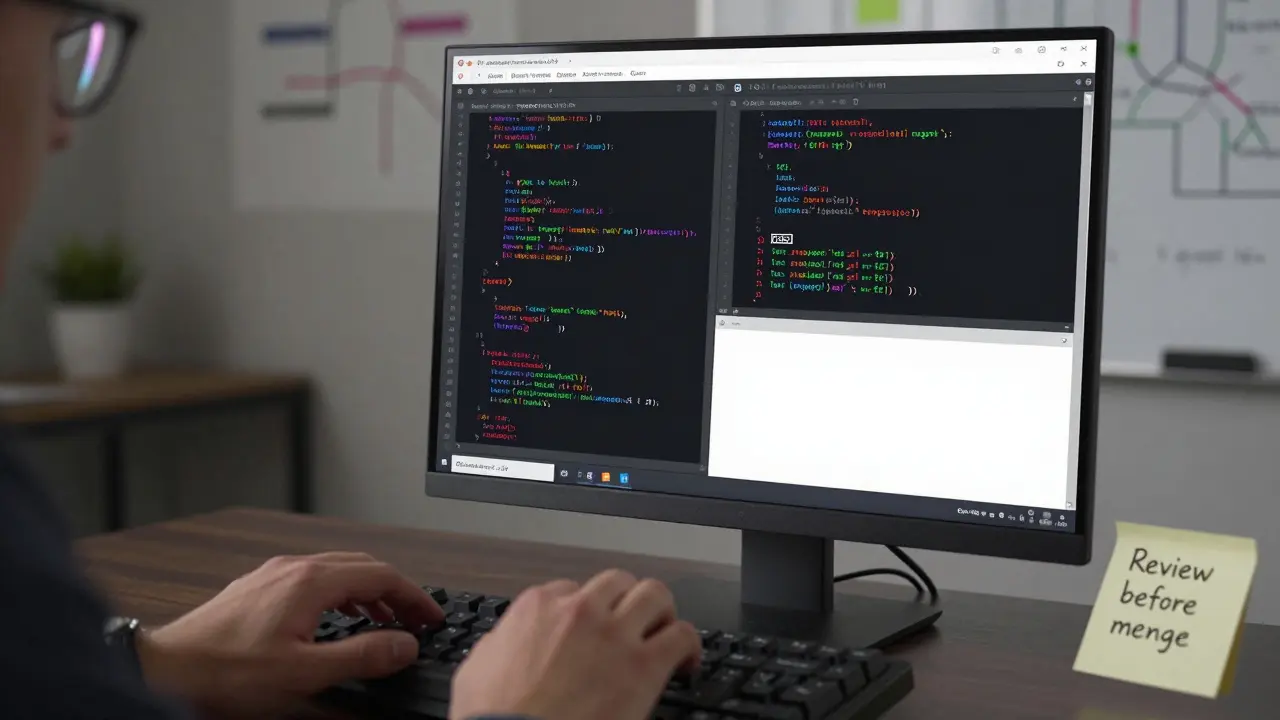
How Cursor Compares to Other Tools
| Tool | Multi-File Support | Context Window | Agents | Best For | Limits |
|---|---|---|---|---|---|
| Cursor | Yes (up to 8 agents) | 128,000 tokens | Up to 8 | Large refactors, cross-file dependency management | Struggles with >100K files, needs manual verification |
| GitHub Copilot Workspace | Partial | 32,000 tokens | 1 | Quick edits, single-file tasks | No persistent state across files |
| Aider | Yes (3 files max per run) | 16,000 tokens | 1 | Small refactors, CLI users | Sequential processing causes inconsistency |
| Sweep.dev | Yes (PR-based) | 32,000 tokens | 1 | Automated pull requests | Only works on GitHub, no real-time editing |
Who Should Use Cursor for Multi-File Changes?
If you’re a solo developer working on a small project? You probably don’t need it. Cursor’s free tier is fine for single-file edits. But if you’re on a team maintaining a large codebase - React, Node.js, Java, or C++ - and you’re tired of spending days on refactors, Cursor is worth it. The Pro plan at $20/month gives you unlimited multi-agent operations. For teams, the Enterprise plan at $40/user/month adds custom deployment, audit logs, and integration with internal CI/CD pipelines. Gartner predicts the AI-assisted coding market will hit $4.8 billion by 2026. And the biggest differentiator? Multi-file refactoring. Companies that adopt tools like Cursor are seeing 30-50% faster code updates, fewer bugs from manual errors, and less burnout from repetitive work.Pro Tips for Getting the Most Out of Cursor
- Start small. Don’t try to refactor the whole codebase at once. Pick one module - say, the auth component - and test Cursor there first.
- Use dependency analysis. Always run View > Show Dependencies before making changes. It shows you what’s connected.
- Review every diff. Even if Cursor says it’s 99% confident, check the files it changed. Look for missed imports or broken tests.
- Don’t auto-apply. Accept changes manually. You’re not just approving code - you’re approving risk.
- Use undo per agent. If one agent messes up, you can revert just its changes without losing others.

What’s Next for Cursor?
Cursor’s roadmap is ambitious. By Q2 2025, they plan to add automatic dependency graph visualization - meaning you’ll see a live map of how files connect, with color-coded risk levels. Q3 will bring integration with enterprise build systems, so Cursor can tell you exactly which tests will break before you even run them. And by Q4, they’re testing collaborative multi-agent workflows - where multiple developers can assign tasks to different agents and merge their changes safely. But the biggest shift isn’t technical. It’s cultural. Engineering teams are starting to treat AI agents like junior developers - not replacements, but assistants. You still need to guide them. You still need to review. But now, you’re not doing the grunt work yourself.Frequently Asked Questions
Can Cursor handle codebases over 100,000 files?
Cursor can analyze large codebases, but performance drops significantly beyond 100,000 files. The multi-agent system struggles to resolve all implicit dependencies at that scale. For these cases, it’s best to break the codebase into logical modules and refactor one at a time. Always use dependency analysis and manually verify critical files.
Does Cursor require Git?
Yes. Cursor uses Git worktrees to isolate changes made by each agent. You must have a Git repository initialized in your project. Changes are staged locally before you commit. This ensures you can review, revert, or discard changes safely.
Is Cursor’s multi-file feature available in the free version?
No. Multi-file changes and the Composer model are exclusive to the Pro tier ($20/month) and Enterprise plans. The free version only supports single-file autocomplete and basic code suggestions.
How long does it take to learn Cursor’s multi-file features?
Most developers become comfortable with the basics in 3-5 hours of hands-on use. To fully leverage advanced features like dependency analysis and agent-specific undo, expect 1-2 weeks of regular use. Teams often run internal workshops to onboard developers.
Can Cursor break my code?
Yes - but not more than a human could. Cursor makes mistakes, especially with implicit dependencies or legacy code. That’s why manual review is critical. Always run tests after applying changes. Never auto-merge without verification. Think of Cursor as a very fast, very smart intern - you still need to check their work.
Aditya Singh Bisht
February 1, 2026 AT 22:16Agni Saucedo Medel
February 3, 2026 AT 13:52ANAND BHUSHAN
February 4, 2026 AT 10:20Indi s
February 5, 2026 AT 05:04Rohit Sen
February 6, 2026 AT 17:42Vimal Kumar
February 7, 2026 AT 19:23Amit Umarani
February 8, 2026 AT 20:15Noel Dhiraj
February 9, 2026 AT 04:43vidhi patel
February 9, 2026 AT 13:51Priti Yadav
February 11, 2026 AT 03:07