How to Build Compute Budgets and Roadmaps for Scaling Large Language Model Programs
 Sep, 18 2025
Training a large language model used to cost a few thousand dollars. Now, it can cost over $100 million. If you’re trying to scale your LLM program, you can’t just throw more money at the problem. You need a clear compute budget and a realistic roadmap. Otherwise, you’ll burn through cash before you see any real return.
Why Your LLM Budget Is Getting Crushed
The numbers don’t lie. OpenAI’s GPT-4 cost between $78 million and $100 million to train. Google’s Gemini Ultra? Around $191 million. These aren’t outliers-they’re the new baseline. And it’s not just training. Inference-the actual use of the model by users-is getting expensive too. OpenAI’s o1 model costs six times more per query than GPT-4o. That means if your app gets 10 million requests a month, you could be spending millions just to keep it running. Energy is half the bill. Hardware, cooling, and power add up fast. A single NVIDIA A100-80GB GPU costs $15,000. To train a top-tier model, you need thousands of them running for weeks. Even medium-sized models like Llama-3.3-70B need at least two A100s ($30,000 hardware cost). If you’re not tracking every dollar, you’re flying blind.What’s Actually Driving the Costs?
There are three big cost buckets: training, fine-tuning, and inference.- Training is the upfront investment. This is where you teach the model from scratch using massive datasets. GPT-4 used about 21 billion petaFLOPs of compute. That’s 2.1 × 10^25 operations. The bigger the model, the more compute it needs-and it’s not linear. Doubling model size doesn’t just double cost. It can multiply it by 4 or 5.
- Fine-tuning is cheaper but still adds up. Fine-tuning LLaMA 2 (70B) can cost tens of thousands of dollars. It’s not trivial, but it’s manageable compared to training from scratch.
- Inference is the silent budget killer. Every time someone asks your chatbot a question, your system runs the model. If you have high traffic, this cost compounds fast. A single query that generates a few hundred words can cost between 0.03 cents and 3.6 cents. Sounds small? Multiply that by 100,000 users a day, and you’re looking at $300 to $36,000 per day.
Don’t Use a Giant Model for a Simple Task
Here’s the biggest mistake companies make: using the biggest model they can afford for everything. You don’t need GPT-4 to answer customer service FAQs. You don’t need Gemini Ultra to classify support tickets. IBM researchers say it plainly: "You don’t need to use large language models for everything." A small model, trained on high-quality, task-specific data, can outperform a giant one on narrow tasks. And it’ll cost 10x less to run. Think of it like cars. You don’t buy a semi-truck to drive to the grocery store. You use a sedan. The same logic applies to LLMs. Use model cascades: route simple queries to small, cheap models. Only send complex questions to the big ones.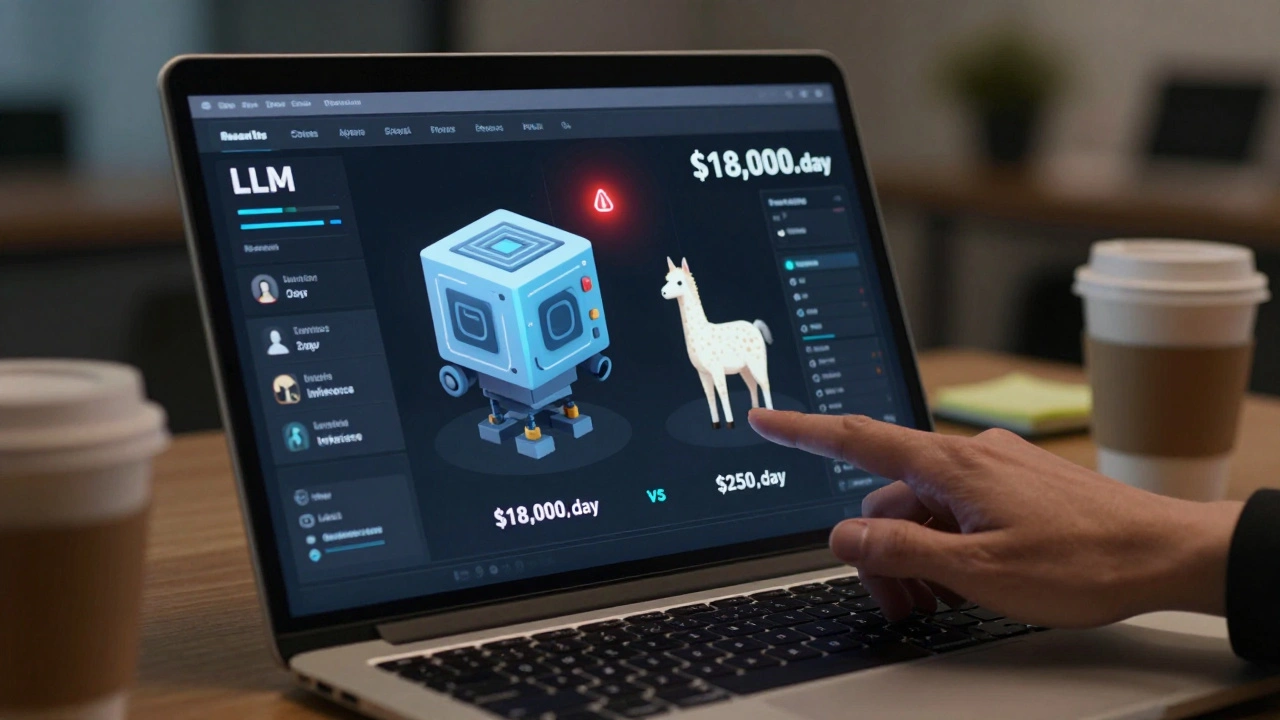
How to Build a Realistic Compute Budget
Start with three questions:- What are you using the model for? Is it customer support? Code generation? Content summarization? Each use case has different cost profiles.
- How many users will use it daily? Estimate query volume. Multiply that by estimated cost per query.
- How often will you retrain or fine-tune? Monthly? Quarterly? Each fine-tune is a cost center.
- Infrastructure: Hardware (GPUs), cloud credits, data center fees.
- Training: One-time cost for initial model.
- Fine-tuning: Recurring cost based on update frequency.
- Inference: Ongoing cost per query. This is the biggest variable.
- Energy: Don’t forget power and cooling. It’s 50% of your total cost.
Hardware Choices: Cloud vs. On-Premise
Cloud providers (AWS, Azure, Google Cloud) offer flexibility. You pay for what you use. But if you’re running heavy workloads 24/7, you’re paying a premium for convenience. On-premise gives you control and long-term savings. But you need upfront cash for hardware, cooling, and IT staff. NVIDIA A100-80GBs are the standard for serious work. Two of them ($30,000) can run medium models like GLM-4.5-Air or Llama-3.3-70B with near-top performance. For smaller teams, RTX 5090s are an option-but they’re not built for scale. You’ll hit limits fast. Most companies start in the cloud. Once they hit consistent usage, they migrate to on-premise or hybrid setups. It’s a financial decision, not a technical one.Cost-Saving Techniques That Actually Work
You don’t need to spend more. You need to spend smarter.- Quantization: Reduce model precision from 16-bit to 8-bit or even 4-bit. This cuts memory use by 50-75% and speeds up inference. No major accuracy drop if done right.
- Batching: Group multiple queries together. Instead of running 100 models one at a time, run one model 100 times in parallel. Saves 30-50% on inference cost.
- Speculative decoding: Use a small model to predict the next few tokens. Then verify with the big model. Reduces compute load without sacrificing quality.
- Model pruning: Remove unused parts of the model. If 10% of weights don’t contribute to output, delete them. You’ll lose almost nothing, save a lot.
- Efficient frameworks: Use DeepSpeed or Fully Sharded Data Parallel (FSDP). They split models across multiple GPUs so you don’t need 10x the hardware.
Scaling Roadmap: From Prototype to Production
Your roadmap should look like this:- Phase 1: Experiment - Use free tiers or small cloud instances. Test with a 7B-13B model. Focus on data quality, not model size.
- Phase 2: Validate - Move to a medium model (30B-70B) on 2-4 A100s. Run real user tests. Measure accuracy, latency, and cost per query.
- Phase 3: Optimize - Apply quantization, batching, and model cascades. Reduce inference cost by 40-60%.
- Phase 4: Scale - Deploy on-premise if usage is steady. Use hybrid cloud for spikes. Build monitoring for cost anomalies.
- Phase 5: Automate - Set alerts for cost spikes. Auto-scale models based on traffic. Use AI to predict usage patterns.
The Future: Efficiency Over Size
The race isn’t about who has the biggest model. It’s about who gets the most performance per dollar. By 2030, data centers will need $6.7 trillion globally just to keep up with AI demand. That’s not sustainable. The winners will be the ones who optimize for efficiency:- Smaller models with better data
- Intelligent routing (not brute force)
- Hardware tailored to workload
- Energy-conscious design
What Happens If You Don’t Plan?
IBM’s 2024 report says 100% of executives surveyed had canceled or postponed at least one AI project because of cost. Not because the tech didn’t work. Because they ran out of money. If you don’t track your compute budget, you’ll hit a wall. Maybe in three months. Maybe in six. But you’ll hit it. And when you do, your team will be stuck explaining why they spent $2 million and got zero ROI. The answer isn’t more money. It’s better planning.How much does it cost to train a large language model in 2025?
Training costs vary wildly. Small models (7B-30B parameters) cost $10,000-$100,000. Medium models (70B-130B) cost $500,000-$2 million. Top-tier models like GPT-4 or Gemini Ultra cost $78 million to over $190 million. The key is that cost scales faster than performance-bigger isn’t always better.
What’s the biggest cost in running an LLM: training or inference?
For most companies, inference is the bigger cost. Training happens once or twice a year. Inference runs every second your app is live. A single user query might cost 0.03-3.6 cents. Multiply that by millions of queries a month, and you’re spending far more on inference than training. That’s why optimizing inference efficiency matters more than chasing larger models.
Can I use smaller models and still get good results?
Yes, and you often should. Smaller models trained on high-quality, task-specific data can outperform larger ones on narrow tasks like classification, summarization, or FAQ answering. IBM and MIT research both confirm that using the right-sized model for the job saves money and improves speed. Don’t use a sledgehammer to crack a nut.
Is cloud or on-premise better for LLMs?
Start in the cloud for flexibility and testing. Once you have steady usage (e.g., 100K+ queries/month), consider on-premise or hybrid setups. On-premise cuts long-term costs by 40-60% but requires upfront investment in GPUs, cooling, and staff. Cloud is better for spikes and experimentation; on-premise wins for scale and predictability.
What are the best tools to reduce LLM costs?
Use DeepSpeed or FSDP for efficient training across multiple GPUs. Apply quantization (4-bit or 8-bit) to reduce memory use. Implement batching and speculative decoding to cut inference costs. Use model cascades to route simple queries to small models. These aren’t optional-they’re essential for sustainable scaling.
How do I know if my LLM program is financially sustainable?
Track your cost per successful user action. If each customer query costs more than the value you get from it (e.g., reduced support tickets, increased sales), your program isn’t sustainable. Set monthly cost caps. Monitor for spikes. Compare your cost per token to industry benchmarks. If you’re spending more than $0.01 per 1,000 tokens on inference without a clear ROI, it’s time to optimize.
Anuj Kumar
December 8, 2025 AT 23:46This whole thing is a scam. Big Tech just wants you to think you need $100 million models. Meanwhile, they’re hoarding the real tech and selling you vaporware. I’ve seen startups go belly-up because they bought into this ‘bigger is better’ lie. It’s all about control. They want you dependent on their cloud servers so they can charge you forever.
And don’t get me started on ‘quantization’ - that’s just hacking the model to look smart while it’s actually hallucinating harder. They call it efficiency. I call it lying to your users with cheaper garbage.
Christina Morgan
December 10, 2025 AT 11:51I love how this breaks down the real math behind LLM costs - so many people think AI is magic, but it’s just electricity and silicon. The car analogy? Perfect. I run a small nonprofit chatbot for mental health resources, and we use a fine-tuned 7B model. It answers 90% of questions just fine. We save thousands a month. No need for GPT-4 to tell someone where to find a crisis line.
Also, energy costs are way under-discussed. I visited a data center last year - the noise alone was like standing next to a jet engine. We need to stop pretending this is sustainable.
Rocky Wyatt
December 12, 2025 AT 10:17Christina’s right, but she’s being too nice. The truth? Most companies don’t even know what their users actually need. They buy the shiniest model because their CTO watched a YouTube video titled ‘How I Built a Million-Dollar AI Empire.’
Meanwhile, real engineers are stuck debugging why their 70B model keeps telling users ‘I can’t help with that’ when it’s just because the inference queue is backed up 4 hours deep. And yes, I’ve seen this happen. Twice. Both companies are now out of business. The tech worked. The budget didn’t.
Also, ‘speculative decoding’? That’s just a fancy word for ‘hoping the small model guesses right.’ It’s not magic. It’s gambling with your compute bill.
Santhosh Santhosh
December 13, 2025 AT 11:22I’ve been working in AI infrastructure in Bangalore for seven years, and I can tell you - this article is one of the few that actually gets it right. The cost of inference isn’t just about per-query pricing; it’s about the hidden latency penalties, the cold-start delays, the GPU memory fragmentation that eats up 30% of your capacity without anyone noticing.
And the part about model cascades? That’s the only reason our team survived last year. We had a customer asking for sentiment analysis on 2 million tweets daily. We tried GPT-4. Cost: $42,000/month. We switched to a distilled 13B model for filtering, then only sent 8% of the high-ambiguity cases to a larger model. Cost dropped to $2,100. Same accuracy. Same uptime.
People don’t realize that efficiency isn’t about cutting corners - it’s about respecting the physics. You can’t run a rocket engine on a bicycle chain. You need the right gear for the job. And most companies are still trying to use F-35s to deliver pizza.
Veera Mavalwala
December 14, 2025 AT 12:45Oh honey, let me tell you - this isn’t about budgets, it’s about ego. Every VC in Silicon Valley wants to back the next ‘GPT-5’ so they can slap a $10B valuation on it. Meanwhile, the engineers are crying in the server room because their RTX 4090s are melting like butter in a microwave.
I saw a startup last month spend $800K training a model to detect if a cat photo was ‘cute’ - yes, that’s a real thing. They used a 175B parameter model. The result? A 2% better accuracy than a 7B model that cost $200 to train.
It’s not AI madness. It’s corporate madness. They’re not building tools. They’re building trophies. And the rest of us? We’re stuck cleaning up the glitter-covered wreckage.
Ray Htoo
December 15, 2025 AT 16:15Big fan of the model cascade idea - I’ve been using it in our internal HR bot for months. Simple questions like ‘What’s PTO policy?’ go to a tiny 3B model. Complex ones like ‘I’m feeling overwhelmed and need guidance’ get routed to a 13B model with emotional context tuning.
And quantization? Game-changer. We went from 8-bit to 4-bit on our inference server and didn’t lose a single user complaint. The latency dropped by 60%. We’re now running on half the GPUs. Honestly, if more teams did this, we wouldn’t be having these energy crises.
Also, DeepSeek’s numbers are wild - 36x faster inference? That’s like going from dial-up to fiber without changing your internet plan. We need more of this kind of innovation, not bigger models.
Natasha Madison
December 16, 2025 AT 08:19They say ‘don’t use a sledgehammer’ - but what if the sledgehammer is American-made? China’s DeepSeek? Llama? Those are just Trojan horses. They’re not saving money - they’re stealing our tech dominance. Every time you use a foreign model, you’re letting them train on your data, your users, your culture.
And don’t even get me started on ‘open-source.’ It’s just a way for foreign governments to get our IP for free. We need to build everything here. In the US. With American GPUs. Or we’ll wake up one day and our AI is owned by someone who doesn’t share our values.