Migrating Between LLM Providers: How to Avoid Vendor Lock-In in 2026
 Feb, 27 2026
By 2026, companies that still rely entirely on a single LLM provider like OpenAI or Anthropic are leaving themselves exposed. It’s not just about cost-it’s about control. When your entire AI system runs on someone else’s API, you’re at their mercy for pricing, uptime, data policies, and even feature updates. The smartest organizations aren’t just switching providers-they’re building systems that don’t care which provider they’re using. And you can too.
What Vendor Lock-In Really Means for LLMs
Vendor lock-in with LLMs isn’t just about being stuck with a contract. It’s about your application code, your data, and your user experience becoming tied to a black box you can’t touch. If OpenAI changes its pricing model tomorrow, you’re forced to absorb the cost-or rebuild. If Anthropic throttles your API calls during peak hours, your chatbot slows down. If a new regulation says you can’t send customer data outside your country, you’re stuck.
Most companies start with Class 1: pure API dependency. They plug in a model, write their prompts, and call it a day. But that’s like renting a car and never learning how to change a tire. When things break, you can’t fix them. And when costs climb, you have no leverage.
The Five Levels of LLM Independence
Migrating away from lock-in isn’t an all-or-nothing leap. It’s a progression. Industry experts now use a five-class system to map your journey:
- Class 1: Full API dependency. You use OpenAI’s GPT-4 or Claude 3.5 without any control.
- Class 2: Fine-tuning via API. You train custom models, but still on the provider’s infrastructure.
- Class 3: Open-source models via managed endpoints. You use Llama 3.1 or Mistral Large 2, but hosted by a third party like Together.ai or Fireworks.ai.
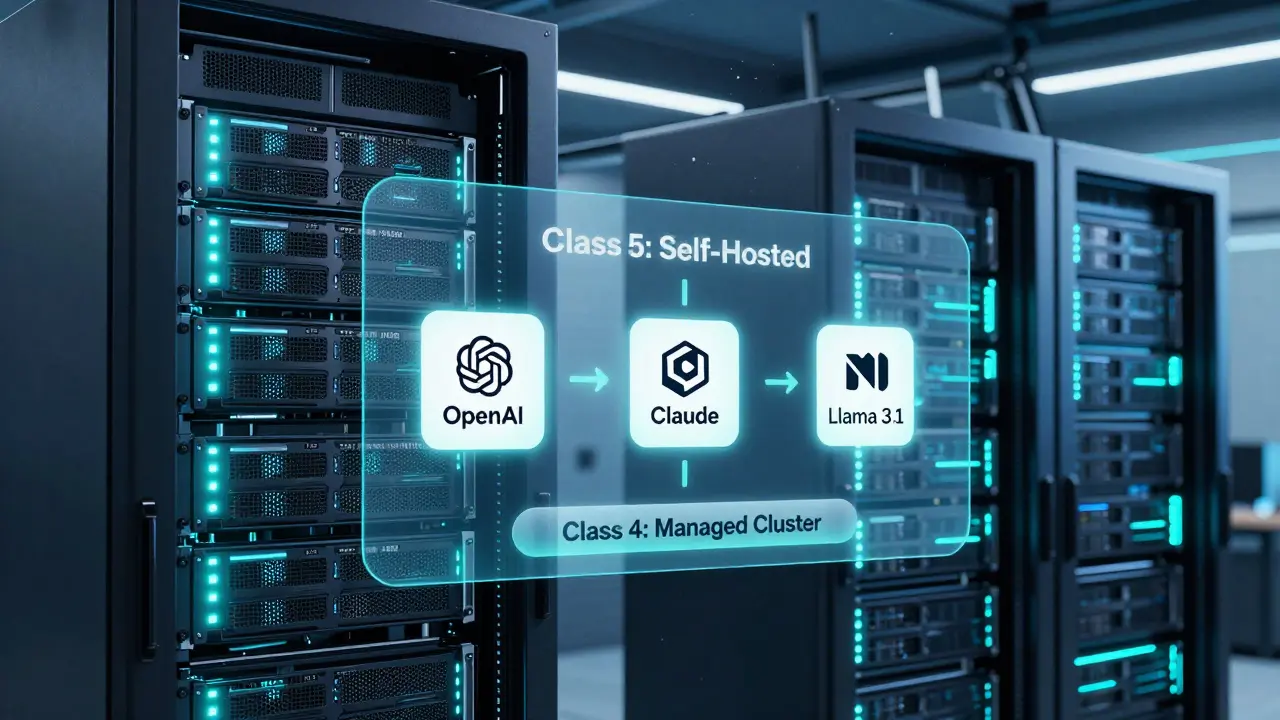
- Class 4: Self-managed infrastructure. You deploy open-source models on serverless GPU clusters or Kubernetes-still not your own hardware, but fully under your control.
- Class 5: Fully self-hosted. You run everything on your own NVIDIA H100 servers, with your own security, monitoring, and updates.
The key insight? You don’t have to jump from Class 1 to Class 5. Most successful teams start at Class 3. They test their application with open-source models, validate performance, and only move to Class 4 or 5 once they’re confident in their setup.
Build a Model-Agnostic Proxy Layer
This is the single most important architectural move you can make. A model-agnostic proxy sits between your application and the LLM. Think of it as a traffic cop that sends requests to the right model, no matter who’s running it.
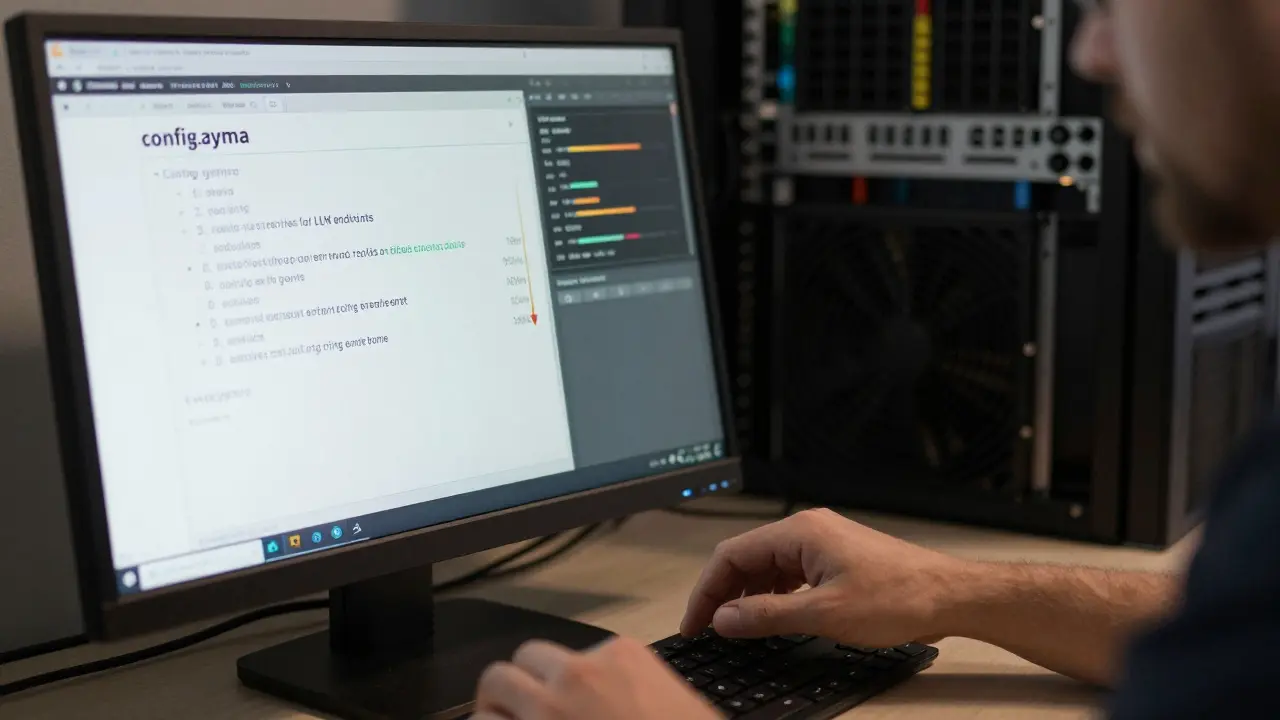
Your app doesn’t talk to "OpenAI" or "Claude." It talks to /api/v1/llm. The proxy handles the rest. Need to switch from Llama 3.1 to Mistral Large 2? Just update one config file-config.yaml. No code changes. No re-deploy. No downtime.
Even better: you can route requests intelligently. Simple tasks-like summarizing a paragraph or tagging a support ticket-go to a fast, cheap local model like Phi-4. Complex reasoning? Send it to a frontier model like GPT-4o or Claude 3.5 Sonnet. This cuts costs and improves speed.
And if one provider goes down? The proxy automatically routes traffic to a backup. No user notices. No panic. Just resilience.
Latency Is Your Secret Weapon
Cloud APIs are slow. Not because they’re bad-they’re not. But they’re shared. When 10,000 companies hit OpenAI at the same time, your request gets queued. You might wait 800ms. Or 2 seconds. It’s unpredictable.
When you host your own Small Language Model (SLM) on local hardware, responses drop below 200ms. That’s the difference between a chatbot that feels instant and one that feels laggy. For voice assistants, real-time transcription, or live code assistants, that 600ms gap ruins the experience.
One SaaS company in Portland switched from OpenAI to a self-hosted Llama 3.1 on a single NVIDIA L40S. Their average latency dropped from 950ms to 180ms. User engagement went up 27%. They didn’t need a better model. They just needed to cut the network hop.
Don’t Forget Your Data
Most teams focus on the model and forget the data. Big mistake.
If you’re using Pinecone or Weaviate to store your company’s customer docs, vector embeddings, or internal knowledge base-you’re still locked in. Those services require sending your data to their servers. Even if you switch models, you’re still sending sensitive information to third parties.
The fix? Replace external vector databases with self-hosted alternatives like Milvus or Qdrant. And don’t use OpenAI’s embedding model. Use BGE-M3 or nomic-embed-text, deployed on your own infrastructure. Now your entire knowledge system stays inside your firewall. No data leaves. No compliance surprises.
Costs Don’t Add Up-They Explode
Let’s talk about the "Token Tax."
OpenAI charges $5 per million input tokens and $15 per million output tokens. Sounds cheap? Until you’re processing 100 million tokens a month. That’s $2,000. Then 500 million? $10,000. Then 2 billion? $40,000. And that’s just one model.
Compare that to a self-hosted Llama 3.1 70B on a single NVIDIA H100. Hardware cost: $30,000. Power and cooling: $2,000/year. Maintenance: $5,000/year. Total cost after year one? $37,000. You break even at around 1.2 billion tokens per year. For most enterprise users, that happens in 6-8 months.
And here’s the kicker: API prices can go up anytime. Self-hosted costs? Fixed. You know exactly what you’ll pay next year. No surprises.
Don’t Skip the Operational Risks
Self-hosting sounds great-until your GPU driver breaks and no one on your team remembers how to fix it.
Class 5 isn’t for everyone. It requires:
- Someone who understands NVIDIA drivers and CUDA
- A monitoring system that tracks model performance, memory leaks, and temperature
- A plan for replacing hardware every 18-24 months
- Backup staff trained on your setup
That’s why Class 4 is often the sweet spot. Use serverless GPU clusters from Lambda Labs, RunPod, or CoreWeave. You get the control of open-source models without the operational burden. Scale up during peak hours. Scale down overnight. Pay only for what you use. No hardware to manage.

Multi-Provider Orchestration Is the New Standard
Even if you don’t self-host, you can still avoid lock-in. Use a central orchestrator to split workloads between providers.
Send 60% of traffic to Claude 3.5 Sonnet. Send 30% to Llama 3.1 hosted on RunPod. Keep 10% as a fallback on OpenAI. If one provider has an outage, the others pick up the load. You’re not dependent on any single company.
And here’s what’s interesting: AWS is already doing this. They’re partnering with OpenAI, but also supporting Mistral and Llama models on their infrastructure. The market is moving toward multi-provider flexibility. The companies that win will be the ones who built systems that can move.
Regulations Are Forcing the Change
The EU Cloud and AI Development Act (2026) requires that AI systems be portable. If your model can’t be moved from one infrastructure to another without rewriting your entire app, you’re not compliant.
Same with HIPAA, GDPR, and other data sovereignty laws. If your customer data is being sent to a U.S.-based API, but you’re operating in Germany, you’re at risk.
Model-agnostic architectures aren’t just smart-they’re becoming mandatory.
Where Do You Start?
Don’t try to go from zero to self-hosted in one week. Start here:
- Replace your embedding model. Switch from OpenAI’s text-embedding-3-small to BGE-M3, hosted on a serverless GPU cluster.
- Replace your vector database. Migrate from Pinecone to Milvus or Qdrant on your own VPC.
- Deploy a model-agnostic proxy. Use a lightweight service like LangChain or a custom FastAPI wrapper that routes to multiple endpoints.
- Test with Class 3. Run your app on Llama 3.1 via Together.ai. Compare latency, cost, and quality to your current setup.
- Graduate to Class 4. Once you’re confident, move to a managed Kubernetes cluster on AWS EKS or Google Cloud Run.
By the time you’re ready for Class 5, you’ll already have the team, the tools, and the confidence to make it work.
Final Thought: AI Is Infrastructure, Not a Service
Five years ago, companies thought of cloud storage like electricity-you just plug in and pay. Now, they build their own data centers. AI is following the same path.
Lock-in isn’t just a technical problem. It’s a strategic one. If you can’t move your AI, you can’t adapt. And in 2026, adaptability is the only competitive advantage that lasts.
What’s the fastest way to reduce LLM vendor lock-in?
The fastest fix is to build a model-agnostic proxy layer. This lets you switch between providers without changing your app code. Pair it with self-hosted embedding models and vector databases like BGE-M3 and Milvus. You’ll reduce dependency overnight.
Is open-source always cheaper than API-based LLMs?
Not always-but it usually is at scale. For under 500 million tokens per year, APIs are simpler. Beyond that, self-hosted models like Llama 3.1 70B or Mistral Large 2 cut costs by 60-80%. The break-even point is typically 6-8 months for enterprise usage.
Can I use multiple LLM providers at once?
Yes-and you should. Many teams now use a routing system that sends simple queries to fast, cheap models and complex ones to frontier models. Some even split traffic between OpenAI, Claude, and a self-hosted Llama model. This reduces risk and improves performance.
What’s the biggest mistake companies make when migrating?
They focus only on the model and ignore the data. Moving from OpenAI to Llama 3.1 won’t help if your customer documents are still being sent to Pinecone or Weaviate. You need to migrate both your inference and your embeddings. Otherwise, you’re just swapping one lock-in for another.
Do I need an NVIDIA H100 to self-host LLMs?
No. For many use cases, an NVIDIA L40S or even an RTX 6000 Ada is enough. H100s are for high-volume, multi-model deployments. Start small. Test with a single GPU. Scale up only when you see real demand.
Frank Piccolo
February 27, 2026 AT 13:15Let’s be real-this whole ‘avoid vendor lock-in’ thing is just tech bros trying to sound deep while ignoring the fact that 95% of companies don’t have the engineering muscle to self-host. You want Class 5? Cool. I want to ship features. Stop pretending this is a strategic imperative when it’s just a glorified ops tax.
And don’t get me started on ‘model-agnostic proxy.’ That’s not architecture-it’s a glorified if/else statement wrapped in a Kubernetes pod. If your entire AI stack depends on routing logic you wrote in 3 hours, you’re already one API change away from disaster.
James Boggs
March 1, 2026 AT 11:36Thank you for this thoughtful breakdown. The five-class framework is incredibly useful, especially for teams just starting to think about LLM architecture. Class 3 is absolutely the right place to begin-testing with open-source models on managed endpoints gives you real-world feedback without the operational overhead. And the proxy layer? Essential. It’s the quiet hero of any resilient AI system.
Addison Smart
March 2, 2026 AT 06:49There’s something deeply human about how we treat AI models like disposable utilities. We treat them like Netflix subscriptions-until the price jumps, or the content changes, or the service goes down. But AI isn’t entertainment-it’s infrastructure. And infrastructure requires ownership, not just access.
I’ve seen teams that switched from OpenAI to Llama 3.1 on RunPod and saw not just cost savings, but a cultural shift. Engineers stopped asking ‘what can we do with this model?’ and started asking ‘what should we build with it?’ That’s the real win.
And yes, data sovereignty matters. If your customer’s legal documents are being sent to a server in Iowa while you’re based in Berlin, you’re not just risking compliance-you’re risking trust. Self-hosted embeddings aren’t a technical choice. They’re an ethical one.
David Smith
March 3, 2026 AT 07:49Oh wow. Another Silicon Valley guru telling us to ‘self-host everything’ like we’re all running Google’s infrastructure. Bro. I run a SaaS with 12 employees. We don’t have a DevOps team. We have one guy who fixes the printer.
And now you want us to manage CUDA drivers? Replace Pinecone with Milvus? ‘Graduate to Class 4’? Like we’re climbing some tech mountain with a rope ladder made of Kubernetes YAML?
Meanwhile, I’m still trying to get our CFO to approve a $200/month OpenAI increase. You’re talking about H100s like they’re coffee machines. I’m trying to keep the lights on. This isn’t strategy. It’s fantasy.
Lissa Veldhuis
March 5, 2026 AT 01:12Okay but let’s talk about the REAL elephant in the room-nobody cares about latency until their users start complaining
I worked at a company that used OpenAI for chat support and we had 3 second response times. Customers thought the bot was broken. We switched to a self-hosted Phi-3 on a single L40S and suddenly people were like ‘whoa this feels alive’
And don’t even get me started on embedding models-using OpenAI’s embedding service while storing data in Pinecone is like locking your front door but leaving your back window open with a sign that says ‘come in and steal my secrets’
Also why is everyone so scared of self-hosting? It’s not magic. It’s just servers. With GPUs. That you can turn off when you sleep. It’s not hard. You just have to stop being lazy.
Michael Jones
March 5, 2026 AT 13:34AI isn’t about models or APIs or cost-it’s about freedom
When you own your infrastructure you stop being a customer and start being a creator
Every time you rely on someone else’s API you surrender a piece of your agency
Yes it’s harder
Yes it takes work
But what’s the alternative? Becoming a digital serf paying rent to a handful of tech monopolies?
The future belongs to those who build their own foundations-not those who beg for scraps from the platform owners
allison berroteran
March 5, 2026 AT 13:48I really appreciate how this post balances technical depth with practical steps. The idea of starting at Class 3 is so much more realistic than the ‘go all-in on self-hosting’ advice we usually get.
I’ve been experimenting with BGE-M3 on a serverless GPU cluster from RunPod, and the difference in latency compared to OpenAI’s embeddings is startling-under 150ms versus 600+ms. It’s not just about cost; it’s about the quality of the interaction.
Also, the point about data sovereignty hit home. We’re in healthcare, and even the thought of sending patient notes to a third-party vector DB gave me chills. Moving to Qdrant on our VPC didn’t just reduce risk-it gave our compliance team peace of mind. That’s worth more than any ROI calculation.
Gabby Love
March 5, 2026 AT 19:03Just want to clarify something-when you say ‘self-hosted Llama 3.1 on H100 breaks even at 1.2B tokens/year,’ you’re assuming 24/7 uptime. Most teams don’t need that. Using spot instances or serverless GPUs (like Lambda Labs) drops the cost significantly. Also, don’t forget inference optimization-quantization and vLLM can cut your GPU usage by 40-60%.
Class 4 is the sweet spot for 90% of companies. No need to overcomplicate it.
Jen Kay
March 6, 2026 AT 23:48Interesting take. I’m glad you mentioned the EU AI Act-because it’s not just about technology. It’s about accountability. If your AI system can’t be audited, moved, or replaced without a six-month engineering project, you’re not future-proofed-you’re legally exposed.
And while self-hosting sounds intimidating, it’s not about owning hardware. It’s about owning control. A model-agnostic proxy isn’t a luxury. It’s a compliance tool. A risk mitigator. A strategic asset.
Yes, it takes effort. But so does avoiding lawsuits. And honestly? The teams that do this right aren’t the ones with the biggest budgets. They’re the ones who started small, stayed consistent, and refused to treat AI like a black box.