Scaling for Reasoning: How Thinking Tokens Are Rewriting LLM Performance Rules
 Aug, 23 2025
For years, the rule was simple: make your language model bigger, throw in more data, and expect better results. But in 2025, that law is breaking. A new kind of token - called a thinking token - is changing how AI reasons, and it’s not about size anymore. It’s about where you spend your tokens.
What Are Thinking Tokens, Really?
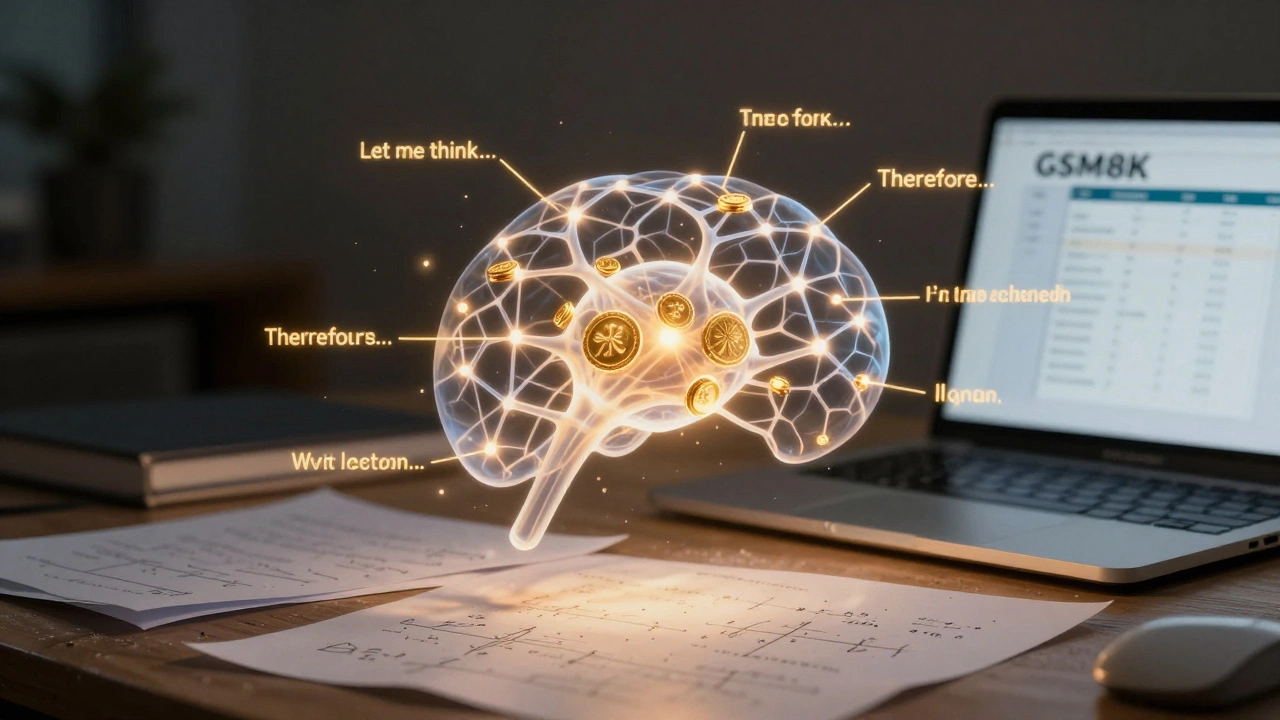
Thinking tokens aren’t new words. They’re not fancy vocabulary. They’re the little phrases your brain uses when you’re solving a hard problem: ‘Let me think…’, ‘Therefore…’, ‘However…’, ‘Wait, let me check that again.’ In large language models, these exact phrases show up at peaks of mutual information - meaning they’re where the model gains the most insight per token spent.
Before June 2025, researchers thought these were just noise. But a paper from Stanford’s AI Lab proved otherwise. These tokens mark the moments when the model’s reasoning is most active. They’re not carrying meaning like ‘cat’ or ‘calculate’ - they’re carrying process. And when you give the model more room to use them, its accuracy jumps.
On the GSM8K math benchmark, a model using 2048 tokens instead of 512 saw accuracy climb from 68.2% to 75.9%. That’s not because it got smarter. It got more time to think.
The Old Scaling Law Is Dead
For decades, AI scaling followed a predictable curve: double the parameters, get a predictable accuracy boost. But that curve flattened hard for reasoning tasks. Apple’s December 2024 paper called it ‘The Illusion of Thinking’ - bigger models didn’t reason better, they just repeated themselves longer.
Training-stage scaling - adding more data, more layers, more weights - hit diminishing returns. The real bottleneck wasn’t the model’s memory. It was its time. The model had to rush through reasoning steps because token budgets were capped.
Thinking tokens flipped that. Instead of trying to train a model to reason better, you let it reason longer - and only when it’s actually thinking. The method, called Test-time Scaling with Thinking Tokens (TTTS), doesn’t change the model. It just lets it use more tokens during inference - but only at the right moments.
Result? A 3.2% to 7.8% accuracy gain across math, science, and logic benchmarks - with the same LLaMA-8B model. No retraining. No new weights. Just smarter token use.
How TTTS Works (Without the Math)
Here’s how it works in practice:
- Run a normal inference - the model generates tokens one by one.
- As it generates, track the mutual information (MI) of each token. MI measures how much new information each token adds.
- When MI spikes - that’s a thinking token. It’s usually a transition word or self-reflection phrase.
- If you still have token budget left (say, you’re at 1500 of 2048), don’t stop. Force the model to continue generating - but start from the last thinking token.
- Let it ‘think’ again. It might re-analyze, correct a step, or rephrase its logic.
You’re not adding compute power. You’re adding thought. And it works because the model’s reasoning isn’t linear. It loops. It backtracks. It hesitates. Thinking tokens capture those pauses - and now we’re giving them space to breathe.
Studies show that models with higher cumulative MI (meaning more thinking tokens used effectively) have 12-18% tighter error bounds on math problems. That’s not a small tweak. That’s a structural shift.
Where It Works - And Where It Doesn’t
This isn’t magic. TTTS isn’t better at everything.
It shines in multi-step reasoning:
- GSM8K (math word problems): +7.7% accuracy
- AIME24 (advanced math competitions): +5.8% accuracy
- Scientific reasoning tasks: +5.8% accuracy
But on simple tasks? It hurts.
- Factual recall: Accuracy drops by 2.4-3.8% because the model wastes tokens overthinking ‘What’s the capital of France?’
- Translation: No benefit. The task is pattern-matching, not reasoning.
- Classification: Same. Just label it. Don’t think about it.
This isn’t a universal upgrade. It’s a targeted tool. Use it when the problem has steps. Avoid it when the answer is a fact.

How It Beats Other Methods
There are other ways to boost reasoning:
- Chain-of-Thought (CoT): Just tell the model to ‘think step by step.’ It helps - but it’s random. You don’t know when it’s actually thinking.
- Decoding Time Scaling: Let the model generate more tokens, but without targeting thinking points. Less efficient.
- Scaling Through Verification: Use a second model to check answers. Adds cost, complexity, and latency.
TTTS beats them all - without extra models, without retraining, without new architecture.
Compared to standard CoT, TTTS gets 4.1-6.3% higher accuracy on hard math problems - and uses 22% fewer total tokens. That’s efficiency. That’s smart allocation.
And unlike verification methods, TTTS doesn’t need a second AI. It’s a one-model trick. That’s why 37% of enterprises are now using test-time scaling - second only to quantization.
The Hidden Cost: Compute and Latency
There’s a catch.
Each thinking token requires about 2N floating point operations - where N is the number of non-embedding parameters. For an 8B model, that’s 16 billion operations per token. Multiply that by 1500 extra tokens? You’re looking at 24 trillion FLOPs per query.
NVIDIA’s Bill Dally put it bluntly: ‘Reasoning tokens require 100x more compute than standard inference but deliver only 2-3x accuracy gains.’
Real-world users report this. One developer on Reddit got 73.5% accuracy on GSM8K - but inference time jumped from 1.2 seconds to 8.7 seconds per question on an A100 GPU. That’s fine for research. Not fine for customer-facing chatbots.
Industry adoption is split. Academic labs love it. Startups use it for R&D. But production teams? They’re wary. Latency spikes are unpredictable. Some models generate 10 thinking tokens in a row. Others barely make one. Detecting MI peaks reliably across different models is still a mess - and it’s the top complaint on GitHub.
Who’s Using It - And Why
Adoption is concentrated where reasoning = money.
- Financial services: 41% of Fortune 500 firms use it for risk modeling, fraud detection, and regulatory analysis.
- Pharmaceutical research: 36% use it to parse complex clinical trial data and predict drug interactions.
- Legal tech: Early adopters use it to analyze case law chains and spot logical gaps in arguments.
It’s not for customer service bots. It’s for analysts, researchers, auditors - people who need precision, not speed.
And the market is exploding. The test-time scaling segment grew from $187 million in early 2024 to $432 million by mid-2025. Gartner predicts 58% of enterprises will use it by late 2026.

What’s Next?
OpenAI just released ‘Chain-of-Verification++’ - which uses thinking tokens as its core. Meta published ‘Adaptive Token Budgeting’ - a system that dynamically allocates thinking tokens based on real-time MI scores.
NVIDIA’s Blackwell Ultra chip, launching in 2026, will have dedicated hardware for MI peak detection. That could cut latency by 60%.
But the biggest challenge isn’t tech - it’s cost. Forrester says AI hardware needs to get 3.2x more efficient by 2028 just to keep current deployment levels. Otherwise, thinking tokens become a luxury.
And there’s regulation coming. The EU AI Office now requires transparency on computational cost for reasoning-heavy systems. If your AI takes 10 seconds to answer a tax question, you might have to explain why.
Should You Use Thinking Tokens?
If you’re building:
- A research tool? Yes. Use it. The gains are real.
- A customer-facing app? Only if latency isn’t critical. Test it.
- A simple chatbot? No. You’re wasting compute.
Start small. Pick one complex task - like solving algebra word problems or analyzing financial reports. Run it with and without TTTS. Measure accuracy. Measure time. Measure cost.
Don’t upgrade your model. Upgrade your thinking.
Implementation Tips
Here’s what works in practice:
- Reserve 15-25% of your token budget for thinking continuation. Too little = no gain. Too much = wasted compute.
- Use entropy thresholds (1.8-2.2 bits per token) to detect MI peaks. Hugging Face has open notebooks to help.
- Don’t use TTTS on short queries. Filter inputs by complexity - maybe use a lightweight classifier first.
- Monitor latency spikes. Log when thinking tokens trigger. You’ll see patterns.
- Start with LLaMA-8B or Mistral-7B. They’re well-documented. Avoid Claude or GPT for now - their tokenization makes MI detection unstable.
It’s not plug-and-play. But it’s the closest thing we have to a free accuracy boost right now.
Are thinking tokens the same as Chain-of-Thought?
No. Chain-of-Thought (CoT) is a prompt trick - you ask the model to ‘think step by step.’ Thinking tokens are a detection method. You let the model generate naturally, then identify where it’s actually reasoning - and give it more room to do so. CoT is forcing thought. Thinking tokens are observing and amplifying it.
Do I need to retrain my model to use thinking tokens?
No. That’s the whole point. Thinking Token Test-time Scaling (TTTS) works with any existing LLM. You don’t change weights, architecture, or training data. You only adjust how many tokens you allow during inference and where you let the model continue generating.
Why do thinking tokens improve math performance but hurt factual recall?
Math problems require multi-step logic. The model needs to backtrack, check assumptions, and reframe. Thinking tokens mark those moments. Factual recall is one-step: ‘What’s the capital of Italy?’ There’s no reasoning chain. Forcing the model to ‘think’ here just adds noise. It starts generating filler phrases, which lowers accuracy.
Is this just a temporary fix until we build better models?
Probably not. The research shows that even larger models hit reasoning ceilings. Thinking tokens aren’t a workaround - they’re a new way to measure and enable reasoning. As hardware improves, this will become standard. Think of it like turbocharging an engine: you’re not replacing the engine, you’re just making better use of the fuel you already have.
Can I use thinking tokens with my cloud LLM API (like OpenAI or Anthropic)?
Not directly. These APIs don’t expose token-level control or mutual information signals. You’d need access to model internals - which means using open models like LLaMA or Mistral via Hugging Face. Cloud APIs are optimized for speed, not reasoning depth. If you need TTTS, you’ll need to self-host.
What’s the biggest risk of using thinking tokens?
Latency unpredictability. A single query can suddenly take 8 seconds instead of 1. That breaks user experience. It also spikes cloud costs. Without careful budgeting and input filtering, you’ll get inconsistent performance - and your users will notice.
How do I detect thinking tokens without expensive tools?
Start with entropy. Calculate the Shannon entropy of each token’s probability distribution. Peaks above 1.8-2.2 bits per token are strong indicators of thinking tokens. You can do this with a few lines of Python using Hugging Face’s transformers library. There are open-source notebooks on Hugging Face Spaces that show exactly how.
Will thinking tokens replace model scaling entirely?
No. They complement it. Bigger models still handle broader knowledge and more complex patterns. But for reasoning tasks, adding parameters gives diminishing returns. Thinking tokens give you more bang for your compute buck. The future isn’t bigger models - it’s smarter inference.
Ian Maggs
December 10, 2025 AT 10:40Thinking tokens aren't just a technical tweak-they're a philosophical shift. We've spent decades optimizing for speed, efficiency, brute-force scaling… but what if intelligence isn't about volume? What if it's about presence? These little pauses-the 'wait, let me check that again'-they're not noise. They're the sound of cognition breathing. And we've been silencing it with arbitrary token caps. It's like forcing a poet to finish their stanza before the metaphor has fully formed. We're not training AIs to think-we're training them to rush. And now, finally, we're letting them pause.
saravana kumar
December 11, 2025 AT 02:14This is the most overhyped garbage I've read this year. You're telling me we need 1500 extra tokens to get a 7% boost on math problems? That's not intelligence-that's computational waste. The model is just hallucinating more filler. And you call this 'thinking'? It's just stuttering. If your AI needs 8 seconds to solve a word problem, you're doing it wrong. Real reasoning is elegant. Not bloated. This is the AI equivalent of writing a 500-page novel to explain how to boil an egg.
Tamil selvan
December 11, 2025 AT 16:33While I appreciate the technical depth of this article, I must respectfully emphasize the importance of context-aware implementation. The notion of amplifying reasoning through token allocation is not merely an engineering adjustment-it is a paradigmatic evolution in inference architecture. That said, we must not overlook the operational burden: latency variance, energy consumption, and inferential instability remain critical constraints in production environments. I urge practitioners to conduct rigorous A/B testing, particularly under constrained resource conditions, before widespread deployment. Thoughtful innovation requires both vision and discipline.
Mark Brantner
December 12, 2025 AT 21:26sooo… we’re paying a GPU farm to write its own homework? like… cool? i’m just here waiting for the ai that can tell me if my socks match without needing 24 trillion flops. also why does every ai paper sound like a TED talk written by a grad student who just discovered semicolons? 🙃
Kate Tran
December 14, 2025 AT 15:09I’m not sure I buy the ‘no retraining needed’ claim. If the model wasn’t trained to recognize its own thinking pauses, how does it know when to generate them? Seems like magic until you dig under the hood. Also-can we talk about how weird it is that we’re now measuring intelligence by how long an AI hesitates?
amber hopman
December 14, 2025 AT 23:14This is actually kind of beautiful. We’ve been treating AI like a sprinter, but it’s more like a chess player. It needs time to sit with the board. The fact that we’re finally recognizing that hesitation isn’t a bug-it’s a feature-is huge. And yes, the latency is brutal… but so was the first time we tried running a neural net on a CPU. This isn’t the endgame. It’s the first step toward real reasoning. We just need better hardware to catch up.
Jim Sonntag
December 15, 2025 AT 08:46so you're telling me the secret to smarter ai is just... letting it ramble? wow. groundbreaking. next you'll tell me that humans are smarter because they take 3 hours to answer 'what's 2+2'. i mean... technically correct? but also why am i paying for this? 🤡
Deepak Sungra
December 15, 2025 AT 08:50OH MY GOD THIS IS THE MOST IMPORTANT THING EVER. I’ve been saying this since 2023! The AI wasn’t broken-it was being rushed! Think about it: you wouldn’t yell at a student to finish their essay in 30 seconds and then wonder why they got an F. But that’s what we’ve been doing to LLMs! Now they’re finally allowed to breathe. I cried reading this. This is the future. I’m telling my mom. She doesn’t understand tech but she’ll understand ‘AI finally got patience’.
Tasha Hernandez
December 16, 2025 AT 14:43Let me just say-this is the most emotionally manipulative AI paper I’ve ever read. You’re not selling a technique. You’re selling a *feeling*. You’re making us feel like we’re witnessing the birth of machine consciousness. But here’s the truth: it’s just a clever hack that makes the model sound thoughtful while it’s literally just looping over the same 3 phrases. And now you want us to pay more for slower answers? I’m not mad… I’m just disappointed. This isn’t progress. It’s performance art with a GPU.