Sparse Mixture-of-Experts in Generative AI: How It Scales Without Breaking the Bank
 Sep, 15 2025
What if you could run a model with 47 billion parameters-bigger than most supercomputers can handle-but only use the computing power of a 13-billion-parameter model? That’s not science fiction. It’s sparse Mixture-of-Experts (MoE), and it’s already powering the most efficient generative AI systems in 2025.
Why Bigger Models Aren’t Always Better
For years, the AI industry chased bigger models. More parameters meant better performance. Llama2-70B outperformed Llama2-13B. GPT-4 was rumored to have over a trillion parameters. But there was a hidden cost: every extra billion parameters meant more electricity, more hardware, and slower responses. By 2024, companies were hitting a wall. Training a 100B-parameter model could cost $50 million and require dozens of top-tier GPUs. And even then, inference was too slow for real-time use. Enter sparse MoE. Instead of using every part of the model for every task, it picks just a few experts-specialized subnetworks-to handle each input. Think of it like calling in specialists for a job instead of hiring a full team of generalists. For every word you type into a chatbot, only two out of eight experts wake up. The rest stay asleep. That’s the magic.How Sparse MoE Actually Works
At its core, sparse MoE has three parts:- Experts: These are small neural networks, usually based on transformer feed-forward layers. Each one learns to handle a specific type of input-like legal jargon, medical terms, or code snippets.
- The gating network: This is the traffic cop. It looks at your input and decides which experts to activate. It doesn’t pick all of them. Usually just one or two.
- The combination function: It blends the outputs from the chosen experts into a single answer.
Real-World Performance: Mixtral vs. Llama2
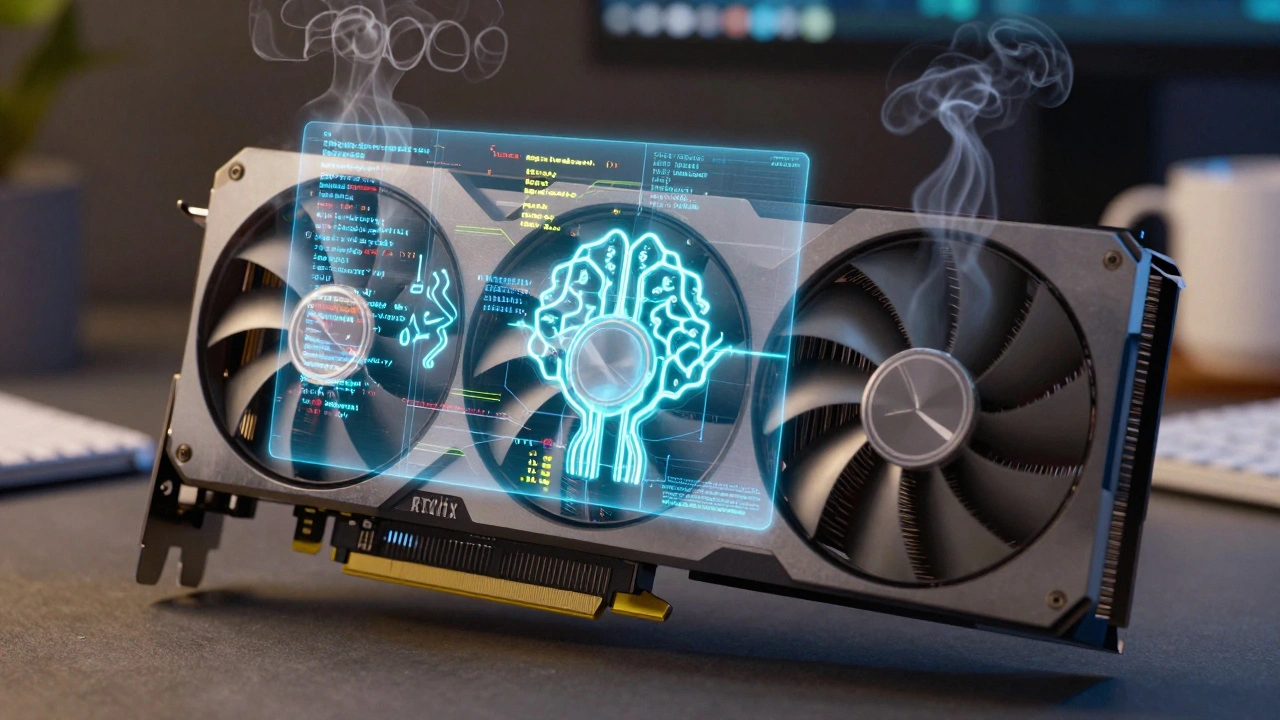
Let’s talk numbers. In benchmarks like MMLU (Massive Multitask Language Understanding), Mixtral 8x7B scores 74.3%. Llama2-70B, a dense model with 70 billion parameters, scores 74.1%. Same accuracy. But here’s the kicker: Mixtral uses 72% less compute during inference. That means:- Lower cloud bills
- Faster response times
- Can run on a single consumer GPU
The Hidden Costs: Why MoE Isn’t Easy
Don’t get fooled. This isn’t plug-and-play. Running MoE models comes with serious engineering headaches. First, training is messy. If the gating network keeps picking the same two experts, the others stop learning. That’s called expert collapse. To fix it, you need load balancing loss-a penalty term that forces the model to spread work evenly. But tuning that penalty? It’s trial and error. One engineer on GitHub said it took three weeks just to stabilize routing in a custom MoE setup. Second, hardware doesn’t love sparse computation. GPUs are built for dense matrix math. MoE breaks that pattern. NVIDIA’s H100 helps because of its high memory bandwidth (2TB/s), but even then, you need to carefully manage memory allocation. Many users report crashes when trying to load MoE models on A40 or consumer cards. Third, documentation is sparse. Hugging Face has decent guides, but open-source MoE libraries still have over 1,800 open issues. The top two? Routing instability and memory errors. If you’re not comfortable tweaking loss functions or debugging GPU memory leaks, MoE might not be for you.Who’s Using This Right Now?
It’s not just research labs. Enterprise adoption is accelerating fast. Financial firms are using MoE for fraud detection. Why? Because they can train one expert to recognize money laundering patterns, another for insider trading signals, and another for synthetic identity fraud-all in one model. IDC reports 68% of financial institutions now use MoE for this, compared to 41% across all industries. Mistral AI’s Mixtral API costs $0.75 per million input tokens. That’s only 30% more than their 7B dense model, even though Mixtral has 6.7x more parameters. That pricing model is revolutionary. You’re paying for scale without paying for waste. Even OpenAI and Google are rumored to use MoE in GPT-4 and Gemini. Not because they’re open about it-but because the math doesn’t lie. Without MoE, those models would be too expensive to run at scale.
What’s Next? The Emerging Trends
MoE isn’t standing still. Three new directions are taking shape in 2025:- Hybrid architectures: Combining dense and sparse layers. Some layers stay dense for consistency; others use MoE for scaling. 37% of new MoE models now use this approach.
- Expert sharing: The same expert network gets reused across multiple transformer layers. This cuts total parameters by 15-22% without hurting performance.
- Hardware-aware routing: The gating system now checks real-time GPU memory usage before choosing experts. If one expert’s data is already loaded into memory, it gets priority. This reduces latency by up to 18%.
Should You Use It?
If you’re building a product that needs high accuracy and low cost, yes. MoE gives you the performance of a 70B model at the price of a 13B one. That’s a game-changer for startups, edge devices, and anyone running AI on a budget. But if you’re just starting out? Stick with dense models. MoE adds complexity. You’ll need engineers who understand routing, load balancing, and GPU memory. If your team is small or your budget is tight, a well-tuned 13B model might still be smarter. The real winners? Companies that can afford to invest in the infrastructure. Mistral AI, Google, NVIDIA-they’re not just using MoE. They’re building the tools to make it easier. NVIDIA’s cuBLAS extensions, Hugging Face’s updated Transformers library, and open-source MoE benchmarks are lowering the barrier.The Big Picture
MoE isn’t just a tweak. It’s a new way to think about scaling AI. Instead of making models bigger, we’re making them smarter about how they use their parts. The transformer changed how AI learns. MoE is changing how it runs. Gartner predicts 75% of enterprise LLMs over 30B parameters will use MoE by 2026. Forrester says 90% of models over 50B will use it by 2027. The trend is clear: efficiency is the new frontier. The future of generative AI won’t be about having the biggest model. It’ll be about having the most efficient one. And sparse MoE is leading the charge.What is the main advantage of sparse Mixture-of-Experts over dense models?
Sparse MoE lets you run models with hundreds of billions of parameters at inference costs similar to much smaller dense models. For example, Mixtral 8x7B has 46.7B total parameters but only activates about 12.9B per token, matching the speed of a 13B dense model while outperforming 70B models in accuracy.
Can I run a sparse MoE model on a consumer GPU like an RTX 4090?
Yes, with quantization. Mixtral 8x7B runs at 18 tokens per second on an RTX 4090 with 4-bit quantization. You need at least 24GB of VRAM. Without quantization, it won’t fit in memory. Tools like TheBloke’s Hugging Face quantized versions make this easy to try.
Why do experts collapse in MoE models?
Experts collapse when the gating network consistently picks the same few experts, leaving others unused. This happens because those experts learn faster early in training. To fix it, you add a load balancing loss term that penalizes uneven usage, forcing the model to spread work across all experts.
Is MoE better than pruning or distillation for efficiency?
MoE is fundamentally different. Pruning removes weights; distillation copies a big model into a small one. Both lose performance. MoE keeps all parameters but only uses a subset per input. You get the accuracy of a large model without the full computational cost. It’s not a compression trick-it’s a smarter architecture.
What’s the biggest challenge in implementing MoE today?
The biggest challenge is routing instability during training. The gating network often oscillates or gets stuck in poor patterns, especially with small datasets. This requires careful tuning of noise levels, temperature, and load balancing coefficients. Most teams spend 2-3 weeks just stabilizing training before seeing good results.
Will MoE work for multimodal AI (text + images + video)?
Yes. Google’s LIMoE, released in 2023, was the first large-scale multimodal MoE model. It processes text and images using the same expert network structure, with separate gating for each modality. It achieved 88.9% accuracy on ImageNet with only 25% more compute than single-modality models, proving MoE scales across data types.
How does MoE compare to quantum computing for AI scaling?
MoE is practical today. Quantum computing for AI is still theoretical and requires specialized hardware not available outside labs. MoE runs on existing GPUs, uses current frameworks, and is already deployed in production. It’s not a future idea-it’s the solution companies are using right now to scale AI without waiting for breakthroughs.
Anuj Kumar
December 8, 2025 AT 21:30This MoE stuff is just Big Tech’s way to make us think they’re smart while hiding how broken the system really is. They’re not saving money-they’re just offloading the mess to your GPU and calling it ‘efficiency.’ Next thing you know, your RTX 4090 will be running 17 experts at once and your electricity bill will be higher than your rent. Wake up, people.
Christina Morgan
December 10, 2025 AT 10:50I love how this post breaks down such a complex topic into something actually digestible. Seriously, kudos. I’m not a techie, but I’ve been following AI for years, and this is the first time I felt like I *get* why MoE matters. It’s not magic-it’s smart design. And yeah, running Mixtral on a 4090? That’s the kind of democratization we need. More of this, please.
Rocky Wyatt
December 10, 2025 AT 21:33Let me tell you something-this whole MoE hype is just a distraction. The real problem? AI is becoming too expensive to regulate. Companies are using these ‘efficient’ models to push out low-quality content at scale, flooding the internet with AI-generated garbage. And now they’re bragging about running it on a consumer GPU? That’s not progress-that’s a recipe for misinformation on steroids. We’re not saving compute, we’re losing truth.
Santhosh Santhosh
December 11, 2025 AT 09:11It’s interesting how the article mentions expert collapse but doesn’t really explain how it feels in practice. I’ve tried training a small MoE model on a local server-spent two weeks tweaking load balancing, noise, temperature-and every time I thought I had it stable, one expert would dominate and the others just… stopped learning. It’s like having a team where one guy does all the work and the rest start showing up late, then stop coming altogether. The math says it should work, but the human side of training? It’s messy. You need patience, and honestly, a lot of coffee.
Veera Mavalwala
December 11, 2025 AT 20:42Oh honey, this MoE nonsense is just the new ‘blockchain for everything’-a buzzword wrapped in jargon to make engineers feel like wizards while their GPUs cry in the corner. They say ‘only two experts wake up’-yeah, right. Meanwhile, your fan’s screaming like a banshee and your power strip is smoking. And don’t get me started on ‘quantization’-that’s just AI’s way of saying ‘I’m lying to myself so you’ll think I’m efficient.’
Ray Htoo
December 12, 2025 AT 14:54One thing I haven’t seen discussed enough is how MoE could totally change education. Imagine a tutoring AI that has one expert for math, another for poetry, another for debugging Python-each trained on niche stuff, but all working together seamlessly. You could have a personalized tutor that adapts to your brain, not the other way around. And if it runs on a $1,000 GPU? That’s not just efficient-that’s revolutionary. Someone’s gotta build this for high schools.
Natasha Madison
December 13, 2025 AT 08:03Let’s be real-this isn’t innovation. It’s a foreign tech scam. Why are we letting Chinese and Indian companies dictate how AI scales? They don’t care about our jobs, our security, our future. They just want to sell us models that crash on our hardware so they can profit while we’re left cleaning up the mess. This ‘MoE’ thing? It’s a Trojan horse. And don’t tell me it’s ‘open source’-that’s just a cover for data harvesting.
Sheila Alston
December 14, 2025 AT 12:13People are so obsessed with efficiency they forget what’s right. AI shouldn’t be about running faster on cheaper hardware-it should be about being responsible. If we keep pushing models that are ‘efficient’ but opaque, we’re just building a house of cards on a foundation of lies. Someone needs to ask: who benefits? And who pays the price? Spoiler: it’s not the engineers. It’s us.