Calibrating Confidence in Non-English Large Language Model Outputs
 Mar, 17 2026
When a large language model says it’s 95% sure about an answer, you expect it to be right 95 times out of 100. But what if that model is answering in Spanish, Arabic, or Hindi? The truth is, its confidence score often doesn’t match reality. In non-English contexts, these models are overconfident-and that’s dangerous.
Imagine a hospital in Mexico City using an AI to help diagnose patients based on symptoms described in Spanish. The model says it’s 98% confident the patient has diabetes. But in reality, it’s wrong 40% of the time. That’s not a glitch. It’s a systemic failure in how confidence is calibrated across languages. Most research on LLM confidence happens in English. The rest? Left to guesswork.
Why Confidence Scores Break Down in Non-English Languages
Large language models are trained mostly on English data. Even models marketed as "multilingual" still learn better from English examples. When they switch to another language, their internal reasoning gets shaky. But their confidence? It doesn’t drop. It stays high. That’s called miscalibration.
Here’s why it happens:
- Training imbalance: Over 70% of training data in most LLMs is English. Models don’t see enough examples in other languages to learn when they’re uncertain.
- Translation artifacts: Many non-English prompts are translated from English. The model sees the translation, not the original cultural or linguistic context, leading to mismatched confidence.
- Evaluation bias: Benchmarks like MMLU and GSM8K test non-English performance using translated questions. But if the translation is flawed, the model’s confidence becomes a reflection of the translation’s quality-not its own accuracy.
Studies from EMNLP 2024 show that on Spanish-language multiple-choice questions, GPT-4-Turbo’s confidence scores are 20-30 percentage points higher than its actual accuracy. In Swahili, the gap widens to over 40 points. The model thinks it’s doing great. It’s not.
How Confidence Calibration Works (And Why It’s Not Enough)
Calibration isn’t about making models smarter. It’s about making their confidence scores honest. The goal: if a model says it’s 70% sure, it should be correct 7 out of 10 times.
Here are the leading methods-and why they fail for non-English use cases:
UF Calibration (Zhang et al., 2024)
This method splits confidence into two parts: Uncertainty (how unclear the question is) and Fidelity (how well the answer matches the prompt). It works by asking the model to generate 10 alternative answers, then comparing them to the original. The more consistent the answers, the more confident it should be.
It’s called "plug-and-play" because you don’t need to retrain the model. Just run it a few extra times. But here’s the catch: it assumes all languages behave the same way. In reality, languages like Mandarin or Arabic have higher ambiguity in word order, tone, and context. The model doesn’t recognize that ambiguity-it just treats it like noise.
Multicalibration (Detommaso et al., 2024)
This approach doesn’t treat all questions the same. It groups them by features-like question length, topic, or answer type-and calibrates each group separately. Think of it like adjusting the thermostat for each room in a house, not just one central dial.
It’s powerful. But researchers tested it only on English datasets. What if we grouped prompts by language? Could we calibrate Arabic separately from Portuguese? The method hasn’t been tried. The framework exists. The data doesn’t.
Thermometer Approach
Imagine a thermometer that tells you how hot the model’s confidence is. An auxiliary model learns to scale the output confidence based on patterns in the data. Simple. Fast. Efficient.
But it needs labeled data-real examples where we know the correct answer. Where do you get enough labeled data in Swahili, Bengali, or Quechua? Most public datasets have fewer than 500 examples per language. The thermometer needs thousands. It’s like trying to calibrate a scale with only five weights.
Graph-Based Calibration
This method generates multiple answers to the same question and builds a "consistency graph"-linking similar responses. If 8 out of 10 answers agree, confidence goes up. It’s smart. It works well on English.
In non-English contexts? The graph falls apart. Why? Because different languages express the same idea in wildly different ways. A correct answer in Hindi might look completely different from a correct answer in Urdu-even if they mean the same thing. The graph sees disagreement. It lowers confidence. But the model was right.

The Hidden Cost of Overconfidence
This isn’t just a technical problem. It’s a real-world risk.
- Healthcare: An AI in Brazil says it’s 90% sure a patient doesn’t have dengue. It’s wrong. The patient gets sent home. They die.
- Legal aid: A refugee in Germany asks an AI if they qualify for asylum. The model says "yes" with 97% confidence. The claim is denied. The system trusts the score, not the truth.
- Customer service: A bank in Indonesia uses an AI to answer loan questions. It says "approved" with 95% confidence. The customer takes the loan. The model was wrong. They go bankrupt.
These aren’t hypotheticals. They’re happening now. And no one is measuring them.
What Needs to Change
We need to stop treating non-English outputs as afterthoughts. Here’s what must happen:
- Build language-specific calibration datasets. We need 10,000+ labeled examples per major language-not just translated English questions, but native ones, written by native speakers.
- Test calibration per language group. Don’t average performance across all languages. Measure it for each one. A model that works well in French might fail in Vietnamese. That’s okay. But we need to know.
- Adapt methods to linguistic structure. A method that works for Subject-Verb-Object languages (like English) won’t work for Subject-Object-Verb ones (like Japanese). Calibration must account for grammar, tone, and cultural context.
- Use native annotators, not translators. If you want to know if a model’s answer is correct in Tamil, ask a Tamil speaker-not someone who translated it from English.
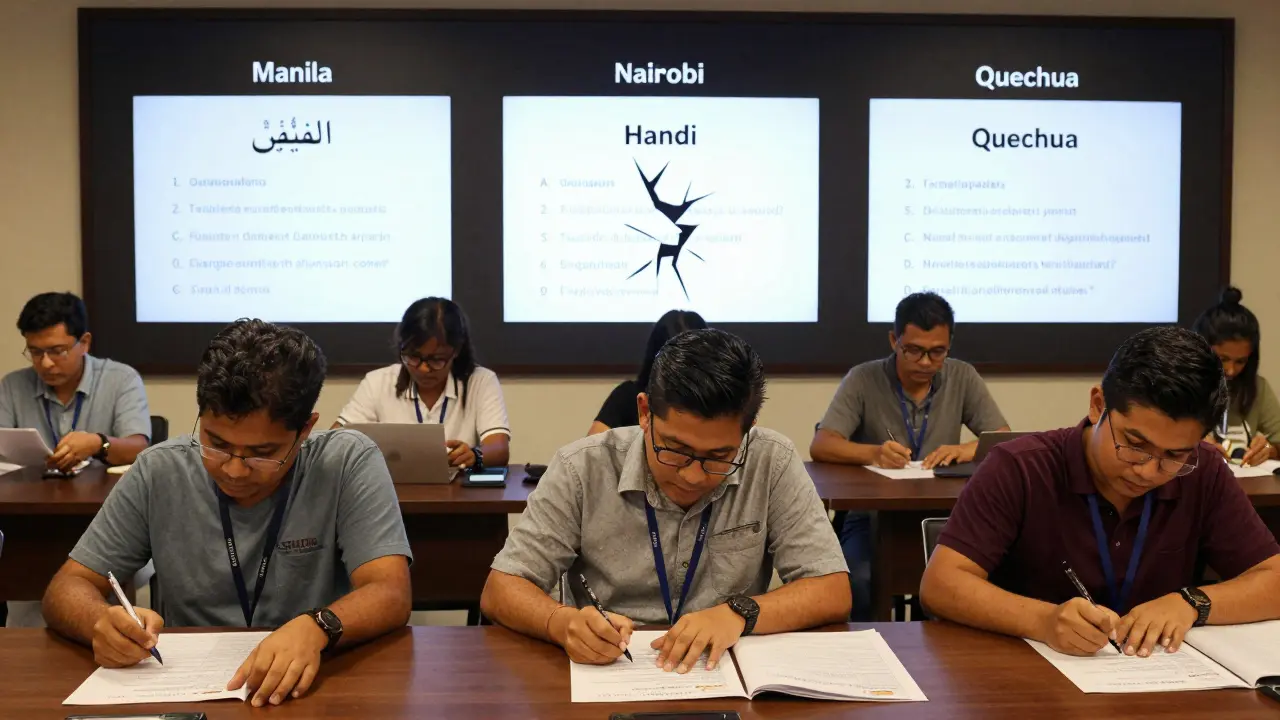
Some startups are starting to do this. One company in Nairobi is building a calibration dataset for Swahili using local teachers and community health workers. Another in Manila is testing confidence scores on Tagalog legal documents. These are small efforts. But they’re the only ones that matter.
What You Can Do Today
If you’re using LLMs in non-English contexts, don’t trust the confidence score. Period.
- Always cross-check: Run the same prompt three times. If answers vary, confidence is meaningless.
- Use human-in-the-loop: For high-stakes decisions, require a human to review any output with confidence above 85%.
- Ask for reasoning: Don’t just take the answer. Ask the model to explain how it got there. If the explanation is vague, the confidence is likely fake.
- Track errors: Keep a log of when the model is wrong in your language. Over time, you’ll see patterns. Use those to adjust your own trust levels.
There’s no magic fix yet. But there’s a clear path: stop assuming English standards apply everywhere. Start measuring what actually happens in your language, your context, your community.
Why do LLMs overconfidently answer in non-English languages?
LLMs are trained mostly on English data, so they learn patterns, structures, and confidence cues from English examples. When they encounter non-English text, they often misinterpret ambiguity as normal variation rather than uncertainty. Their confidence scores aren’t recalibrated for linguistic differences, so they keep giving high scores even when accuracy drops-sometimes by 30-50 percentage points.
Can I use existing confidence calibration tools like UF Calibration for Spanish or Arabic?
You can try, but they’ll likely perform poorly. UF Calibration assumes all languages behave similarly when generating multiple responses. In reality, languages like Arabic or Mandarin have higher structural ambiguity and fewer training examples. The method may misread variation as inconsistency, lowering confidence where it should be high-or vice versa. Without language-specific tuning, you’re just applying an English solution to a non-English problem.
Are there any tools that already work well for non-English confidence calibration?
Not at scale. There are no widely adopted, production-ready tools designed specifically for non-English confidence calibration. A few research teams are building datasets in Swahili, Bengali, and Quechua, but they’re not yet integrated into mainstream platforms. The best approach right now is to combine human review with simple consistency checks across multiple model runs.
How do I know if my LLM’s confidence score is reliable in my language?
Run a simple test: collect 100 real-world prompts in your target language. Have human experts label the correct answers. Then compare the model’s confidence scores to its actual accuracy. If the model says it’s 90% confident but is correct only 60% of the time, the scores are not calibrated. You need to adjust trust levels or implement human review.
Is this problem getting better over time?
Not yet. Most papers in 2024 still focus on English benchmarks. Even when models claim "multilingual" support, calibration remains an afterthought. The field is waking up, but progress is slow. Real change will come only when organizations start demanding language-specific calibration metrics-and stop accepting "good enough for English" as good enough for everyone.
What Comes Next
The next leap in LLM reliability won’t come from bigger models or faster chips. It’ll come from better honesty. From models that say, "I’m not sure," when they’re not sure-even if that means lowering their confidence score in Swahili, Hindi, or Arabic.
Until then, treat every confidence score like a weather forecast: useful, but never absolute. And always check the local conditions first.
Kevin Hagerty
March 18, 2026 AT 13:52I bet the engineers who trained these models are sipping lattes in SF while some kid in Lagos gets a wrong diabetes diagnosis because the AI said '98% confident' and the nurse didn't question it.
Someone please tell me this isn't just another Silicon Valley 'move fast and break things' disaster. Oh wait - it is.
Janiss McCamish
March 19, 2026 AT 14:30I've seen this firsthand - a client in Mexico got denied care because the AI said 'low risk' with 94% confidence. Turned out the symptoms were classic dengue. Human intuition saved their life.
Confidence scores aren't truth. They're guesses with a fancy number attached. Always verify.
Richard H
March 21, 2026 AT 11:40Stop whining about 'linguistic context.' We don't need special treatment for every dialect. Build better models. Train them on more data. Stop making excuses.
This isn't a multicultural issue. It's a lazy engineering problem.
Kendall Storey
March 21, 2026 AT 18:41Meanwhile, the patient got the right diagnosis. The system failed. Not the model.
We need to stop treating linguistic variation as noise. It's feature, not bug.
Ashton Strong
March 23, 2026 AT 14:40It is imperative that institutions prioritize language-specific calibration datasets as a matter of ethical responsibility, not technical convenience.
The fact that Swahili, Quechua, and Bengali datasets contain fewer than 500 labeled examples while English datasets number in the millions is not merely a statistical anomaly - it is a moral failure.
I urge all stakeholders to allocate resources toward native speaker annotation initiatives without delay.
Pamela Tanner
March 24, 2026 AT 17:13