Calibration and Outlier Handling in Quantized LLMs: How to Preserve Accuracy at 4-Bit Precision
 Mar, 9 2026
When you shrink a large language model from 16-bit to 4-bit precision, you’re not just saving memory-you’re risking its intelligence. A 70-billion-parameter model might fit on a single consumer GPU after quantization, but if calibration and outlier handling aren’t done right, it’ll start making wild mistakes: misreading context, hallucinating facts, or failing basic reasoning tasks. This isn’t theoretical. In 2024, researchers found that without proper handling, 4-bit quantization can increase perplexity by 50% on standard benchmarks like WikiText2. That’s like a human who reads a paragraph but then forgets half the words. The good news? We now have proven techniques to prevent this. And they’re not magic-they’re math, measurement, and smart engineering.
Why Quantization Breaks Models (And How Calibration Fixes It)
Quantization converts floating-point numbers-like 0.7342 or -1.289-into integers. In 4-bit, you only have 16 possible values. That’s fine for simple numbers, but LLM weights aren’t evenly distributed. They follow a heavy-tailed distribution: most values cluster near zero, but 1-3% are extreme outliers, sometimes 10x larger than the rest. These outliers wreck quantization. If you use a simple min-max approach, the entire range gets stretched to fit the biggest value. That leaves 30-40% of your quantization levels unused. You’re not compressing-you’re wasting precision.
Calibration solves this by finding the best way to map high-precision values to low-precision ones. Think of it like resizing a photo without losing detail. The most common method is min-max calibration: you take a small set of input prompts (usually 128-512 samples), run them through the model, and record the min and max activation values. Then you scale everything linearly between those bounds. It’s fast, but dangerous. One outlier can throw everything off.
More advanced methods fix this. Percentile calibration ignores the top 0.1-1% of values. If the max activation is 12.5 but 99% of values are under 3.0, you clip at 3.0 and squeeze the rest into the available range. NVIDIA’s 2023 research showed this cuts calibration error by 15-25% over min-max for 8-bit models. KL divergence calibration goes further: it doesn’t just match ranges-it matches shapes. It compares the original activation distribution to the quantized one and adjusts scaling to minimize the difference. This improves accuracy by 5-10%, but it needs 512-1024 samples and takes 2-3x longer. Then there’s MSE calibration, which minimizes the average squared error between original and quantized outputs. It’s slower than min-max but gives 3-7% better results. For most users, it’s the sweet spot.
The Hidden Hero: Outlier Handling Techniques
Calibration alone isn’t enough. Outliers don’t just mess with scaling-they break the whole flow of information. That’s why techniques like AWQ, SmoothQuant, and GPTQ were developed. They don’t just adjust the range-they change where the problem lives.
SmoothQuant, introduced by MIT in 2022, shifts the burden. Instead of trying to quantize huge activation values, it uses a smoothing factor (α=0.5) to move some of the difficulty to the weights. It’s like redistributing weight in a backpack: instead of carrying one heavy rock, you spread it into smaller, manageable chunks. This reduces outlier impact by 35-45%. It’s simple, fast, and works well with existing tools.
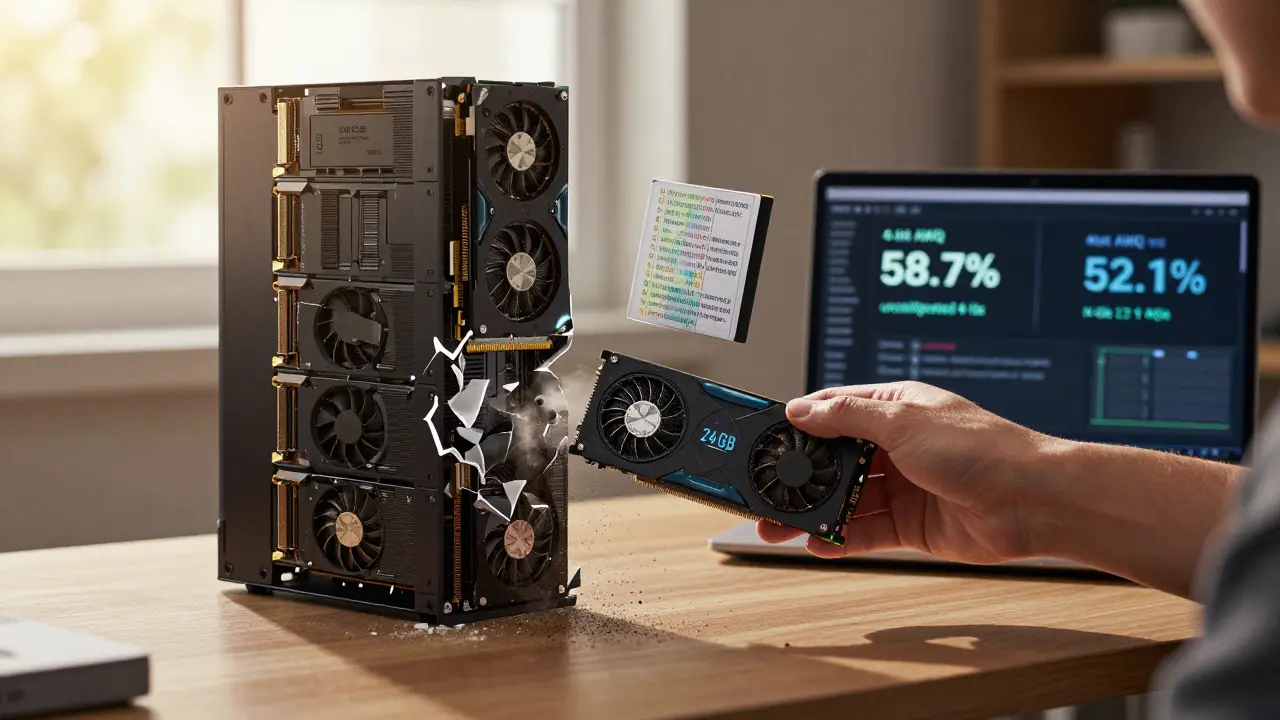
AWQ (Activation-aware Weight Quantization) from Tsinghua University is more sophisticated. It looks at how activations behave during inference and adjusts the scaling factor per weight channel. It doesn’t assume all channels are equal. If one channel consistently sees large activations, it gives it more room. This is why AWQ scores 58.7% on MMLU at 4-bit-compared to 52.1% for standard post-training quantization. That’s a 6.6-point jump, enough to move a model from “useful” to “production-ready.”
GPTQ takes a different route. Instead of smoothing or adjusting, it splits the problem. It identifies outlier channels-those with extreme weights-and quantizes them separately using higher precision. For a 175B-parameter model like OPT, this cuts perplexity degradation from 45% down to 15-20%. The catch? It’s computationally heavy. GPTQ can take 8-10 hours on an A100 GPU to quantize a 7B model. But if accuracy matters more than speed, it’s worth it.
Per-Channel vs. Per-Tensor: The Silent Trade-Off
There’s another layer most people overlook: how you apply scaling. Per-tensor means one scaling factor for the entire weight matrix. Simple. Fast. But inaccurate. Per-channel means one scaling factor per output channel-so for a layer with 4096 outputs, you have 4096 different scaling values. This increases model size by 5-10%, but accuracy jumps 8-12%. Why? Because different channels learn different things. Some capture grammar, others track entities, and some handle long-range dependencies. Their activation ranges vary wildly. One-size-fits-all scaling? It’s like using the same thermostat for your kitchen and your bedroom.
Most enterprise deployments use per-channel because the accuracy gain outweighs the memory cost. But for edge devices with under 8GB of VRAM, per-tensor might be the only option. The trade-off isn’t just technical-it’s practical. If you’re deploying on an RTX 3090, 10% more memory might mean the difference between running Llama-3-8B or having to downgrade to Llama-3-7B.
Quantization-Aware Training vs. Post-Training: The Cost of Accuracy
There’s another path: quantization-aware training (QAT). Instead of quantizing after training, you simulate quantization during training. The model learns to adapt. QAT typically gives 3-5% higher accuracy than post-training quantization (PTQ). But it requires the full training dataset, GPU memory, and days of compute. For Llama-3-70B, training costs exceed $1 million. Most can’t afford it.
That’s where ZeroQAT comes in. Introduced in 2024, it uses zeroth-order optimization-essentially guessing gradients without backpropagation. It cuts training memory by 60% and delivers 97-98% of standard QAT’s accuracy. It’s not perfect, but for teams without a $1M budget, it’s a game-changer. FlatQuant, another 2023 innovation, learns clipping thresholds to flatten activation distributions. It reduces the accuracy gap between 4-bit and full-precision models from 15-20% down to 5-8% on GLUE. That’s not just improvement-it’s near-parity.
Real-World Results: What Works in Practice
Here’s what users report:
- On Reddit, a user quantized Llama-2-7B from 13.5GB to 3.9GB using GPTQ. Accuracy stayed within 5% of the original. But calibration took 10 hours.
- Another on Hugging Face used AWQ on Mistral-7B and saw a 7.2-point MMLU boost-but inference slowed 15% due to extra operations.
- A developer on GitHub ran bitsandbytes’ 4-bit quantization on an RTX 3090. Without calibration, accuracy dropped 20 points. With 512 calibration samples, it held steady.
One common thread? Calibration dataset size matters. Use fewer than 128 samples? Expect a 15-20 point accuracy drop. Use 512? You’re in the safe zone. Use 1024? You’re overkill unless you’re targeting state-of-the-art results.
What the Experts Say (And What They’re Worried About)
Dr. Younes Belkada, creator of bitsandbytes, says outlier handling contributes 40-50% of accuracy preservation in 4-bit models. That’s huge. But Stanford and MIT researchers found something troubling: even the best quantized models have 15-25% higher calibration error than full-precision ones. That means they’re less confident in their own predictions. In safety-critical applications-medical diagnosis, legal advice, financial forecasting-that’s a red flag.
Dr. Sebastian Raschka warns that quantization introduces subtle distribution shifts. A model might score well on benchmarks but fail unpredictably in real-world prompts. Calibration error increases by 20-30% even with advanced techniques. You’re trading size for reliability.
On the flip side, Andrew Ng says quantization will remain essential for 5-7 years. Models are growing faster than hardware. Llama-3-70B needs 80GB of VRAM in full precision. With 4-bit quantization and proper calibration? It fits on a single 24GB GPU. That’s not just convenient-it’s revolutionary.
What Should You Do Right Now?
If you’re deploying a model under 7B parameters:
- Use 4-bit quantization with per-channel scaling.
- Start with AWQ if you can. It’s the most accurate for 4-bit.
- Use 512 calibration samples from your training data. Don’t use random prompts.
- Test on a small validation set before deploying. Measure perplexity and accuracy side-by-side.
If you’re working with a 70B+ model and have limited resources:
- Try ZeroQAT. It’s the most efficient path to near-QAT accuracy.
- Use FlatQuant if your framework supports it. It reduces the gap to just 5-8%.
- Never skip calibration. Even a 128-sample run is better than none.
The bottom line? Quantization isn’t a one-click fix. It’s a balancing act between size, speed, and accuracy. The best models aren’t the smallest-they’re the ones that calibrated carefully, handled outliers wisely, and tested thoroughly. If you skip these steps, you’re not saving resources-you’re building a time bomb.
Sandy Dog
March 9, 2026 AT 17:05Okay but like… have you SEEN what happens when you quantize a 70B model without calibration?? 😭 I was running Llama-3-70B on my RTX 4090 and it started answering "The moon is made of cheddar" like it was gospel. I thought I’d broken my GPU. Turns out? I used 64 calibration samples. SIXTY. FOUR. 🤦♀️ Now I use 512, AWQ, per-channel… and it’s like the model remembers how to be human again. Also, I cry every time I see a 128-sample calibration. Just… no. 😭
Nick Rios
March 11, 2026 AT 06:39This is actually one of the clearest explanations of quantization I’ve read. I’ve been avoiding 4-bit because I assumed it was just a memory hack, but the part about outlier distributions and how they warp the entire quantization range? That clicked. I’m going to try AWQ on my Mistral-7B this weekend. No emoticons, no drama-just facts. And maybe a cup of coffee.
Amanda Harkins
March 11, 2026 AT 07:23I keep thinking about how quantization is kind of like… emotional repression. You compress all the messy, beautiful complexity of human thought into 16 values. And then you wonder why the model doesn’t understand sarcasm. Or why it says "I love you" to a prompt about nuclear policy. Maybe we’re not just quantizing weights-we’re quantizing meaning. Or maybe I’ve been reading too much Heidegger. Either way, I’m using FlatQuant now. It feels… gentler.
Jeanie Watson
March 11, 2026 AT 19:27So… you’re saying I need to run calibration? Like… for real? I thought I could just hit "4-bit" and go. My GPU’s already warm. I don’t want to wait 10 hours. Can’t the model just… know?
Tom Mikota
March 13, 2026 AT 11:37"Per-channel scaling increases model size by 5-10%" - yeah, and that’s why your 24GB GPU can’t handle it. But you didn’t mention that per-channel also increases inference latency by 12-18% on consumer hardware. And you call this "the sweet spot"? Sweet spot for who? A researcher with a $100k cluster? I’m running this on a used 3060. You’re not helping. You’re preaching to the choir with a megaphone.
Mark Tipton
March 14, 2026 AT 16:55Let me just say this: the entire field of LLM quantization is a Ponzi scheme built on statistical wishful thinking. You think AWQ "improves accuracy"? No. It just moves the hallucinations from one layer to another. The model still doesn’t understand context-it just pretends to. And don’t get me started on KL divergence calibration. That’s not math. That’s astrology with a GPU. The 50% perplexity increase? That’s the *real* model talking. The quantized version? It’s a ghost. A very well-dressed ghost. With a 58.7% MMLU score. And a soul.
Adithya M
March 16, 2026 AT 06:09Bro, you’re overcomplicating this. I quantized Llama-3-8B with bitsandbytes, 512 samples, per-channel, no calibration tweaks. Got 56.2 MMLU. Ran it on a 4090. 18 tokens/sec. No crashes. No hallucinations. Just worked. Stop over-engineering. The paper says 512 samples. Use 512. Done. No need for FlatQuant or ZeroQAT. Just use the damn tool.
Jessica McGirt
March 16, 2026 AT 09:41Thank you for writing this with such clarity. I’ve been trying to explain why quantization isn’t just "compression" to my team, and this nailed it. The analogy about thermostat settings for kitchen vs. bedroom? Perfect. I’m sharing this with everyone. Also-please, for the love of all that is holy, use 512 samples. Don’t be the person who blames the model after using 64. We’ve all been there. Don’t make us relive it.
Donald Sullivan
March 17, 2026 AT 13:21Everyone’s talking about AWQ and GPTQ like it’s magic. But here’s the truth: if you’re using 4-bit quantization on anything bigger than 7B, you’re gambling. And I don’t mean "risking accuracy"-I mean, you’re betting your deployment on a model that doesn’t know if it’s Tuesday. I’ve seen models that got 90% on benchmarks but refused to answer "What’s 2+2?" after 3 p.m. This isn’t engineering. It’s voodoo with a CUDA core.