Customizing LLMs: Fine-Tuning, Adapters, and Prompts Explained
 May, 5 2026
You have a massive Large Language Model that understands general English perfectly. But it doesn't know your company's internal jargon, it doesn't follow your specific formatting rules, and it might hallucinate when asked about niche topics. You need to customize it. The problem? Retraining a model with billions of parameters from scratch costs thousands of dollars in GPU time and takes weeks.
Fortunately, you don't need to rebuild the engine to change the destination. Modern AI offers three distinct paths for LLM customization: adjusting the input (prompts), adding lightweight modules (adapters), or updating the core weights (fine-tuning). Each path has different costs, complexities, and performance ceilings. Choosing the wrong one can waste months of development time; choosing the right one gets you a specialized assistant in days.
The Spectrum of Control vs. Cost
Before picking a tool, you need to understand the trade-off between control and computational cost. Think of an LLM like a professional chef.
- Prompting is giving the chef a detailed recipe card. It’s free, instant, and reversible, but the chef can only cook what they already know how to make.
- Adapters are teaching the chef a new knife technique or spice blend. It requires some practice (training), but it’s cheap and doesn’t change who the chef is.
- Fine-Tuning is hiring a new sous-chef or retraining the entire kitchen staff. It’s expensive and permanent, but it fundamentally changes how the team operates.
Your goal is to find the cheapest method that achieves your accuracy target. Most organizations start with prompts, move to adapters if they hit a wall, and only consider full fine-tuning if absolutely necessary.
Path 1: Prompt Engineering (Zero-Shot Adaptation)
Prompt Engineering is the art of designing input text to guide the model's behavior without changing its weights. This is the entry point for almost every project. You provide context, examples, and instructions within the input window.
Techniques here include Chain-of-Thought prompting, where you ask the model to explain its reasoning step-by-step before answering, which significantly reduces logic errors. Another powerful method is Few-Shot Learning, where you include 3-5 examples of desired input-output pairs in the prompt. For instance, if you want consistent JSON output, showing the model three correct JSON examples often works better than just instructing it to "output JSON."
The limitation is clear: prompts are transient. If the model needs to learn a complex pattern that exceeds its attention span or requires deep domain knowledge not present in the pre-training data, prompting will fail. Additionally, every token in the prompt costs money at inference time. Long, complex prompts increase latency and billable compute.

Path 2: Adapters and Parameter-Efficient Fine-Tuning (PEFT)
This is currently the sweet spot for most enterprise applications. Parameter-Efficient Fine-Tuning (PEFT) is a set of techniques that train only a small fraction of model parameters while keeping the majority frozen. Instead of updating all 70 billion weights in a large model, you update less than 1%.
The most dominant technique here is LoRA (Low-Rank Adaptation). LoRA works on the insight that when adapting a model to a new task, the weight updates lie along a low-dimensional subspace. Instead of storing full weight matrices, LoRA injects trainable rank decomposition matrices into existing layers.
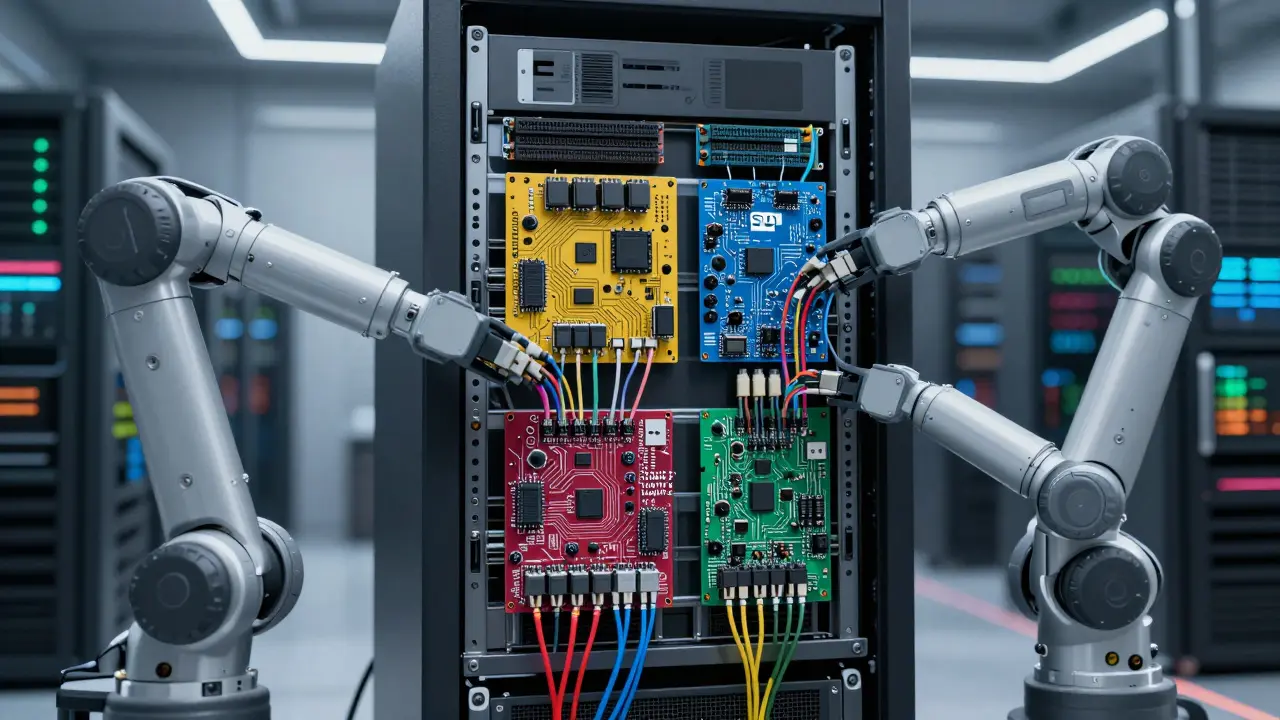
Imagine the original model weights as a huge, frozen iceberg. LoRA adds small, movable blocks on top. During training, you only move these blocks. When you’re done, you save just the blocks (which might be 50MB instead of 140GB). At inference, you merge them back or keep them separate.
| Method | Compute Cost | Inference Speed | Best Use Case |
|---|---|---|---|
| Prompting | None | Slower (longer context) | General tasks, simple formatting |
| LoRA Adapters | Low | Fast (negligible overhead) | Domain specialization, style transfer |
| Full Fine-Tuning | Very High | Standard | Fundamental capability changes |
Why do adapters win so often? They prevent catastrophic forgetting. When you fully fine-tune a model on medical data, it might become worse at writing poetry because it overwrites its general language understanding. Adapters isolate the new knowledge, leaving the base model intact. You can also swap adapters instantly. One minute your bot is coding in Python; swap the adapter, and it’s debugging SQL, all using the same base model.
A newer variant, QLoRA, combines LoRA with 4-bit quantization. This allows you to fine-tune massive models on a single consumer-grade GPU (like an RTX 4090) by compressing the model weights during training. This has democratized access to high-end customization.
Path 3: Full Fine-Tuning
Full Fine-Tuning involves updating all parameters of the neural network during training. This is the nuclear option. You take the entire model architecture and run gradient descent on every single weight.
This approach is rarely needed for standard business tasks. However, it shines when you need to change the fundamental capabilities of the model. For example, if you are building a model specifically for legal contract analysis and want it to ignore non-legal text entirely, full fine-tuning helps embed that constraint deeply into the model’s structure.
The downsides are severe. You need significant VRAM (often multiple A100 GPUs), storage for the full checkpoint, and time. More importantly, managing versions becomes a nightmare. If you release a new base model version, you must re-fine-tune everything from scratch. With adapters, you just re-run the small adapter training job.
Alignment Techniques: Beyond Raw Accuracy
Once you have customized the model’s knowledge, you often need to align its behavior with human preferences. A model might give the correct answer but in a tone that is too aggressive, or it might refuse helpful requests due to overly strict safety filters.
Reinforcement Learning from Human Feedback (RLHF) was the standard for years. It involves training a reward model based on human ratings, then using Proximal Policy Optimization (PPO) to adjust the language model. PPO is complex, unstable, and computationally heavy.
A simpler, more robust alternative gaining traction is Direct Preference Optimization (DPO). DPO skips the separate reward model and policy optimization steps. It directly optimizes the language model’s likelihood of preferred outputs over rejected ones. It’s faster, easier to implement, and produces results comparable to RLHF. If you are doing any form of alignment today, DPO is the recommended starting point.
Decision Framework: Which Path Should You Take?
Don't guess. Use this checklist to decide:
- Is the knowledge static and factual? If yes, use Retrieval-Augmented Generation (RAG). Don't fine-tune for facts. RAG lets you update information instantly without retraining.
- Do you need a specific tone, format, or style? If yes, try Prompting first. If the model fails to adhere consistently, move to LoRA.
- Do you need the model to perform a complex reasoning task it wasn't trained for? If yes, use LoRA or QLoRA with a dataset of expert demonstrations.
- Do you need to change the model's fundamental safety or refusal boundaries? If yes, consider DPO or Full Fine-Tuning.
For 80% of use cases, the combination of RAG (for facts) and LoRA (for style/format/reasoning) provides the best balance of cost, performance, and maintainability. Full fine-tuning should remain a last resort for highly specialized, closed-domain systems where latency and absolute precision outweigh flexibility.
What is the difference between LoRA and QLoRA?
LoRA (Low-Rank Adaptation) freezes the base model and trains small adapter matrices. QLoRA extends this by quantizing the base model to 4-bit precision before training. This drastically reduces memory usage, allowing you to fine-tune large models on consumer hardware, though it may introduce slight quality degradation compared to full-precision LoRA.
Should I fine-tune my model or use RAG?
Use RAG (Retrieval-Augmented Generation) for factual knowledge that changes frequently, such as product manuals or news. Fine-tuning is better for stylistic tasks, complex reasoning patterns, or formats that require deep integration into the model's weights. Combining both is often the best strategy.
Does fine-tuning cause catastrophic forgetting?
Yes, full fine-tuning can cause catastrophic forgetting, where the model loses general abilities while learning specific tasks. Adapter methods like LoRA mitigate this by isolating new knowledge in separate modules, preserving the base model's original capabilities.
How much data do I need for LoRA fine-tuning?
LoRA is data-efficient. Depending on the complexity of the task, anywhere from 500 to 5,000 high-quality examples is often sufficient. Quality matters more than quantity; clean, diverse, and relevant datasets yield better results than large, noisy ones.
Is Direct Preference Optimization (DPO) better than RLHF?
DPO is generally preferred for its simplicity and stability. It eliminates the need for a separate reward model and the complex PPO algorithm used in RLHF. DPO achieves similar alignment results with lower computational overhead and fewer hyperparameters to tune.