Input Tokens vs Output Tokens: Why LLM Generation Costs More
 Mar, 3 2026
When you ask an AI like GPT-4o or Claude Sonnet a question, you’re not just getting an answer-you’re paying for every word it reads and every word it writes. And here’s the twist: the words it writes cost far more than the words it reads.
Most people assume the cost of using an LLM is about how long your prompt is. But in reality, the bigger expense isn’t what you send in-it’s what the model spits back out. If your chatbot gives long, detailed replies, you’re not just getting more value-you’re paying 4 to 8 times more per word than you did for the prompt you typed.
What Are Input and Output Tokens?
Think of tokens as the building blocks of language for AI. A token isn’t always a full word. Sometimes it’s a piece of a word, like "un-" or "-ing," or even punctuation. When you type a question, every word, symbol, and space gets broken into tokens. That’s your input. When the AI replies, every word it generates-every sentence, comma, and period-is counted as an output token.
For example, if you ask: "Explain quantum computing in simple terms," that’s about 7 input tokens. If the AI replies with a 150-word explanation, that could be 200+ output tokens. The model doesn’t just read your question-it builds a whole new text from scratch, word by word.
Why Output Tokens Cost So Much More
The reason output tokens cost more comes down to how the AI works under the hood.
When you send input, the AI processes all of it at once. It’s like reading a whole book in one go. The system runs one fast calculation across all the words you typed. Even if your prompt is 10,000 tokens long, it still only takes one pass.
But when the AI writes a response? It has to generate each token one at a time. For every new word, it looks at everything it’s written so far, predicts the next word, checks its internal logic, and only then moves on. That’s not a single pass-it’s hundreds or thousands of separate computations.
Each output token requires the AI to reload its entire context, keep track of every previous word, and run a full neural network inference. That uses way more GPU power, memory, and time. The longer the response, the more times this process repeats. It’s like typing an essay one letter at a time, with a 30-second pause between each letter.
How Much More Do Output Tokens Cost?
The pricing gap isn’t small-it’s massive. As of 2026, here’s what the big players charge:
- GPT-4o (OpenAI): $2.50 per million input tokens, $10.00 per million output tokens → 4× difference
- GPT-4o Mini: $0.15 per million input, $0.60 per million output → 4× difference
- GPT-5.2 Pro: $21.00 per million input, $168.00 per million output → 8× difference
- Claude Sonnet 4: $3.00 per million input, $15.00 per million output → 5× difference
- Claude Opus 4: $15.00 per million input, $75.00 per million output → 5× difference
Even the cheapest models follow this pattern. There’s no provider that charges output tokens at the same rate as input. The industry standard? At least 3×. Most hover around 4× to 5×. The most powerful models push it to 8×.

But Wait-Isn’t Input Usually Bigger?
You might think: "If output costs more per token, but input is longer, then input must cost more overall." And you’d be right-most of the time.
Real-world usage shows users typically send 3 to 10 times more input tokens than output tokens. Why? Because of context. System prompts, past chat history, uploaded documents, code snippets, and RAG (retrieval-augmented generation) data all pile up as input.
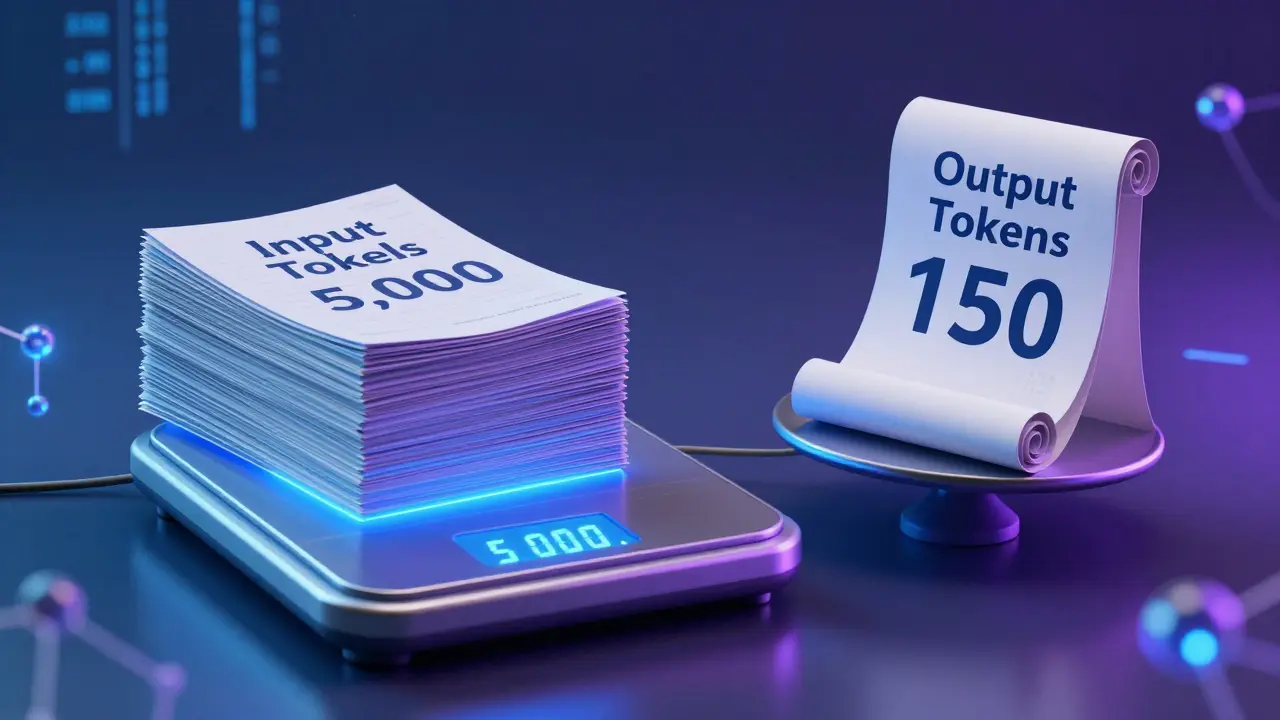
Imagine a customer service bot. You type: "My order #7892 didn’t arrive." The system pulls up your order history, shipping logs, policy documents, and past replies-all of which get tokenized. That’s 5,000 input tokens. The AI replies with: "Your package is delayed due to weather. New ETA: March 10." That’s 15 output tokens.
Even though output costs 4× more per token, the total bill here is still dominated by input. But if that reply was 500 tokens long-maybe with a full refund breakdown, apology, and offer for a discount-now output costs more than input.
So the real lesson? It’s not just about per-token cost. It’s about total token volume.
There’s a Third Layer: Reasoning Tokens
Here’s something most users don’t realize: the AI doesn’t just generate output. It thinks first.
When models use "chain-of-thought" reasoning-like breaking down a math problem or explaining why a code fix works-they generate internal tokens that never show up in the final reply. These are called reasoning tokens.
And guess what? They cost more than output tokens.
Some providers, like Anthropic and OpenAI, now charge for these hidden steps. A model might spend 300 reasoning tokens to solve a logic puzzle, then output 50 tokens of final answer. You pay for all 350. But the 300 reasoning tokens? They’re priced at 1.5× the output rate. So if output is $10/million, reasoning is $15/million.
This creates a three-tier cost structure:
- Input tokens: cheapest
- Output tokens: 3-8× more than input
- Reasoning tokens: 1.5× more than output
Long, detailed reasoning = exponentially higher bills.
How to Cut Your LLM Costs
If you’re using LLMs at scale, here’s how to avoid surprise bills:
- Shorten system prompts: "You are a helpful assistant" is fine. "You are a world-class legal expert with 20 years of experience in contract law, specializing in EU regulations..." is not. Every extra line adds input tokens.
- Trim conversation history: Don’t send 50 past messages every time. Keep only the last 3-5 exchanges.
- Force concise replies: Add "Answer in one paragraph" or "Use bullet points" to reduce output length.
- Avoid verbose reasoning: If you don’t need step-by-step logic, disable it. Many models default to "think step by step"-turn that off unless you’re debugging.
- Use caching: DeepSeek and others now cache repeated prompts. If you ask the same question twice, input tokens cost 10× less on a cache hit.
- Monitor token usage: Most APIs show token counts. Check them weekly. If output tokens are over 50% of total, you’re over-generating.
Is This Pricing Fair?
Some engineers argue that output tokens shouldn’t cost 4× more. The real hardware cost difference, they say, is closer to 2×. So why the gap?
It’s likely intentional. Providers use these multipliers to make pricing predictable. If you charged based on exact GPU usage, bills would vary wildly. A 10-word answer might cost 10 cents. A 1,000-word answer might cost $12. That’s confusing. A fixed 4× multiplier? Easy to budget for.
It’s also a behavioral nudge. If output was cheap, users would make every response 500 words long. By making output expensive, companies encourage efficiency-which keeps servers running smoothly.
What This Means for You
LLMs aren’t magic. They’re expensive machines. And every word they generate costs real money.
Whether you’re running a chatbot, automating reports, or building a research assistant, your biggest cost isn’t the prompt you wrote. It’s the answer the AI gave.
Stop treating AI like a free text generator. Start treating it like a high-performance server. Optimize what you send in. But more importantly-optimize what it sends back.
Shorter replies. Cleaner prompts. Less context clutter. Fewer reasoning steps. That’s how you cut costs-not by switching models, but by changing how you talk to them.
Why do output tokens cost more than input tokens?
Output tokens cost more because they require sequential processing. While input tokens are read in one fast pass, each output token must be generated one at a time, requiring a full model inference for every word. This uses far more GPU power, memory, and time, making output generation significantly more expensive to compute.
Is input or output more expensive in real-world usage?
It depends. While output tokens cost 3-8× more per token, input tokens are often 3-10× longer in real use due to system prompts, chat history, and context files. So in most cases, input drives the total cost-but if you get long AI replies, output can quickly become the bigger expense.
Do all AI providers charge the same way?
Yes, across all major providers in 2026-OpenAI, Anthropic, DeepSeek, Mistral, and others-the pattern is consistent: output tokens cost 3-8× more than input tokens. Even the cheapest models follow this ratio. Some, like DeepSeek, offer caching to reduce input costs, but output pricing remains unchanged.
What are reasoning tokens, and do they cost extra?
Reasoning tokens are internal steps the AI takes to think through a problem-like breaking down math or explaining logic-before generating a final reply. These tokens don’t appear in the output but are still charged. In 2026, most providers charge reasoning tokens at 1.5× the rate of output tokens, making long reasoning chains very expensive.
How can I reduce my LLM costs?
Shorten system prompts, limit chat history, force concise answers, disable "think step by step" unless needed, and use caching where available. Always check your token usage logs-many users overpay because they don’t realize how much output they’re generating.
Karl Fisher
March 4, 2026 AT 11:40Time to start saying ‘one sentence’ and mean it.
Buddy Faith
March 4, 2026 AT 18:08Scott Perlman
March 5, 2026 AT 16:57Now I just say ‘short answer’ and feel like a genius. Small changes, big savings. Keep it simple, folks.
Sandi Johnson
March 6, 2026 AT 22:52Also, ‘reasoning tokens’? So now we’re paying for its internal monologue? I didn’t even know it had one. Poor thing. It must be exhausted.
Eva Monhaut
March 8, 2026 AT 02:24I’ve started trimming my prompts, turning off step-by-step unless absolutely necessary, and honestly? My workflows are faster, cheaper, and more focused. It’s not about using less AI - it’s about using it better.
mark nine
March 8, 2026 AT 14:25Tony Smith
March 9, 2026 AT 11:52Therefore, one must exercise rigorous constraint upon the verbosity of one’s queries. For to ask for an essay is to ask for a soul to be born - and souls, as we know, are costly.
Rakesh Kumar
March 10, 2026 AT 05:34Now I just say ‘summary’ and save so much. My startup budget is smiling. And yes, I turned off ‘think step by step’ - no one needs to know how it got to the answer. Just give me the answer.