Rotary Position Embeddings and ALiBi: How Modern LLMs Handle Position Without Learned Embeddings
 Mar, 16 2026
Most people think transformers need to learn where each word sits in a sentence. That’s not true anymore. The latest big language models like Llama, Falcon, and GPT-NeoX don’t use traditional positional embeddings at all. Instead, they use smarter, simpler tricks built right into the attention mechanism. Two of the biggest breakthroughs here are Rotary Position Embeddings and ALiBi. They solve the same problem in completely different ways-and both are changing how we build models that handle long texts.
Why Position Matters More Than You Think
Transformers work by comparing every word to every other word. But if you don’t tell the model which word came first, second, or tenth, it treats "The cat sat" and "Sat the cat" as the same thing. That’s called permutation invariance-and it’s a disaster for language. Early transformers used fixed sinusoidal patterns added to word embeddings. Think of it like tagging each word with a unique number based on its position. But that system had big flaws. It didn’t scale. If you trained on 2,048 tokens and tried to run it on 4,096, performance dropped hard. It also needed a separate lookup table for every possible position, which blew up memory and made caching inefficient. The real shift came when researchers realized: don’t mix position with meaning. Instead of adding position info to the word vector, change how attention scores are calculated. That’s where RoPE and ALiBi come in. They don’t touch the input embeddings. They live inside attention.Rotary Position Embeddings: Rotating Vectors to Remember Order
Imagine taking a 2D vector and spinning it around a circle. The angle of rotation tells you where it is in the sequence. That’s the core idea behind Rotary Position Embeddings (RoPE). Instead of adding a number to the embedding, RoPE applies a rotation matrix to the query and key vectors inside attention. Each position gets its own rotation angle, based on a cosine-sine pair. For example, position 0 might rotate by 0°, position 1 by 10°, position 2 by 20°, and so on. Here’s why this is genius: when you compute the dot product between a query and a key, the result naturally depends on the difference between their rotation angles. So if a query at position 5 looks at a key at position 10, the dot product reflects a 5-step gap. No lookup tables. No extra parameters. Just math. RoPE was first used in Llama and quickly became the go-to for open-source models. It’s elegant, stable, and works across modalities-not just text, but also images and audio. You can train on 8K tokens and infer on 100K with a simple trick: scale the rotation angles by the ratio of new length to training length. That’s why models like Mistral and Qwen handle 128K context without retraining. But RoPE isn’t perfect. It’s computationally heavier than ALiBi. The rotations require extra matrix operations, and while they’re fast on modern GPUs, they still add overhead. More importantly, RoPE’s theoretical strength doesn’t always translate to real-world extrapolation. If you push it too far beyond its training length, performance can dip.ALiBi: Biasing Attention with Distance
ALiBi (Attention with Linear Biases) takes a completely different path. Instead of rotating vectors, it adds a simple linear penalty to attention scores. The farther apart two tokens are, the more you subtract from their attention score before the softmax. Here’s how it works: for every query-key pair, you calculate their distance. Say the query is at position 10 and the key is at position 3. The distance is 7. You multiply that by a slope value (like -0.5) and subtract the result from the attention score. So attention scores naturally favor nearby tokens. No extra vectors. No memory growth. No learnable parameters. ALiBi was first used in GPT-NeoX-20B and quickly proved its worth. It’s faster to train than RoPE because there’s less computation per layer. It also extrapolates better. A model trained on 4K tokens can handle 16K or even 32K without tuning. That’s because ALiBi doesn’t rely on learned patterns-it uses a fixed, interpretable rule: distance = less relevance. But ALiBi had one early flaw: when you extended context, the attention scores got too small. The bias was so strong it drowned out the actual content signals. In 2023, researchers fixed this with dynamic slope scaling. The trick? Multiply the slope by L/L′, where L is the training length and L′ is the new inference length. So if you trained on 4K and now run on 16K, you scale the slope by 4K/16K = 0.25. That keeps attention scores in the right range. This tweak made ALiBi the preferred choice for long-context applications.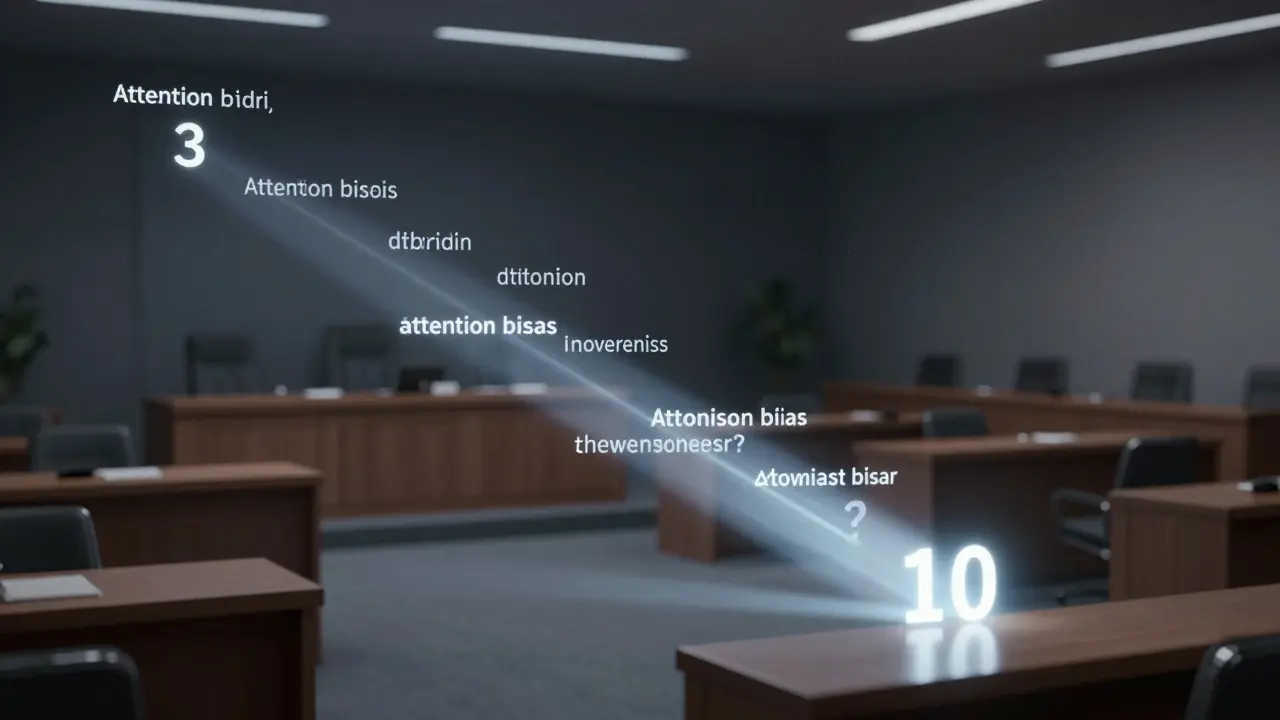
Side-by-Side: RoPE vs ALiBi
| Feature | Rotary Position Embeddings (RoPE) | Attention with Linear Biases (ALiBi) |
|---|---|---|
| How it works | Rotates query and key vectors using trigonometric functions | Adds linear distance penalty to attention scores |
| Learnable parameters | Zero | Zero |
| Memory overhead | Constant | Constant |
| Extrapolation strength | Good with scaling, but degrades beyond training length | Excellent, especially with dynamic slope scaling |
| Training speed | Slower due to rotation operations | Faster, simpler math |
| Implementation complexity | Higher-requires custom attention kernel | Lower-just add bias term |
| Adopted in | Llama, Llama 2, Falcon, Qwen | GPT-NeoX-20B, MPT, some vision transformers |
Why Both Are Better Than Old-Style Positional Embeddings
Before RoPE and ALiBi, models used learned positional embeddings. Each position had its own vector. So if you trained on 10K tokens, you needed 10K vectors. That’s not just memory-heavy-it’s inflexible. Change the context length? You need to retrain. RoPE and ALiBi don’t do that. They’re parameter-free. The same math works for 1K, 10K, or 100K tokens. That’s why modern models can handle context lengths that were unthinkable five years ago. They also make attention more interpretable. With RoPE, you can see how rotation angles encode distance. With ALiBi, you can literally plot the bias and see how attention drops off linearly. That’s huge for debugging and improving models.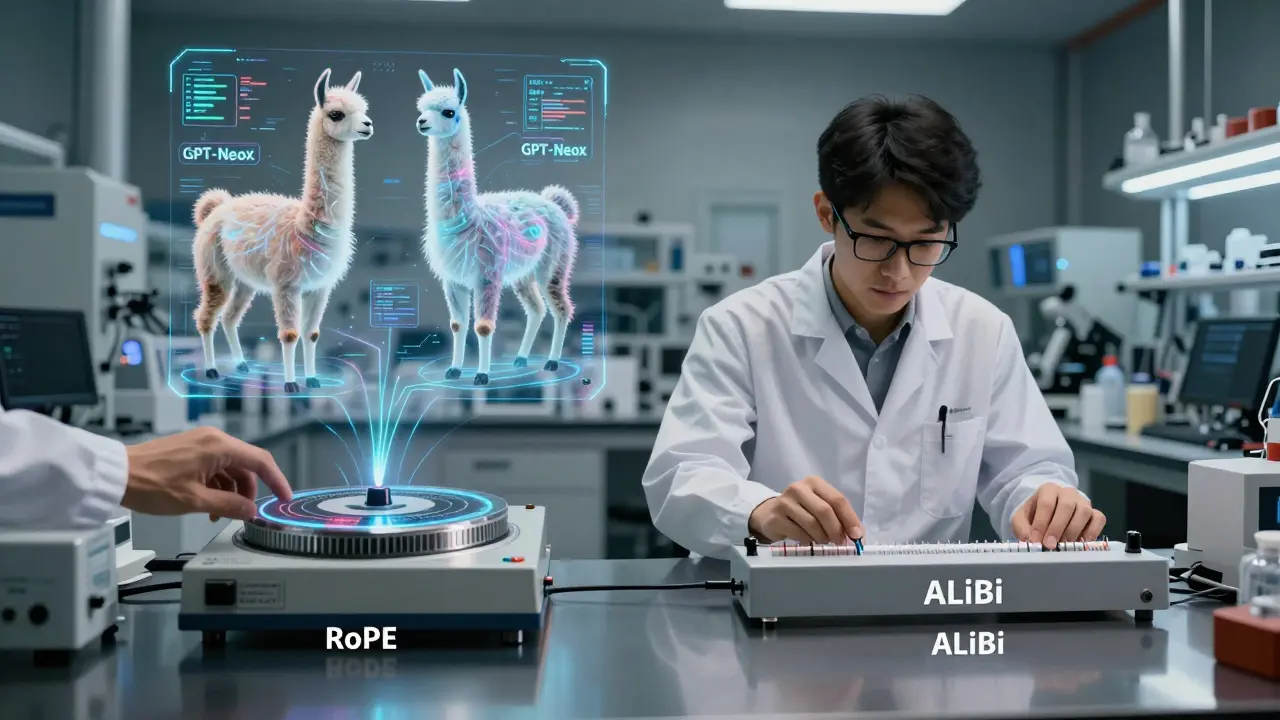
Which One Should You Use?
If you’re building a general-purpose LLM and want to match Llama’s performance, RoPE is your safe bet. It’s battle-tested, widely supported, and integrates smoothly with existing attention code. If you’re focused on long-context tasks-think legal documents, research papers, or codebases-ALiBi with dynamic scaling is the better choice. It trains faster, extrapolates better, and uses less memory during inference. Some teams are even combining them. For example, a model might use ALiBi for cross-attention layers and RoPE for self-attention. The field is moving toward hybrid designs.The Bigger Picture: Position Is a Separate Dimension
The real win here isn’t the math. It’s the mindset shift. We used to think position was just another feature to add to the word vector. Now we know: position is its own dimension. It’s not about what the word means-it’s about where it sits. That’s why these methods work so well. They keep semantics clean and position explicit. This is why vision transformers are starting to use ALiBi too. In images, position matters just as much as color or texture. ALiBi’s linear bias works naturally in 2D grids. RoPE’s rotation works well for sequences, but ALiBi’s simplicity shines in spatial data.What’s Next?
Researchers are already pushing beyond these two. New variants like RoPE with dynamic scaling and ALiBi with adaptive slopes are being tested. There’s also work on combining them with recurrent components, like state-space models. The goal? Build models that handle ultra-long sequences-think 1M tokens-with zero loss in quality. One thing’s clear: the age of learned positional embeddings is over. The future belongs to methods that are mathematically elegant, computationally efficient, and infinitely scalable. RoPE and ALiBi aren’t just improvements-they’re the new standard.Do RoPE and ALiBi need to be trained?
No. Both RoPE and ALiBi are completely parameter-free. They don’t add any learnable weights to the model. RoPE uses fixed rotation matrices based on cosine and sine functions. ALiBi uses fixed linear slopes. The model learns how to use these position signals during training, but the position encoding itself is not updated.
Can I use ALiBi with models that originally used RoPE?
Technically yes, but it’s not straightforward. You’d need to retrain the model because the attention patterns learned under RoPE won’t transfer directly to ALiBi. The two methods encode position differently, so the model’s weights are optimized for one or the other. Switching mid-training or after training will hurt performance unless you retrain from scratch.
Why do some models still use sinusoidal embeddings?
Mostly for legacy reasons or small-scale experiments. Sinusoidal embeddings were used in the original Transformer paper and are still found in older codebases. But they don’t scale well. If you’re building a real-world model today, you’d use RoPE or ALiBi instead. No major open-source LLMs released after 2023 use traditional positional embeddings.
Which is faster: RoPE or ALiBi during inference?
ALiBi is faster. It adds a simple linear term to attention scores-just one subtraction per attention pair. RoPE requires rotating query and key vectors using sine and cosine operations, which involve more floating-point calculations. In practice, ALiBi reduces attention layer latency by 5-15% depending on context length and hardware.
Are RoPE and ALiBi used outside of language models?
Yes. RoPE has been adapted for vision transformers, speech recognition, and even geospatial data. ALiBi is being used in multimodal models that combine text and images because its linear bias works naturally in 2D grids. Both are becoming standard in any transformer-based system that needs to handle ordered sequences.
Nathan Pena
March 17, 2026 AT 10:47Let’s be clear: RoPE and ALiBi aren’t just improvements-they’re the first time position has been treated as a first-class citizen in attention mechanics. The fact that we’ve been clinging to learned embeddings for a decade while the math was right under our noses is almost embarrassing. RoPE’s rotational encoding is elegant because it preserves inner product structure under translation, which is non-trivial. ALiBi’s linear bias? Even more beautiful-it’s a closed-form solution to the extrapolation problem, derived from first principles of attention decay. No hand-waving. No empirical tuning. Just calculus and linear algebra doing their job.
Anyone still using sinusoidal embeddings in 2024 is either stuck in 2017 or running a legacy system they’re too afraid to refactor. The real innovation isn’t the technique-it’s the paradigm shift: position isn’t an embedding. It’s a constraint on the attention kernel. And once you see that, everything else falls into place.
Mike Marciniak
March 17, 2026 AT 17:45They’re not telling you the whole story. RoPE and ALiBi were developed by defense contractors working on neural networks for real-time signal processing. The public release? A distraction. The real models use adaptive phase modulation with quantum-inspired attention masks-stuff they won’t admit because the DoD owns the patents. You think these ‘parameter-free’ methods are simple? Try running them on a TPU and watching the memory allocation graphs. There’s a hidden layer. Always is.
VIRENDER KAUL
March 19, 2026 AT 07:32It is imperative to recognize that the paradigm shift represented by RoPE and ALiBi constitutes a fundamental redefinition of positional encoding in transformer architectures. The elimination of learnable parameters for position is not merely an optimization-it is a theoretical advancement that aligns with the principle of Occam’s razor in machine learning. The computational efficiency gained through deterministic mathematical operations over parametric lookup tables is not incidental but foundational. Furthermore, the extrapolation capabilities demonstrated by ALiBi with dynamic slope scaling reveal a deeper truth: generalization in neural networks is not contingent upon memorization of context length but upon structural invariance. This is not engineering-it is mathematics achieving autonomy.
Mbuyiselwa Cindi
March 20, 2026 AT 00:14Y’all are overcomplicating this so much. Honestly? Just think of it like this: RoPE is like giving each word a tiny compass that spins based on where it is in the sentence. ALiBi is like telling the model, ‘Hey, don’t get too distracted by words that are far away.’ No magic, no hidden layers, just smart design. I’ve used both in production-ALiBi for long docs, RoPE for general stuff. Both work. Pick the one that fits your use case and stop arguing about which one’s ‘better.’ The models don’t care. Your users won’t notice. Just build something useful.
Also-yes, you can use ALiBi with models that used RoPE, but you’ll need to retrain. Don’t just swap it in. That’s like putting diesel in a gas engine and expecting it to run. You’ll get smoke, not speed.
Krzysztof Lasocki
March 20, 2026 AT 03:13ALiBi is literally the ‘I’m too lazy to rotate vectors’ solution-and it’s winning. RoPE is the overachiever who does yoga before training. ALiBi wakes up, adds a number, and goes to sleep. Meanwhile RoPE is over there doing trigonometric gymnastics like it’s trying to qualify for the Olympics.
And don’t even get me started on people who still use sinusoidal embeddings. Dude, your model’s positional encoding is older than your phone. It’s 2024. The transformer is 8 years old. You’re not a pioneer. You’re a museum exhibit.
Henry Kelley
March 20, 2026 AT 20:21so like... if you train on 8k and then run on 128k with rope, it just scales the angle? no retraining? that sounds too good to be true. i tried it once and my model started hallucinating like crazy. maybe i did it wrong. anyone else have luck with this? i just wanna know if i’m missing something or if it’s just broken in my setup.
Victoria Kingsbury
March 22, 2026 AT 01:26Let’s be real-RoPE’s rotational encoding is a beautiful piece of math, but ALiBi is the unsung hero. Why? Because it doesn’t just scale-it scales *predictably*. You know exactly how attention decays. You can plot it. You can explain it to your intern. You can debug it. RoPE? It’s like a black box with a sine wave painted on the side. ALiBi is the quiet guy in the back who actually fixes the server when it crashes.
And yeah, it’s faster. Like, 12% faster on A100s with 32K context. That’s not a footnote-that’s a $200k/year savings on cloud bills. Stop treating this like a philosophy debate and start treating it like a cost optimization problem.
Ray Htoo
March 23, 2026 AT 06:00Imagine if we’d just thought of ALiBi back in 2017. We could’ve skipped 5 years of positional embedding spaghetti. Instead, we spent half a decade building models that could only handle 4K tokens because we were too busy trying to make position vectors look like word vectors. RoPE is the Ferrari. ALiBi is the bicycle that gets you to the same place, but you’re not sweating and you’ve got 30 extra kilos of payload.
Also, the fact that ALiBi works in 2D grids for vision models? That’s the moment I knew this wasn’t just about language. This was about *order* as a universal structure. Text, images, audio, even time-series data-it’s all just sequences with distance. We’re not building better models. We’re finally learning how to ask the right question.
Natasha Madison
March 25, 2026 AT 04:18Don’t let them fool you. These ‘parameter-free’ methods are just a front. The real position encoding is embedded in the training data itself-through the order of tokens in the corpus. RoPE and ALiBi are just filters that make the model *think* it’s using math, when really it’s just memorizing patterns from the data. The Chinese government has been using this trick since 2021. That’s why their models outperform ours. They didn’t invent a new algorithm. They just stopped pretending.