Secure Branch Protection for Vibe-Coded Repositories: A 2026 Guide
 Apr, 10 2026
Vibe coding is changing how we build software. Instead of meticulously typing every line, we're using conversational prompts to let AI agents handle the heavy lifting. But here's the catch: when you "vibe" your way to a feature, you're essentially inviting a highly confident but occasionally hallucinating partner into your codebase. AI can accidentally delete a critical auth check or suggest a library that doesn't actually exist-only for an attacker to create a malicious package with that exact name. This is where branch protection is a set of automated guardrails and mandatory checks that prevent unverified or insecure code from merging into the main production branch. If you're relying on AI to generate your logic, you can't rely on "vibes" for your security.
The Risks of Vibe Coding
When AI writes your code, it doesn't always follow security best practices. We've seen a rise in "hallucinated bypasses," where the AI simply forgets to include a security middleware or removes a validation step to make the code "work" faster. Even worse is package hallucination. An AI might suggest an npm package that sounds perfect, but it's fake. Attackers monitor these hallucinations and publish malicious packages with those names-a classic typosquatting move that can lead to a full system compromise.
Beyond that, AI loves defaults. If you ask it to set up a database, it will almost always give you the most permissive settings possible. This leads to the "Lovable and Tea" style disasters, where database configurations ship without any actual access controls, leaving your data wide open to anyone with a URL.
Essential Scanning Pillars for AI Repositories
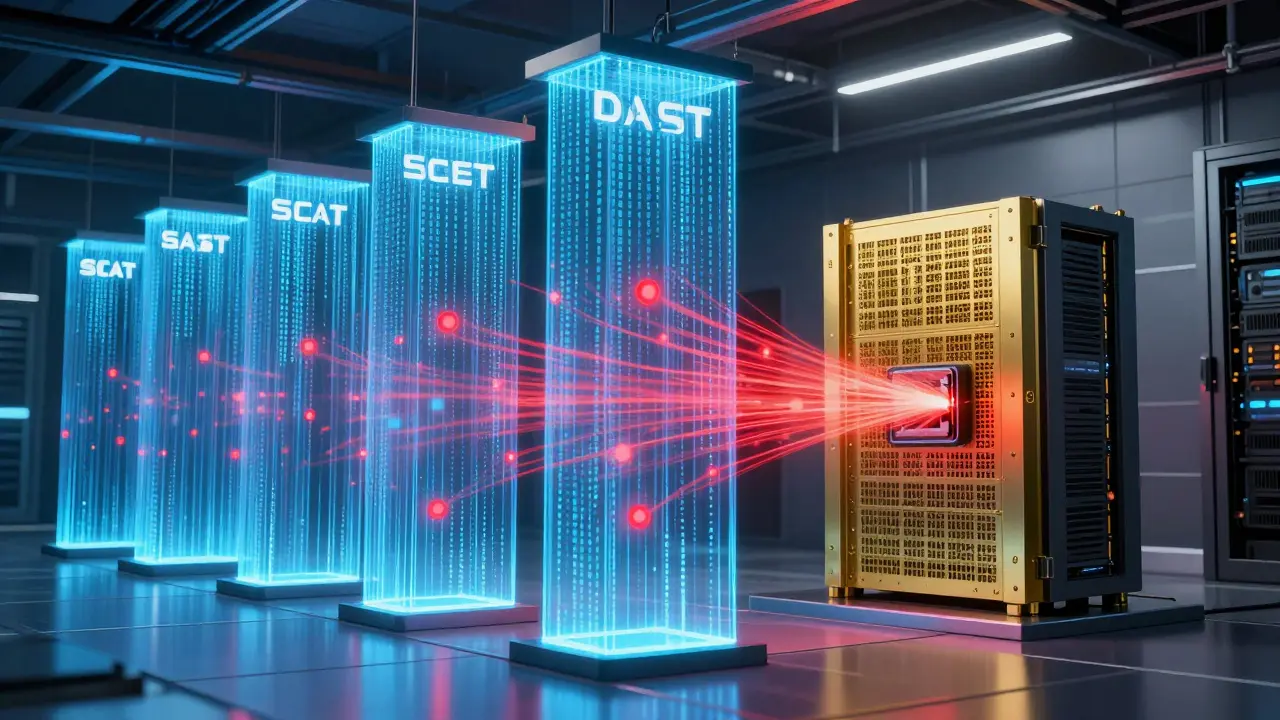
To stop these issues, your branch protection needs to move beyond a simple "one approved review" rule. You need a multi-stage scanning pipeline that treats AI-generated code as untrusted third-party input. Every pull request should trigger four specific types of scans before a human even looks at it.
| Scan Type | What it Catches | Recommended Tools |
|---|---|---|
| SAST | SQL injection, XSS, insecure crypto | Semgrep, CodeQL, Snyk Code |
| SCA | Vulnerable dependencies, fake packages | Snyk, Trivy, npm audit |
| Secrets Scanning | API keys, tokens, passwords | Gitleaks, GitGuardian |
| DAST | Runtime bypasses, CORS issues | OWASP ZAP, Burp Suite |
Stopping the Supply Chain Attack
Supply chain security is where vibe coding gets dangerous. Because AI agents often install packages and connect to MCP servers (Model Context Protocol) before you even see the code, the infection can happen in the IDE. A smart strategy is implementing cooldown policies. This means blocking any newly published npm package versions for a few days. Most supply chain attacks are caught by the community shortly after release; waiting a bit prevents you from being "patient zero."
You should also enforce strict version pinning. If the AI suggests "some-cool-lib": "^1.0.0", your branch protection should flag it. Forcing exact versions ensures that what was tested in the PR is exactly what gets deployed, preventing the "it worked on my machine" vibe from introducing a vulnerability in production.
Hardening the Infrastructure
Since AI often forgets the "boring" parts of security, your branch protection must mandate specific headers and configurations. For example, if you're using Express, your CI should check for the implementation of helmet.js. You want to see a Strict-Transport-Security max-age of at least 31536000 seconds and a Content-Security-Policy set to default-src 'self'.
On the database side, don't trust the AI's schema. Enforce Row Level Security (RLS) on every table. The rule should be simple: users can only read or write their own data. If the AI tries to merge a migration that creates a table without an explicit access policy, the merge should be blocked automatically. Never let a service role key be exposed to the client-side code-a mistake AI makes surprisingly often.
Permission Architecture and Least Privilege
AI assistants tend to ask for AdministratorAccess or *:* permissions because it's the path of least resistance to make the code work. Your governance model must fight this. Implement IAM roles with the narrowest possible scope. Each service should have its own identity. If a vibe-coded function only needs to upload a file, it shouldn't have permission to delete a bucket.
For application-level access, ensure that default user roles are set to the absolute minimum. Any escalation of privilege should be explicit and documented. If you're using HashiCorp Vault, integrate it into your pipeline so that secrets are never stored in the source control, even in a private branch. Use tools that redact sensitive values from logs so a failed AI-generated build doesn't leak your production keys into the CI logs.

The Human-AI Review Loop
Automation is great, but you still need a human in the loop. The best approach for vibe coding is a two-stage prompting process combined with a mandatory peer review. First, let the AI build the feature logic. Second, ask the AI to act as a "security engineer" to review its own work for path traversal and remote code execution risks.
However, don't trust the AI's self-review. The human reviewer should focus specifically on the delta between the AI's logic and the security requirements. Use a checklist that covers authentication, input validation, and error handling. If the AI replaced a complex validation function with a simple true to bypass a bug, that's a red flag that only a human eye (or a very strict SAST rule) will catch.
What exactly is vibe coding?
Vibe coding is a development style where the programmer describes the desired behavior of an application in natural language to an AI assistant, which then generates the bulk of the code. The focus shifts from writing syntax to guiding the "vibe" or intent of the software.
Why isn't a standard code review enough?
AI can generate hundreds of lines of code in seconds. Humans are prone to "review fatigue" and may overlook a missing security check or a subtly misspelled package name that looks correct at a glance. Automated branch protection provides a consistent safety net that doesn't get tired.
How do I prevent AI from adding fake packages?
Use Software Composition Analysis (SCA) tools like Snyk or Trivy in your branch protection rules. Additionally, implement a cooldown policy that blocks the merge of any package version published within the last 24-72 hours to avoid fresh supply chain attacks.
What is a "hallucinated bypass"?
This occurs when an AI, while trying to fix a bug or optimize a flow, accidentally deletes or comments out a security check, such as an authentication middleware or an authorization check, effectively creating a backdoor in the application.
Which tools are best for securing AI-generated PRs?
A combination of Semgrep for SAST, Gitleaks for secrets, and a tool like the Kusari Inspector for transitive dependency and typosquatting checks provides a comprehensive defense layer.
Next Steps for Your Team
If you're already using AI assistants in your workflow, start by auditing your current branch protection rules. If you only have "Require a pull request before merging," you're exposed. Add a SAST tool like Semgrep to your GitHub Actions or GitLab CI first. Then, move toward dependency pinning and secret redaction. For those in high-security environments, consider implementing an egress policy that blocks unauthorized outbound traffic from your CI/CD runners, ensuring that AI-generated code can't exfiltrate your environment variables to a remote server.
rahul shrimali
April 11, 2026 AT 22:15Spot on! Need these guardrails now let's get it done
Eka Prabha
April 13, 2026 AT 19:33The systemic reliance on these LLM-driven abstractions is a facade for a deeper architectural erosion. While the author pushes for SAST and DAST as a panacea, we must consider if this is merely a heuristic obfuscation designed by corporate entities to accelerate the deprecation of human cognitive oversight. The socio-technical implications of "vibe coding" are clearly aligned with a surveillance-capitalism model where the developer is reduced to a prompt-engineer, losing the granular epistemological understanding of the compiled binary. It is frankly an ethical catastrophe to suggest that a few Gitleaks scans can mitigate the ontological risk of an AI that is fundamentally designed to simulate truth rather than provide it.
Bharat Patel
April 14, 2026 AT 20:00It is interesting how we are redefining the act of creation. We used to be the architects, and now we are becoming the curators of intent. This shift from syntax to semantics is quite a journey for the human mind, isn't it?
Bhagyashri Zokarkar
April 15, 2026 AT 15:59omg i just tried to do this and it took like four hours because my ai just kept loopsing and i felt so drained just staring at the screen and then i realized i forgot a comma and the whole thing broke and i just wanted to cry because why is technology so hard when it is supposed to be easy and i feel like i am just a ghost in the machine lol
Rakesh Dorwal
April 17, 2026 AT 08:54The tools mentioned like Snyk and Semgrep are mostly Western-owned and we should be very careful about where our proprietary logic is being scanned. I bet there is a hidden agenda to collect our code patterns to train their next big model and sell it back to us as a service while we lose our digital sovereignty. We need a sovereign AI stack that doesn't leak our national intellectual property to some server in California.
Vishal Gaur
April 17, 2026 AT 23:38I dont know man this all sounds like a lot of work for something that is supposed to make our lifes easier lol like i just want to prompt something and have it work without setting up like five diffrent pipelins and checking if my hiddren headers are correct because honestly who even has the time for that when the AI is doing the heavy lifting anyway right?
Nikhil Gavhane
April 19, 2026 AT 02:02It is really heartening to see a guide that focuses on safety. Many developers are feeling overwhelmed by the pace of AI, so having a clear checklist like this helps everyone feel more confident in their work.