Transfer Learning in NLP: How Pretraining Enabled Large Language Model Breakthroughs
 Mar, 15 2026
Before 2018, training an NLP model for a specific task like sentiment analysis or question answering meant starting from scratch. You needed thousands of labeled examples, weeks of training time, and powerful hardware. Then came something that changed everything: transfer learning. Instead of building models from zero, researchers started using models that had already learned the deep patterns of human language from billions of words. This wasn’t just an improvement-it was a revolution.
How Transfer Learning Changed NLP Forever
Transfer learning in NLP means reusing knowledge from one task to help with another. Think of it like learning to drive a car, then using that experience to learn how to ride a motorcycle. You don’t start from zero-you already know how to steer, brake, and read road signs. In NLP, the "car" is a model trained on massive amounts of text-books, articles, websites, forums. The "motorcycle" is your specific job: summarizing news, answering customer questions, tagging names in a document.
This approach flipped the old way of doing things. Before, you trained one model for one task. Now, you train one model once-on everything-and then tweak it slightly for any task you need. That’s the power of pretraining.
The Rise of Pretrained Models: BERT, GPT-3, and Beyond
The breakthrough didn’t come from a single idea. It came from a chain of models, each pushing the boundaries further.
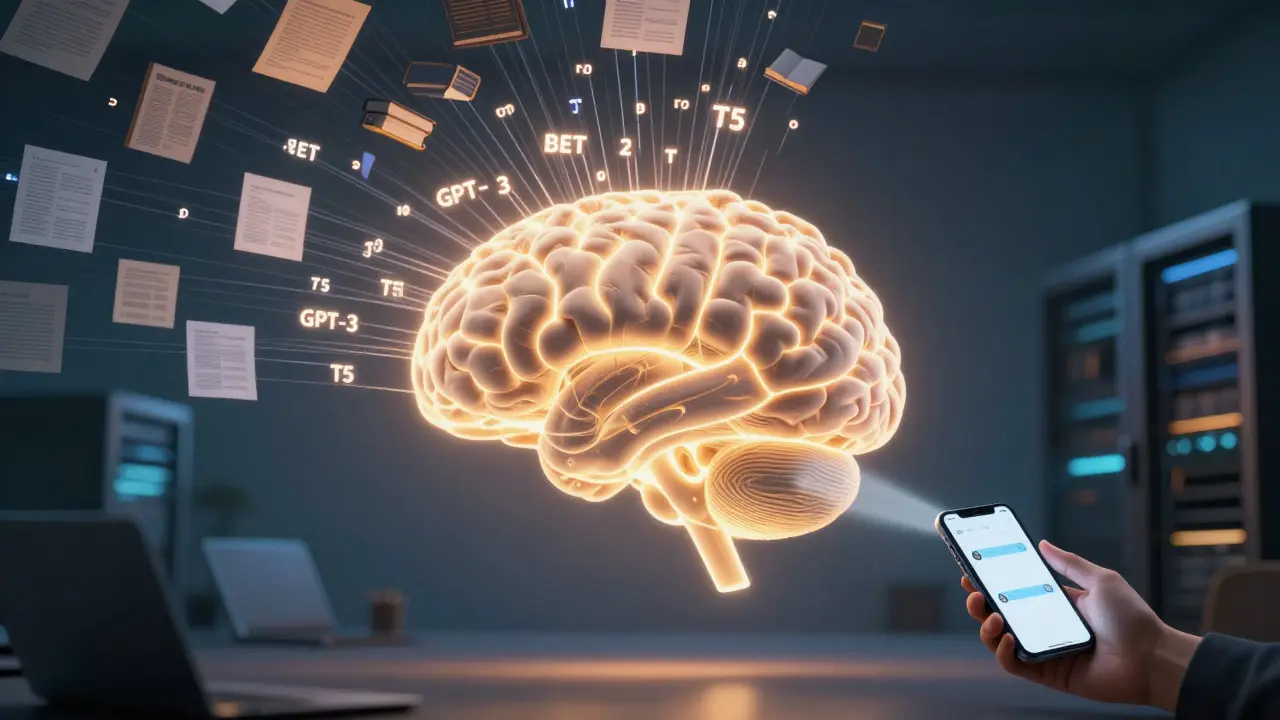
BERT is a bidirectional transformer model developed by Google in 2018 that revolutionized NLP by understanding context from both sides of a word simultaneously. It was trained using two clever tricks: Masked Language Modeling (MLM), where it guesses missing words in a sentence, and Next Sentence Prediction (NSP), where it decides if two sentences go together. This taught BERT not just vocabulary, but grammar, logic, and even implied meaning.
Then came GPT-3 from OpenAI. With 175 billion parameters, it wasn’t just bigger-it was smarter. GPT-3 didn’t need fine-tuning for most tasks. Just give it a prompt like "Translate this to French: ‘Hello, how are you?’" and it would respond correctly. That’s because its pretraining on internet-scale text gave it a general understanding of language so deep, it could mimic almost any NLP task without extra training.
T5 (Text-to-Text Transfer Transformer) took things further by making every task look the same: input text → output text. Summarization? "Summarize: [input]." Translation? "Translate to Spanish: [input]." Classification? "Is this positive or negative? [review]." This unified approach made it easier to train, test, and deploy models across dozens of tasks using the same architecture.
XLNet improved context understanding by predicting words in random order, avoiding the left-to-right bias of earlier models. ALBERT made models smaller and faster by sharing weights across layers, cutting memory use by 80% without losing accuracy.
The Two-Stage Process: Pretraining and Fine-Tuning
Every modern NLP model follows two clear steps.
Step 1: Pretraining-This is where the model learns the language. It reads massive datasets: Wikipedia, Common Crawl, books, Reddit threads. It doesn’t know what the data is about. It just learns patterns: how words connect, how questions are structured, how tone changes between paragraphs. This stage uses unsupervised learning, meaning no labels are needed. The model learns by predicting what comes next, or what’s missing.
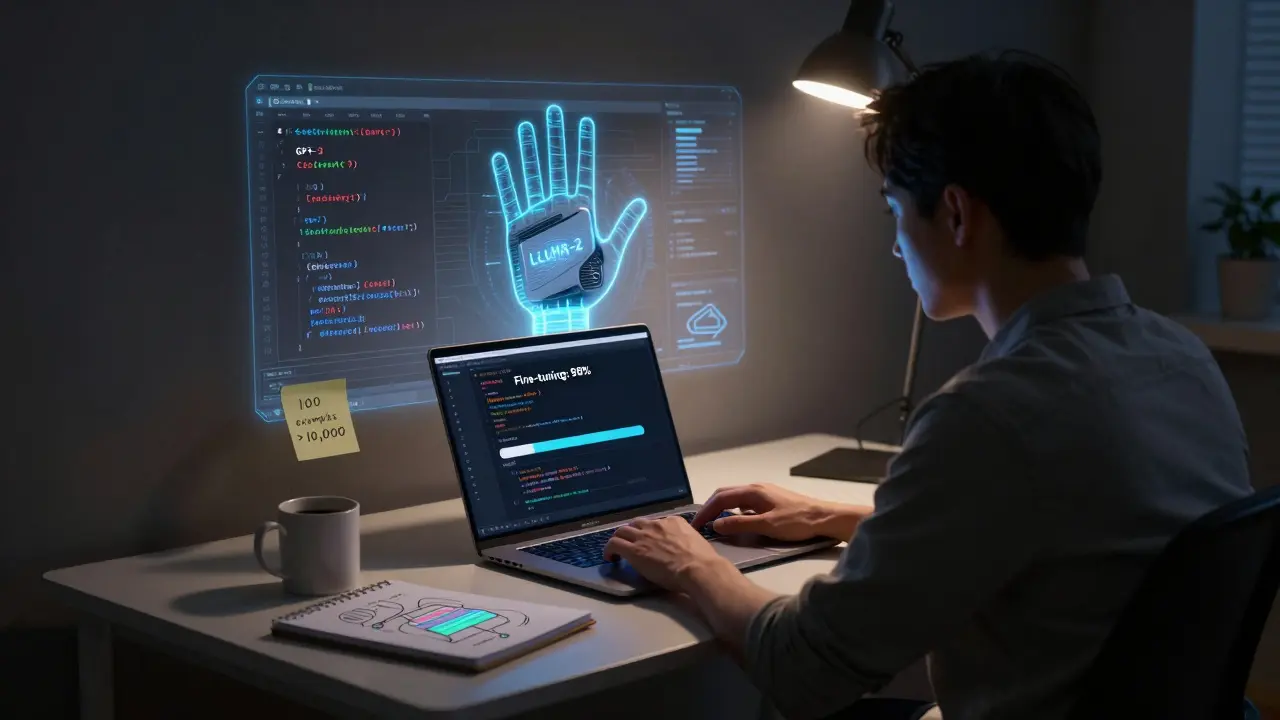
Step 2: Fine-tuning-Now you take that pretrained model and adjust it for your task. Say you want a chatbot that handles customer support. You take BERT or GPT-3 and train it on 500 labeled examples of customer questions and correct answers. You don’t retrain the whole model. You freeze most layers-keeping the deep language knowledge intact-and only adjust the last few layers to match your specific output. This takes hours, not weeks. And it works better than training from scratch with ten times more data.
Some models, like T5, skip fine-tuning entirely. They’re trained to treat every task as text-to-text, so they can handle new tasks just by changing the prompt. That’s called zero-shot or few-shot learning. It’s like handing someone a Swiss Army knife instead of a single tool.
Why Transfer Learning Is So Powerful
Here’s what transfer learning actually gives you:
- Less data needed-You can train a high-performing model with 100 examples instead of 10,000. That’s huge for niche domains like legal documents or medical records where labeled data is scarce.
- Faster training-Pretrained models shave weeks off development time. A startup can go from idea to working prototype in days.
- Better performance-On benchmarks like GLUE and SuperGLUE, models using transfer learning outperformed older methods by 15-30%. In real-world use, they understand sarcasm, ambiguity, and context far better.
- One model, many uses-The same base model can be fine-tuned for translation, summarization, classification, and chat-all without rebuilding anything.
Before transfer learning, only big tech companies could afford to train advanced models. Now, a researcher with a single GPU can fine-tune GPT-2 or LLaMA and build something that rivals what Google or Meta built years ago.
Real-World Applications
This isn’t theory. It’s in use everywhere:
- Customer service bots-Companies use fine-tuned models to answer FAQs, escalate complex issues, and reduce support costs by 40%.
- Medical text analysis-Models trained on PubMed papers help doctors extract diagnoses from clinical notes, even when terminology is inconsistent.
- Legal document review-Law firms use transfer learning to find relevant clauses in contracts, cutting review time from weeks to hours.
- Content summarization-News outlets and research platforms use models like T5 to auto-generate summaries of long articles.
- Sentiment analysis-Brands track public opinion on social media by fine-tuning models on product reviews and tweets.
These aren’t niche experiments. They’re production systems running at scale. Instagram uses BERT to understand comments. Amazon uses transformers to parse product questions. Even small businesses use APIs from Hugging Face to deploy models without owning a single GPU.
Challenges and Limits
It’s not perfect. Transfer learning has real downsides.
- Computational cost-Pretraining a model like GPT-3 cost millions. You don’t need to do that, but you still need strong hardware to fine-tune large models.
- Data bias-If the pretrained model learned from biased internet text, it will repeat those biases. A model trained on Reddit might think certain groups are associated with negative traits.
- Black box behavior-You don’t always know why a model made a decision. That’s dangerous in healthcare or finance.
- Overfitting on small datasets-If you fine-tune on too few examples, the model might memorize them instead of learning patterns.
Researchers are tackling these with techniques like data filtering, ethical audits, and parameter-efficient fine-tuning (PEFT), which tweaks just 1% of the model’s weights instead of all of them.
The Future: Smarter, Smaller, Faster
The next wave of transfer learning is about efficiency. Models like LLaMA-2 and Mistral are proving you don’t need 175 billion parameters to be powerful. Smaller models, trained on better data, can match or beat giants. Techniques like LoRA (Low-Rank Adaptation) let you customize models with under 100MB of extra data.
Soon, you’ll be able to download a 500MB model, fine-tune it on your company’s internal emails, and run it on a laptop. The barrier to entry is collapsing. Transfer learning isn’t just a technique anymore-it’s infrastructure. Like electricity. You don’t build power plants to charge your phone. You plug in.
What is the main advantage of transfer learning in NLP?
The main advantage is that transfer learning lets you build high-performing NLP models with far less data and computational power. Instead of training from scratch, you start with a model that already understands language deeply-trained on billions of words-and only adjust it slightly for your specific task. This cuts training time from weeks to hours and reduces the need for thousands of labeled examples.
Do I need to train my own model from scratch?
No, you almost never need to. There are hundreds of open-source pretrained models available-BERT, GPT-2, LLaMA, T5-that you can download and fine-tune for your use case. Even if you’re building a custom chatbot or sentiment analyzer, you start with these models and adapt them, not build them.
How much data do I need to fine-tune a model?
You can get strong results with as few as 100-500 labeled examples, especially if you’re using a large pretrained model. For very simple tasks like binary classification, 50 examples might be enough. This is a huge drop from the thousands or millions needed before transfer learning.
Can transfer learning work for low-resource languages?
Yes, but it depends. Models pretrained on multilingual datasets (like mBERT or XLM-R) already understand dozens of languages. You can fine-tune them on small datasets in languages like Swahili, Bengali, or Finnish. Performance improves significantly compared to training from scratch, though it’s still weaker than in high-resource languages like English.
What’s the difference between BERT and GPT-3?
BERT is bidirectional-it reads text from both left and right to understand context. It’s best for tasks like question answering or classification where understanding the full sentence matters. GPT-3 is autoregressive-it predicts the next word one at a time, like a very advanced autocomplete. It excels at generating text, like writing essays or chat responses. BERT needs fine-tuning for most tasks; GPT-3 often works with just a prompt.
Is transfer learning only for big companies?
No. Thanks to open-source models and cloud APIs, even small teams and individual developers can use transfer learning. Platforms like Hugging Face offer free access to models, tutorials, and fine-tuning tools. You don’t need a team of 50 engineers or a $1 million GPU cluster to build a powerful NLP system today.
Wilda Mcgee
March 15, 2026 AT 16:44Just wanted to say this post nailed it. I’ve been teaching NLP to undergrads for three years now, and transfer learning is the single biggest game-changer I’ve ever seen in the classroom. Before, students would hit a wall trying to gather enough labeled data. Now? They’re building functional chatbots in a weekend. I’ve even had students fine-tune LLaMA on regional dialects of English - stuff like Southern drawl or NYC slang - and the results were shockingly good. It’s not magic, but it feels like it.
Also, shoutout to Hugging Face. That platform alone has democratized this whole field. No more waiting for corporate lab access. Just click, download, tweak. Beautiful.
Rob D
March 17, 2026 AT 02:01LMAO you guys act like this was some genius breakthrough. We’ve been doing transfer learning in computer vision since 2012. CNNs on ImageNet? That’s the OG transfer hack. NLP just caught up because it took forever to get enough text data. And now everyone’s acting like BERT was carved in stone by the gods. Newsflash: it’s just better data + bigger GPUs. America’s tech bros love to turn engineering into religion.
Meanwhile, China’s been training multilingual models on their own data for years. You think GPT-3 was the first to understand context? Nah. They just didn’t blog about it.
Franklin Hooper
March 18, 2026 AT 06:04Pretraining. Fine-tuning. Two stages. Not three. Not four. Two. Please stop calling it a ‘revolution.’ It’s a technique. A well-executed one, yes. But not a paradigm shift. The term ‘transfer learning’ has been in use since the 1990s. What changed? Scale. Not philosophy. Also, ‘zero-shot’ is a misnomer. It’s few-shot with clever prompting. Don’t confuse marketing with mechanics.
Jess Ciro
March 19, 2026 AT 10:00They’re not telling you the whole story. Every pretrained model is trained on data scraped from the internet. That means Reddit, 4chan, Twitter, forums full of hate. So when your ‘ethical’ model starts saying racist things? It’s not a bug. It’s a feature. They knew. They just didn’t care. The ‘bias audits’? Jokes. They scrub the worst offenders and call it a day. Meanwhile, your job application bot is rejecting women because it learned that ‘nurse’ usually follows ‘she’ and ‘CEO’ follows ‘he.’
They’re not building intelligence. They’re building mirrors. And the mirror’s cracked.
saravana kumar
March 19, 2026 AT 17:26This post is overly enthusiastic. Yes, transfer learning reduces data needs. But let’s be real - in India, most companies still use rule-based systems because cloud APIs cost too much and internet speed is unreliable. Fine-tuning BERT on a 10GB dataset? On a 10 Mbps connection? Good luck. And don’t get me started on the lack of labeled data in Hindi or Tamil. We’re not in Silicon Valley. This isn’t a democratization. It’s a luxury.
Also, why is everyone ignoring computational carbon? Training GPT-3 emitted as much as five cars over their lifetime. Is that sustainable?
Mark Brantner
March 19, 2026 AT 20:50OMG I JUST FINE-TUNED A MODEL ON MY GRANDMA’S TEXT MESSAGES AND IT NOW GENERATES HER VOICE WHEN SHE’S ASLEEP 😭 IT’S LIKE A DIGITAL GHOST BUT ALSO A LITTLE SCARY??
also who else is using LoRA to turn GPT-2 into a sarcastic chatbot that roasts your ex? i’m in love. this is the future. send help. or coffee. preferably both.
Kate Tran
March 20, 2026 AT 10:47One thing people forget: transfer learning works best when you respect the model’s limits. I’ve seen too many teams shove a medical diagnosis task into a model pretrained on Reddit memes. It’s like using a race car to haul bricks. You need to match the tool to the task. Not every problem needs GPT-4. Sometimes a tiny fine-tuned DistilBERT is all you need - and way more ethical.
Also, open-source models aren’t just cheaper. They’re accountable. You can audit them. That’s priceless.
amber hopman
March 20, 2026 AT 17:51Love this breakdown. But I want to push back gently - the ‘one model, many uses’ thing? It’s true… but only if you’re careful. I worked on a project where a sentiment model trained on product reviews got repurposed for mental health chat logs. It started labeling trauma as ‘negative sentiment’ and auto-replied with ‘Thanks for sharing! Have a great day!’
Transfer learning doesn’t fix context. It just moves the problem downstream. We need guardrails. Not just code. Ethics. Human oversight. Always.
Jim Sonntag
March 22, 2026 AT 01:48Look, I get the hype. But let’s be real - this isn’t innovation. It’s recycling. We’ve been reusing knowledge since humans first taught kids to read by memorizing stories. What’s new is the scale. And the profit. Companies are monetizing public data scraped from forums, blogs, Wikipedia - then selling back access to it.
Meanwhile, the people who wrote that data? They never got paid. Not even a thank you. So yeah, it’s powerful. But it’s also kinda… colonial?
Deepak Sungra
March 23, 2026 AT 04:18Bro. You’re all missing the point. The real revolution? It’s not the models. It’s the fact that now a 17-year-old in Kerala can download LLaMA, tweak it with 200 examples of Tamil poetry, and post it on Hugging Face - and suddenly it’s being used by universities in Germany. That’s the real win.
Before, you needed a PhD, a lab, and a corporate sponsor. Now? You need a laptop, curiosity, and Wi-Fi. That’s not just tech. That’s liberation.
Also, I fine-tuned a model to write haikus about my cat. It’s better than my ex. And it doesn’t ghost me.