Cross-Attention in Encoder-Decoder Transformers: How LLMs Handle Conditioning
 Jun, 3 2026
Imagine trying to translate a complex legal contract from French to English without being able to look back at the original text. You’d have to memorize every single word and clause perfectly before starting your first sentence. If you forgot one detail halfway through, the whole translation falls apart. That is exactly what early neural network models had to do. They relied on a fixed memory vector-a bottleneck that limited how much context they could actually use.
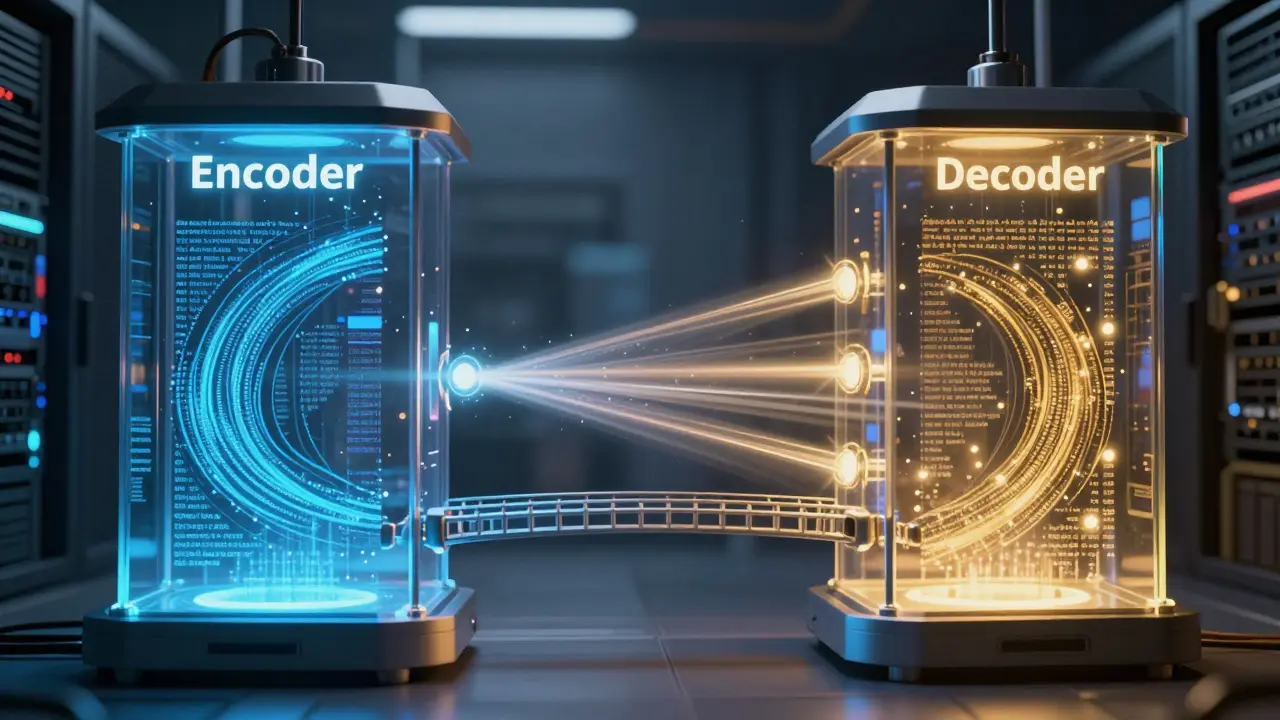
Then came the transformer architecture, and with it, a game-changer called cross-attention. This mechanism allows the decoder (the part of the model generating output) to constantly check back with the encoder (the part processing input). It’s not just about remembering; it’s about actively selecting which pieces of information matter most right now. For large language models (LLMs) and multimodal systems, this conditioning capability is the difference between generic guesses and precise, context-aware responses.
The Anatomy of Cross-Attention
To understand why cross-attention works so well, we need to look under the hood of the standard encoder-decoder transformer. The design, popularized by the seminal "Attention Is All You Need" paper, separates concerns into two main blocks: the encoder and the decoder. But they don’t work in isolation. They talk to each other via cross-attention layers located inside the decoder stack.
Here is how the data flows through a single decoder layer:
- Masked Self-Attention: First, the decoder looks at its own previous outputs. It asks, "What words have I already generated?" This ensures coherence within the target sequence but keeps it blind to the source input for a moment.
- Cross-Attention: Next, the decoder reaches out to the encoder. It uses queries from its current state to attend to keys and values derived from the encoder’s processed input. This is where the conditioning happens.
- Feed-Forward Network: Finally, the combined information passes through a position-wise feed-forward network to refine the representation.
This specific ordering is critical. If you swapped steps one and two, the decoder wouldn’t know its own context when pulling from the source. By doing self-attention first, the model knows what it has already said. Then, via cross-attention, it decides what new information from the source sequence is needed to generate the next token accurately.
Queries, Keys, and Values: The Mechanics
The magic of cross-attention lies in the mathematical interaction between three vectors: Queries ($Q$), Keys ($K$), and Values ($V$). In self-attention, all three come from the same sequence. In cross-attention, they are split across the encoder-decoder boundary.
Think of it like a library search system:
- Query ($Q$): Generated from the decoder state. This represents the question or the current need. For example, if the decoder is about to generate the word "cat," the query might be looking for features associated with small, furry animals.
- Keys ($K$) and Values ($V$): Generated from the encoder output. These represent the available information in the source text. The keys act as labels for each piece of information, while the values contain the actual content.
The model calculates the compatibility between the decoder’s query and the encoder’s keys using a dot product ($Q @ K^T$). This score tells the model how relevant a specific part of the source text is to the current decoding step. To prevent these scores from becoming too large (which causes numerical instability during training), the results are scaled by $1/\sqrt{d_k}$, where $d_k$ is the dimension of the key vectors.
After scaling, a softmax function converts these scores into probabilities. A high probability means the decoder should pay close attention to that specific encoder position. Finally, these probabilities weight the value vectors, aggregating the most relevant source information into the decoder’s current state.
| Feature | Self-Attention | Cross-Attention |
|---|---|---|
| Source of Q, K, V | All from the same sequence | Q from Decoder; K, V from Encoder |
| Primary Goal | Internal coherence and dependency modeling | Alignment between source and target sequences |
| Location | Both Encoder and Decoder layers | Decoder layers only |
| Masking | Causal mask (in decoder) to prevent seeing future tokens | Padding mask to ignore empty slots in source sequence |
| Use Case Example | Understanding subject-verb agreement in a sentence | Translating a specific noun phrase from French to English |

Why LLMs Need Conditioning
You might wonder why modern autoregressive LLMs (like GPT-4 or Llama 3), which are decoder-only, don’t always use this structure. The answer lies in the task. Decoder-only models rely entirely on self-attention because they treat the entire prompt as part of the input sequence. However, when you introduce external context-such as in Retrieval-Augmented Generation (RAG) or multimodal tasks-the need for explicit conditioning returns.
In traditional machine translation, cross-attention allows the decoder to align words dynamically. If the source sentence is long and complex, the decoder doesn’t need to compress everything into a single hidden state. Instead, it can look up specific parts of the encoder output as needed. This eliminates the "bottleneck" problem seen in earlier recurrent neural networks (RNNs).
For example, consider translating a sentence with multiple pronouns. Without cross-attention, the model might lose track of who "he" refers to by the end of the paragraph. With cross-attention, every time the decoder generates a pronoun, it can re-scan the encoder’s representation of the source text to find the correct antecedent. This dynamic lookup makes the translation robust even for very long documents.
Multimodal Applications: Beyond Text
Cross-attention isn’t limited to text-to-text tasks. It has become the backbone of multimodal AI systems, such as image captioning and visual question answering. In these architectures, an image encoder (like a Vision Transformer) processes the visual input, while a text decoder generates the description.
Here, the cross-attention mechanism bridges two completely different modalities. The text decoder generates queries based on the words it wants to say next (e.g., "red," "car"). It then attends to the keys and values produced by the image encoder. This allows the model to focus on specific regions of the image that correspond to the text concepts.
There are two common ways to implement this in multimodal setups:
- Concatenated Approach: Outputs from different encoders (e.g., text and image) are concatenated into a single sequence of key-value pairs. The decoder attends to them collectively. This is simpler but may blur the distinction between modalities.
- Separate Layers: Distinct cross-attention layers are used for each modality. This provides finer control, allowing the model to weigh visual information differently than textual context.
Libraries like Hugging Face Transformers support both approaches, making it easier for developers to experiment with multimodal conditioning. This flexibility is crucial for building assistants that can see, hear, and read simultaneously.

Handling Masks and Stability
Implementing cross-attention correctly requires careful handling of masks. In real-world data, sequences vary in length. We pad shorter sequences to match the longest one in a batch. If the decoder attends to these padding tokens, it will learn useless associations.
To prevent this, we apply an encoder padding mask. Before the softmax normalization, we set the attention scores corresponding to padding positions to a large negative number (effectively negative infinity). When softmax is applied, these scores become near-zero, ensuring the model ignores the padding entirely.
Numerical stability is another concern. As mentioned earlier, the scaling factor $1/\sqrt{d_k}$ is essential. Without it, the dot products between high-dimensional vectors can become extremely large. This pushes the softmax function into its saturated region, where gradients vanish. Vanishing gradients mean the model stops learning. Proper initialization of projection matrices ($W_Q$, $W_K$, $W_V$) also helps maintain appropriate variance throughout the network during training.
Efficiency Challenges and Future Directions
While powerful, cross-attention is computationally expensive. The complexity scales quadratically with the sequence length because every decoder position attends to every encoder position. For long documents or high-resolution images, this becomes a bottleneck.
Researchers are actively working on solutions. Sparse attention patterns limit the number of positions attended to, reducing compute costs. Linear attention approximations offer faster alternatives by reformulating the attention calculation. Additionally, efficient variants designed for long sequences are being integrated into modern frameworks.
As we move toward more complex AI agents, the ability to condition generation on diverse, dynamic sources of information will remain central. Cross-attention provides the architectural foundation for this capability, enabling models to stay grounded in their inputs rather than drifting into hallucination.
What is the main difference between self-attention and cross-attention?
Self-attention operates within a single sequence, allowing tokens to relate to each other internally. Cross-attention connects two different sequences, typically allowing a decoder to attend to an encoder's output. In cross-attention, queries come from the decoder, while keys and values come from the encoder.
Why is cross-attention important for machine translation?
Cross-attention enables the decoder to dynamically access relevant parts of the source sentence as it generates each target word. This avoids the bottleneck of compressing the entire source meaning into a fixed-size vector, leading to more accurate translations, especially for long or complex sentences.
How does cross-attention work in multimodal AI?
In multimodal systems, cross-attention bridges different data types, such as text and images. An image encoder produces visual features (keys/values), and a text decoder generates queries based on the words it wants to produce. This allows the model to align visual concepts with textual descriptions.
What role do masks play in cross-attention?
Masks ensure the model ignores irrelevant data. Padding masks prevent attention to empty slots added for batch alignment. Causal masks (in self-attention) prevent the decoder from seeing future tokens. In cross-attention, proper masking ensures the decoder only attends to valid source content.
Is cross-attention used in decoder-only LLMs like GPT?
Standard decoder-only LLMs primarily use self-attention because they process the prompt and response as a single continuous sequence. However, cross-attention principles are applied in hybrid architectures, such as Retrieval-Augmented Generation (RAG), where the model conditions on external retrieved documents.