Document Intelligence: How Multimodal AI Reads PDFs, Charts, and Tables
 Aug, 30 2026
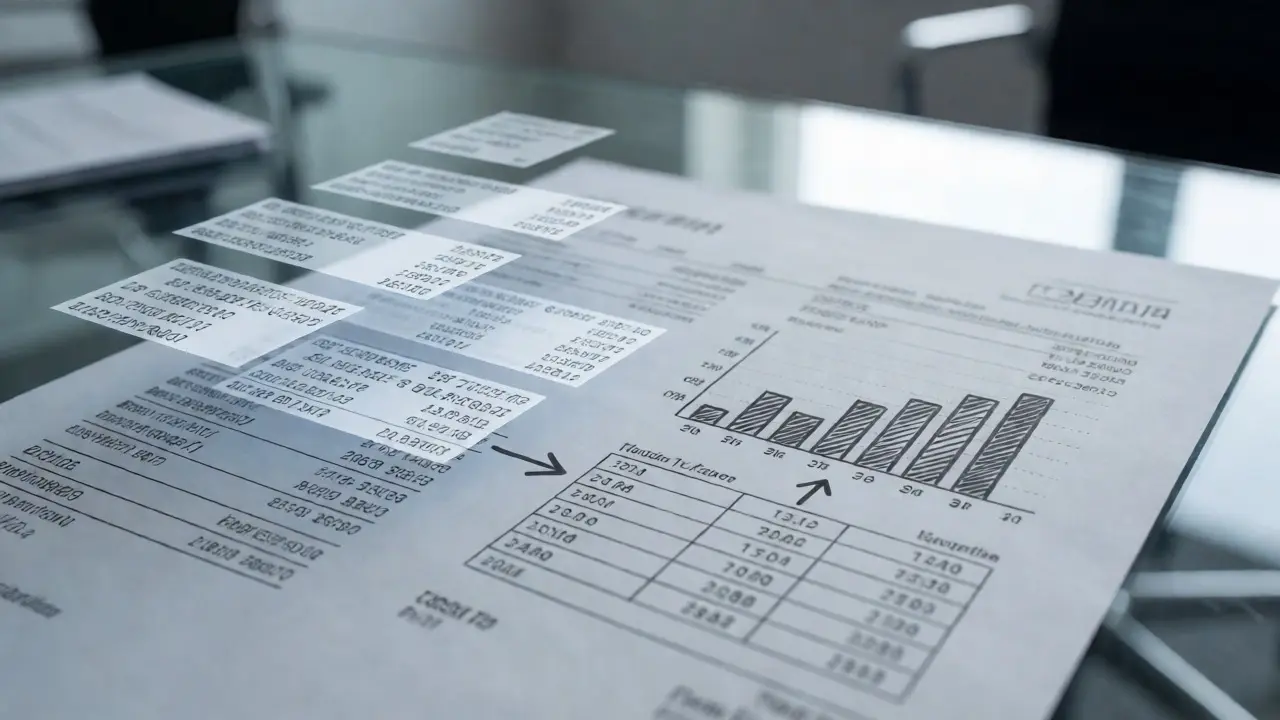
You know that feeling when you scan a complex invoice or a technical schematic, and the OCR spits out gibberish? The numbers are there, but they’re floating in space, disconnected from the labels next to them. You spend more time fixing the data than using it. This is where Document Intelligence powered by multimodal generative AI changes the game. It doesn’t just read text; it looks at the whole page like a human would, understanding how a chart relates to the paragraph above it or how a signature validates a contract clause.
Why Traditional OCR Fails on Complex Documents
For decades, we relied on Optical Character Recognition (OCR). It’s great for converting a clean, typed letter into editable text. But real-world documents aren’t clean. They have stamps, handwritten notes, embedded charts, and tables that span multiple columns. Traditional OCR treats these elements as separate islands. It might correctly extract the number "500" but fail to tell you if that’s a dollar amount, a quantity, or a date year. It lacks context.
Multimodal AI solves this by processing visual and textual data simultaneously. Instead of seeing pixels and characters separately, models like Google’s Gemini or Microsoft’s Azure Document Intelligence analyze the layout, the typography, and the semantic relationships between elements. If a number appears in bold within a table header, the AI understands its structural importance. If a hand-drawn arrow points from a diagram to a specific cell in a table, the AI captures that relationship. This contextual awareness is the key difference between extracting raw data and gaining actual insight.
The Three-Stage Architecture of Multimodal Processing
How does this magic actually work under the hood? It’s not just one big black box. Most robust systems follow a structured pipeline with three distinct stages. Understanding this helps you troubleshoot issues and set realistic expectations for accuracy.
- Input Processing: The system ingests the document and breaks it down. It uses specialized encoders for different modalities. For text, it might use an OCR engine tuned for high accuracy. For images and charts, it uses vision transformers. For tables, it employs layout-aware parsers that detect rows, columns, and merged cells. Crucially, this stage preserves the spatial coordinates of every element.
- Representation Fusion: This is where multimodal AI shines. The system creates a unified representation, often called an "information graph." In this graph, text nodes connect to image nodes and table nodes. If a paragraph mentions "Figure 1," the graph links that text node directly to the image node representing Figure 1. This fusion allows the model to reason across modalities. It can answer questions like, "What trend does the chart in Section 3 contradict?" because it knows which chart belongs to which section.
- Content Generation: Finally, the fused representation feeds into a Large Language Model (LLM). The LLM generates the output-whether it’s a JSON structure, a summary, or a direct answer to a user query. Because the input was richly contextualized, the output is far more accurate than if the LLM had only seen plain text.
Handling Charts and Visual Data
Charts are notoriously difficult for machines. A bar chart isn’t just an image; it’s a visual encoding of numerical data. Early attempts to process charts involved simple image classification, which told you "this is a bar chart" but didn’t tell you what the bars meant. Multimodal generative AI takes this further by combining visual recognition with data extraction.
Some advanced pipelines convert charts into intermediate representations, such as CSV files or JSON objects, before feeding them to the LLM. For example, if a document contains a line graph showing sales over five years, the system might first extract the axes labels and data points, reconstructing the underlying dataset. Then, the LLM analyzes this reconstructed data alongside the surrounding text. This approach prevents hallucinations. If the LLM tries to guess a value that isn’t visually present, the cross-check against the extracted data flags the error.
| Feature | Traditional OCR | Rule-Based Extraction | Multimodal Generative AI |
|---|---|---|---|
| Context Awareness | Low (isolated text) | Medium (template-dependent) | High (cross-modal reasoning) |
| Chart Understanding | None (treats as image) | Low (requires manual mapping) | High (extracts trends/data) |
| Adaptability | Low | Low (breaks with format changes) | High (learns from examples) |
| Handwriting Support | Poor | Variable | Good (with vision models) |

Taming the Table Monster
Tables are the bread and butter of business documents, yet they are a nightmare for automation. Why? Because their meaning depends entirely on structure. A value in the third column means nothing without knowing the header of that column. Traditional methods often fail when tables have merged cells, nested headers, or irregular borders.
Multimodal AI addresses this by treating table structure as a primary feature. Layout-aware models don’t just look for grid lines; they analyze whitespace, font weight, and alignment to infer logical structures. When combined with LLMs, the system can interpret ambiguous headers. For instance, if a column header says "Net," the LLM can look at the currency symbols in the cells below to determine if it means Net Income or Net Weight. This semantic disambiguation reduces the need for manual review significantly.
However, precision remains critical. As noted by researchers at Duco, general-purpose multimodal models sometimes struggle with fine-grained text recognition in dense tables. A single misread digit in a financial report can be catastrophic. Therefore, the best implementations often hybridize specialized OCR for character-level accuracy with multimodal LLMs for structural and semantic understanding. This ensures that while the AI understands the *meaning* of the table, it also gets the *numbers* right.
Real-World Applications Across Industries
This technology isn’t just academic. It’s solving tangible problems right now.
- Finance: Banks use multimodal AI to process loan applications. These documents contain income statements (tables), credit reports (text), and property appraisals (images/charts). The AI correlates the borrower’s stated income in the form with the figures in the attached tax returns, flagging discrepancies instantly.
- Healthcare: Medical records are messy. They include lab results (tables), doctor’s notes (handwritten text), and imaging scans (X-rays/MRIs). Multimodal systems can link a radiologist’s note about a "shadow in the upper left lobe" to the specific region of the X-ray image, aiding in faster diagnosis and coding.
- Manufacturing: Technical drawings and maintenance logs are rich in symbols and annotations. An AI can read a blueprint, identify a part number, check it against a stock database, and correlate it with recent failure signatures recorded in audio logs from the factory floor.

Implementation Challenges and Pitfalls
Don’t expect plug-and-play perfection. There are hurdles.
First, cost. Running large multimodal models is expensive compared to simple OCR. You need cloud infrastructure capable of handling GPU-intensive tasks. Second, latency. Analyzing a 50-page PDF with charts and tables takes longer than scanning text. For real-time applications, this delay matters.
Third, the "Hallucination Gap." While LLMs are great at summarizing, they can invent details if the visual input is unclear. If a chart is blurry, the AI might confidently state a trend that doesn’t exist. Mitigation strategies include confidence scoring-where the system flags low-confidence extractions for human review-and grounding techniques that force the AI to cite the exact pixel location of its evidence.
Finally, data privacy. Sending sensitive documents to third-party APIs raises compliance concerns. Many enterprises opt for private deployments or use models that run locally on-premise to keep data within their firewall.
The Future of Document Understanding
We are moving away from "document processing" toward "document interaction." Soon, you won’t just extract data; you’ll converse with your documents. Imagine uploading a quarterly report and asking, "Based on the sales chart on page 4 and the risk assessment on page 12, what should our Q3 strategy be?" The AI will synthesize visual trends and textual warnings to provide a reasoned recommendation.
As models become more efficient and specialized for document tasks, the gap between specialized OCR accuracy and general multimodal reasoning will close. Tools like Azure Document Intelligence and Google Vertex AI are already integrating these capabilities natively. For businesses, the takeaway is clear: stop fighting with bad data extraction. Invest in multimodal solutions that understand the full picture, not just the words.
Can multimodal AI read handwritten text?
Yes, modern multimodal models have significantly improved handwriting recognition. Unlike traditional OCR, which often fails on cursive or messy script, multimodal AI uses vision transformers trained on diverse handwriting datasets. It can interpret handwritten annotations on forms, signatures, and even marginalia in scanned books, especially when combined with context from printed text nearby.
How does multimodal AI handle tables better than regular OCR?
Regular OCR extracts text strings but loses the spatial structure. Multimodal AI analyzes the geometric layout of the document. It detects rows, columns, merged cells, and header associations. By fusing this structural data with the text content, it can accurately map values to their correct categories, even in complex tables with nested headers or irregular borders.
Is multimodal document intelligence expensive to implement?
It can be. Costs depend on volume and complexity. Cloud-based APIs charge per page or per token processed, which adds up for high-volume enterprises. On-premise solutions require significant hardware investment (GPUs). However, the ROI comes from reduced manual data entry errors and faster decision-making, often offsetting the initial tech costs.
What are the main limitations of current multimodal models?
The primary limitation is accuracy on fine-grained text. General multimodal models may misread small fonts or dense numerical data compared to specialized OCR engines. Additionally, they can suffer from "hallucinations," where the model invents plausible-sounding but incorrect information if the visual input is ambiguous. Hybrid approaches combining specialized OCR with LLMs are currently the best mitigation.
Which platforms offer multimodal document intelligence?
Major cloud providers lead this space. Google Cloud offers Vertex AI with Gemini models designed for native multimodal reasoning. Microsoft provides Azure Document Intelligence (formerly Form Recognizer) integrated with Azure OpenAI. AWS offers Amazon Textract enhanced with generative AI features. Specialized vendors like C3.ai and Duco also provide tailored solutions for enterprise document workflows.
Meagan Mueller
September 1, 2026 AT 07:37theyre just scraping your data to train their own models while you pay for the api its a racket
Dave Gibbeson
September 2, 2026 AT 01:07LISTEN UP. This is exactly what we need to stop wasting hours on manual entry.
Stop accepting garbage OCR output as normal. Multimodal AI is the only way forward if you want actual insights and not just text dumps. Get off the fence and implement this now because your competitors are already doing it.
Sabrina Newland
September 3, 2026 AT 00:52its fascinating how we moved from seeing pixels to understanding meaning 🤯 but i wonder about the ethical implications of machines interpreting human intent in contracts? feels like we are handing over too much cognitive load to algorithms that dont truly 'know' anything they just predict patterns 😕
Amara Akbar
September 3, 2026 AT 08:51Dear community,
I appreciate the thorough breakdown provided here. It is crucial to remember that technology serves us, not the other way around. While the efficiency gains are undeniable, we must ensure that our teams feel supported during this transition rather than replaced. Let's embrace these tools with a mindset of collaboration and continuous learning.
Mark Harvey
September 5, 2026 AT 06:01love this perspective especially the part about context being key
it really helps when you can trust the system to connect the dots between charts and text instead of just dumping raw numbers on you keep up the good work
Art HND
September 7, 2026 AT 04:42Overhyped. Traditional rule-based engines still beat LLMs on speed and cost for structured forms. You're paying for magic tricks.
Brandon Olvera
September 7, 2026 AT 20:05Keep your sensitive docs out of foreign clouds. We need domestic solutions or nothing matters.
Elizabeth Brooks
September 9, 2026 AT 07:11this is super helpful thanks for sharing! i was struggling with nested tables last week and the layout aware parsing tip saved me so much time. definitely going to look into hybrid approaches for our finacial reports since accuracy is critical there.