Executive Education on Generative AI: A Strategy Guide for Boards and C-Suite Leaders
 Jun, 22 2026
Generative AI is no longer a buzzword reserved for tech conferences. It is the central topic in boardrooms across the globe. By 2026, Gartner analysts project that 75% of enterprises will have implemented at least one generative AI initiative. The question is not whether your organization should adopt these tools, but how quickly you can integrate them without breaking your culture or compliance frameworks.
For boards, C-suite executives, and senior business leaders, the gap between understanding the technology and executing a strategy is widening. You don't need to write code, but you do need to speak the language of risk, value, and transformation. This is where executive education comes in. But with over 120 programs launched since late 2022, picking the right one is tricky. Let’s cut through the noise and look at what actually works for senior leadership.
The Shift from Passive Observers to Proactive Leaders
In early 2023, many executives treated generative AI as an IT problem. That mindset has shifted dramatically. Today, the most successful transformations come from leaders who understand both the technology's capabilities and its organizational implications. Dr. David DeRiggi, faculty director at MIT xPRO, notes that executives must develop "technical fluency" alongside strategic frameworks to champion AI responsibly.
This isn't about learning Python. It’s about understanding Large Language Models (LLMs), AI-driven decision-making systems, and content automation workflows. You need to know how these tools impact customer experience, talent productivity, and product development. Without this knowledge, you risk falling behind competitors who are already using AI to personalize marketing and automate routine tasks.
The market responded quickly. Top business schools like MIT, Wharton, Kellogg, Harvard, Columbia, and Rotman now offer specialized tracks. These programs bridge the gap between technical jargon and board-level strategy. They help you move from asking "What is this?" to "How does this change our five-year plan?"
Top Executive Programs Compared: Cost, Time, and Value
Not all executive education is created equal. Some programs are intensive six-month journeys, while others are quick eight-week sprints. Your choice depends on your time availability, budget, and current level of AI literacy.
| Program Provider | Duration | Cost (USD) | Key Focus | Best For |
|---|---|---|---|---|
| MIT xPRO | 6 Months | $15,000 | Comprehensive strategy, CSAIL faculty, capstone project | C-Suite needing deep transformation roadmap |
| Wharton (UPenn) | 6 Months | ~$14,000* | Oxford 4Ps framework, enterprise-grade strategy | Strategic planners and board members |
| Kellogg (Northwestern) | 8 Weeks | $3,900 | Agentic intelligence, customer experience, marketing | Executives needing quicker upskilling |
| Columbia Business School | Variable | ~$4,500* | Interdisciplinary approach (Management, Engineering, Neuroscience) | Leaders seeking holistic human-AI integration views |
| Harvard Kennedy School | 6 Weeks | $2,800 | Practical guidance for non-technical leaders across sectors | Government, nonprofit, healthcare leaders |
| IBM | 2 Months | ~$79/month | Affordable, self-paced, basic fluency | Budget-conscious teams or initial exploration |
MIT xPRO currently holds the #1 position in rankings due to its connection with MIT's Computer Science and Artificial Intelligence Laboratory (CSAIL). The $15,000 price tag is steep, but it includes a personalized AI strategy roadmap and access to elite networking. In contrast, Kellogg’s program offers a more accessible entry point at $3,900, focusing heavily on "agentic intelligence"-autonomous AI agents that go beyond simple text generation.
If you are on a tight budget, IBM’s subscription model is hard to beat. However, it lacks the peer networking and prestigious credentialing that often justify the ROI for C-suite roles. Remember, when you pay for a top-tier program, you are paying for the cohort-the other executives you will be working with-as much as the curriculum.
Curriculum Deep Dive: What You Actually Learn
You might wonder if these programs are just theoretical fluff. The best ones are not. They focus on practical implementation frameworks. Here is what you should expect to cover:
- Use Cases and Business Integration: Identifying where AI adds real value versus where it creates hype. This includes workflow automation and data-driven product R&D.
- Tech Stacks and Tools: Understanding platforms like Microsoft Copilot, LLMs, and proprietary enterprise models. You won’t code, but you’ll learn how these tools connect to your existing infrastructure.
- Ethics and Risk Management: This is critical. Catherine D'Ignazio, a professor at MIT Sloan, warns that many programs oversimplify ethical complexities. Look for courses that address bias amplification, intellectual property concerns, and regulatory compliance (like the EU AI Act).
- Organizational Change: How to convince your team to adopt new tools. This involves change management strategies and measuring ROI.
Professor Mohanbir Sawhney of Kellogg emphasizes that leaders must understand the "organizational implications." This means looking at how AI changes job roles, performance metrics, and company culture. A common pitfall is implementing AI without updating the processes around it. The best programs include simulations and workshops to practice these conversations before you have them with your actual board.

The Ethics and Compliance Imperative
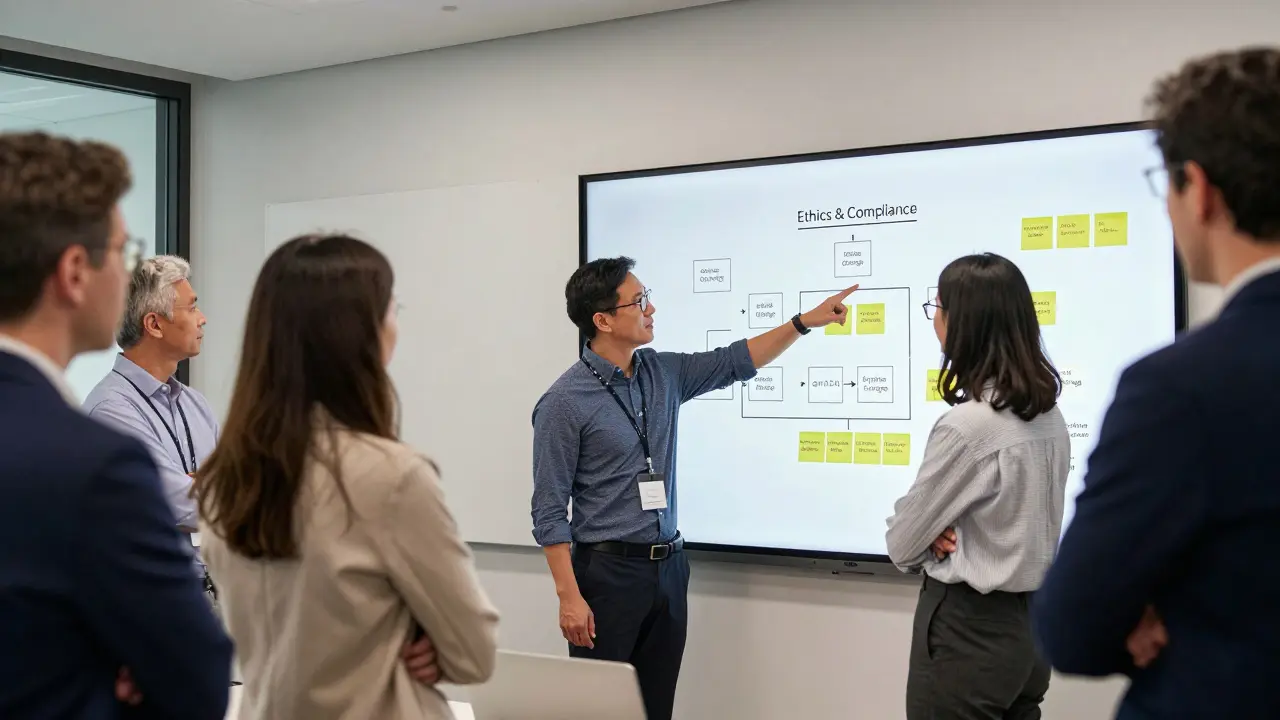
In 2026, ignoring the ethical side of AI is a liability. With regulations like the EU AI Act fully implemented, boards are under pressure to ensure their AI initiatives are compliant. Only 37% of programs in 2025 included comprehensive ethics modules, but that number jumped to 68% in 2026 offerings. This shift reflects a growing awareness that bad AI decisions can lead to lawsuits, reputational damage, and loss of customer trust.
When evaluating a program, ask: "Do they teach us how to audit our AI for bias?" "Do they cover data privacy laws?" If the answer is no, look elsewhere. Wharton’s program, for instance, added specific modules on regulatory oversight in response to these changing legal landscapes. This kind of practical, legally-grounded knowledge is invaluable for board members responsible for fiduciary duty.
ROI and Implementation: From Classroom to Boardroom
The ultimate test of any executive education is whether it leads to action. According to Digital Defynd, 89% of participants in top-tier programs reported implementing at least one AI initiative within six months of completion. MIT and Wharton led this metric with 94% and 92% respectively.
Sarah Chen, Chief Strategy Officer at a Fortune 500 company, shared her experience on LinkedIn after completing MIT xPRO’s program. She noted that the capstone project requirement forced her to develop a concrete AI strategy for her organization rather than just learning theory. Six months later, her company had implemented three major AI initiatives directly derived from her final project.
This highlights a key differentiator: Capstone Projects. In 2026, 83% of programs require participants to develop an organization-specific AI strategy. This ensures you leave with a actionable plan, not just a certificate. When choosing a program, prioritize those that mandate a real-world application component.
Who Should Enroll? Audience Breakdown
These programs are designed for specific roles. Understanding your place in the hierarchy helps you choose the right track.
- Board Members: Represent 17% of participants. Their focus is on governance, risk oversight, and long-term strategic alignment. They need high-level insights into competitive advantage and regulatory trends.
- C-Suite Executives (CEO, CTO, CIO): Need to drive enterprise-wide transformation. They benefit from programs that cover cross-functional integration, such as how AI impacts marketing, HR, and finance simultaneously.
- Business Unit Leaders: Often focused on specific use cases like customer service automation or supply chain optimization. Shorter, more tactical programs like Rotman’s 6-week course may be more suitable.
Demographic data shows the average participant is 52 years old with 22 years of executive experience. This suggests that these programs are not for junior staff. They are for seasoned leaders who need to update their mental models for a new technological era.
Future Trends: Agentic AI and Market Consolidation
The landscape is evolving fast. Industry analysts predict that by 2027, the market will consolidate. Of the 120+ programs available today, only 25-30 high-quality options will remain. The top business schools will dominate, while lower-quality providers fail to deliver promised outcomes. In fact, 41% of new entrants in 2025 failed to meet expectations.
Another major trend is the rise of Agentic Intelligence. Unlike basic generative AI that creates text or images, agentic AI involves autonomous systems that can execute complex tasks with minimal human intervention. Kellogg’s program now includes expanded content on this topic, reflecting the industry shift. As a leader, understanding the difference between a chatbot and an autonomous agent is crucial for planning future workforce structures.
Additionally, post-completion support is becoming standard. 65% of 2026 programs offer consulting support after graduation, compared to just 22% in 2024. This extended hand-holding helps bridge the gap between learning and doing, ensuring that the strategies you develop actually get implemented.
How to Choose the Right Program: A Checklist
Before you sign up, run through this checklist to ensure the program fits your needs:
- Check the Faculty: Are they connected to leading research labs (like MIT CSAIL) or purely academic theorists?
- Look for Capstones: Does the program require a real-world project tied to your organization?
- Assess Ethics Coverage: Is there a dedicated module on bias, IP, and regulation?
- Consider the Cohort: Who else will be in the room? Peer learning is a huge part of the value proposition.
- Verify Post-Completion Support: Do they offer coaching or consulting after the course ends?
- Align with Timeline: Can you commit 10-15 hours a week for a hybrid program, or do you need a self-paced option?
Corporate sponsorship is also a factor. In 2025, 78% of participants in top-tier programs received full or partial company funding. Make the case to your CFO by highlighting the ROI data: nearly 90% of graduates implement initiatives within six months. Frame it as an investment in competitive survival, not just professional development.
Is executive education on Generative AI worth the cost?
For C-suite and board members, yes. The cost ranges from $2,800 to $15,000, but the ROI is significant. Data shows that 89% of participants in top programs implement at least one AI initiative within six months. Given that 75% of enterprises are adopting AI by 2026, failing to upskill could result in lost competitive advantage. Additionally, 78% of top-tier participants receive corporate funding, reducing personal financial burden.
Do I need technical coding skills to enroll?
No. These programs are designed for non-technical leaders. The focus is on strategic frameworks, risk management, and business integration, not programming. Programs like Harvard Kennedy School’s explicitly state they provide "intuitive understanding" rather than deep technical knowledge. You need to understand how AI works conceptually to make informed decisions, not how to build it.
Which program is best for board members?
Board members often benefit from programs that emphasize governance, ethics, and long-term strategy. MIT xPRO and Wharton are top choices due to their comprehensive six-month structures and focus on enterprise-grade strategy. Wharton’s use of the Oxford 4Ps framework is particularly useful for high-level strategic planning. Ensure the program covers regulatory compliance, such as the EU AI Act, which is critical for fiduciary responsibility.
What is the difference between Generative AI and Agentic AI?
Generative AI creates content (text, images, code) based on prompts. Agentic AI refers to autonomous systems that can execute complex, multi-step tasks with minimal human intervention. While generative AI assists humans, agentic AI acts independently within defined parameters. Programs like Kellogg’s are now including agentic intelligence because it represents the next phase of business transformation, impacting workforce structure and operational efficiency more profoundly than simple content generation.
How much time commitment is required?
Time commitments vary significantly. Intensive hybrid programs like MIT xPRO require 10-15 hours per week for six months. Shorter online programs like Kellogg’s (8 weeks) or Harvard’s (6 weeks) typically require 3-5 hours weekly. Self-paced options like IBM’s may require similar weekly hours but offer more flexibility. Executives with limited technical backgrounds should expect the higher end of the time estimate to grasp core concepts.
Will my company pay for this training?
Likely. Corporate sponsorship for executive AI education rose to 78% in 2025, up from 42% in 2023. To secure funding, present the ROI data: nearly 90% of graduates implement initiatives within six months. Highlight that this is not just personal development but a strategic investment in organizational competitiveness and risk mitigation.