GPUs vs TPUs: Choosing the Right Compute Infrastructure for Generative AI Training
 Aug, 8 2026
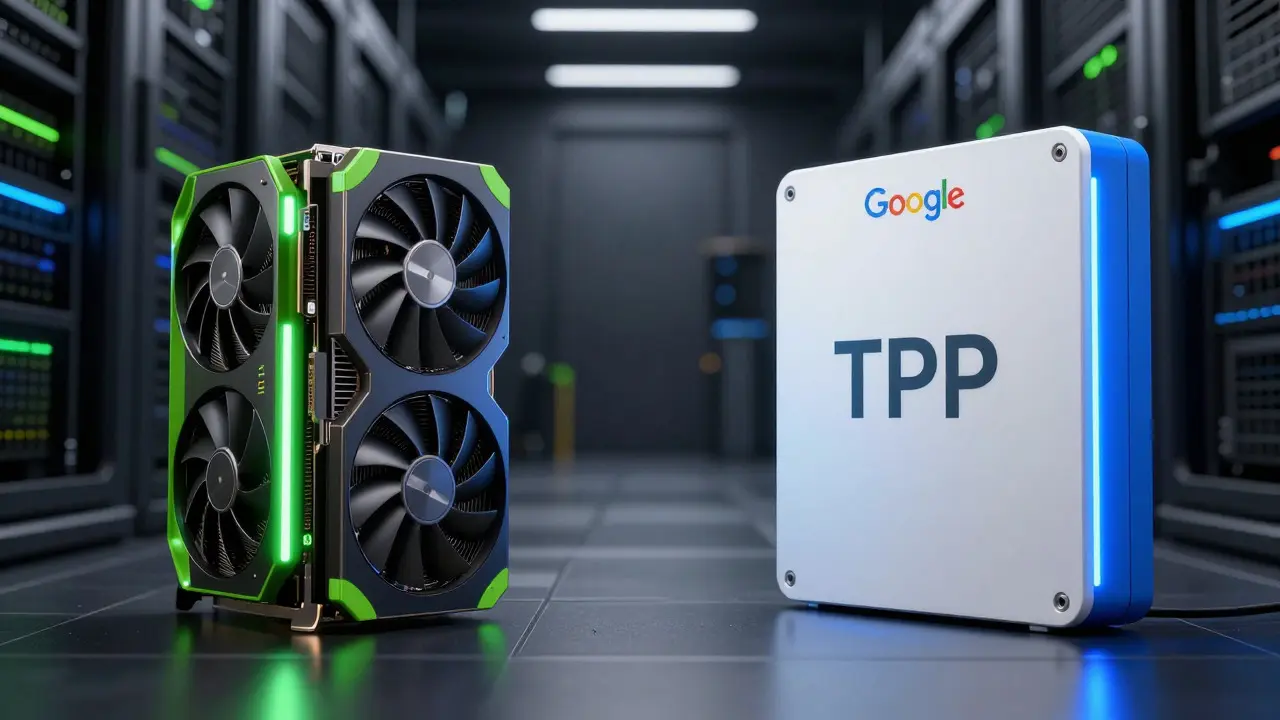
Training a large language model today is less about writing clever code and more about managing massive amounts of electricity, heat, and silicon. You have two primary paths to take: sticking with the industry-standard NVIDIA GPUs, which offer unmatched flexibility and ecosystem support, or moving to Google TPUs, which promise significantly lower costs for specific, large-scale workloads. The decision isn't just technical; it's financial and strategic. Get it wrong, and your training run could cost millions more than necessary. Get it right, and you unlock faster iteration cycles and better margins.
This guide breaks down the real-world performance, cost economics, and architectural differences between these two giants. We will look at the hardware specs, the software ecosystems, and how distributed training actually works in production environments as of 2026.
Key Takeaways
- Cost Efficiency: For large-scale LLM training, Google TPU v5p and v6e generations often deliver 4 to 10 times better cost-effectiveness compared to NVIDIA H100 clusters, primarily due to lower hourly rates and higher Model FLOPs Utilization (MFU).
- Ecosystem Lock-in: NVIDIA GPUs remain the default choice for research, prototyping, and multi-cloud deployments because of the ubiquitous CUDA ecosystem. TPUs are locked to Google Cloud Platform (GCP) but offer superior automated scaling via XLA.
- Hardware Specs: NVIDIA H100 offers 80GB-141GB of HBM memory per chip with high throughput, while TPU v5p provides massive aggregate memory (760GB in 8-chip slices) and deterministic execution that minimizes data waiting periods.
- Distributed Training: GPU training requires manual coordination using libraries like NCCL, whereas TPU training uses GSPMD to automatically shard models across thousands of chips, simplifying the developer experience for massive pods.
- Hybrid Strategy: Most sophisticated organizations use a hybrid approach: leveraging TPUs for cost-effective pre-training and stable inference, while keeping GPUs for experimental research and flexible deployment.
The Hardware Reality: GPUs vs. TPUs
To understand why one might be cheaper or faster than the other, we first need to look at what these chips are designed to do. Graphics Processing Units (GPUs) were originally built for rendering video games. Their strength lies in parallel processing-handling many simple tasks simultaneously. Over time, NVIDIA repurposed this architecture for deep learning through its CUDA platform, creating a dominant ecosystem that almost every AI researcher knows.
In contrast, Tensor Processing Units (TPUs) are Application-Specific Integrated Circuits (ASICs). They were designed from the ground up by Google specifically for tensor operations-the mathematical backbone of neural networks. Because they don't need to handle graphics or general-purpose computing, they can be optimized purely for matrix multiplications and convolutions.
| Feature | NVIDIA H100 / H200 | Google TPU v5p | Google TPU v6e |
|---|---|---|---|
| Type | GPU (General Purpose) | TPU (ASIC) | TPU (ASIC) |
| Memory Per Chip | 80GB - 141GB HBM | ~95GB (in 8-chip slice) | Higher capacity optimized for inference |
| Throughput | ~3,800 tokens/sec/chip | ~3,450 tokens/sec/chip | Optimized for high-volume inference |
| Interconnect | NVLink + External Network | Optical Circuit Switch (OCS) | Advanced Optical Interconnect |
| Primary Advantage | Ecosystem breadth, flexibility | Cost-efficiency, linear scaling | Best price-performance for inference |
The raw numbers tell only part of the story. While the NVIDIA H100 has slightly higher raw throughput per chip, the TPU v5p achieves approximately 58% Model FLOPs Utilization (MFU) compared to the H100's ~52% on identical LLM workloads. MFU measures how much of the theoretical peak performance you actually get to use. The TPU's deterministic execution and specialized inter-chip interconnect (ICI) minimize the time processors spend waiting for data, making them more efficient in practice for long-running training jobs.
The Cost Equation: Why TPUs Are Cheaper for Scale
If performance were the only metric, GPUs would still hold a strong lead due to their versatility. But in enterprise AI, cost is king. The economic argument for TPUs becomes undeniable when you scale up.
An 8-chip node of NVIDIA H100 GPUs typically costs between $12.00 and $15.00 per hour on cloud platforms, depending on whether you use Spot instances or Reserved pricing. A comparable slice of TPU v5p (8 chips) costs between $8.00 and $11.00 per hour. This immediate difference compounds over weeks or months of training. According to recent industry reports, TPU v5p delivers 15-25% better performance per dollar than H100s. When looking at the latest TPU v6e generation, the gap widens further, offering up to 4 times better performance per dollar for large language model training and recommendation systems.
Why is there such a disparity? First, TPUs are exclusive to Google Cloud Platform (GCP). Google subsidizes the hardware development to drive cloud consumption. Second, the availability of large contiguous blocks of TPUs is generally higher than for H100 clusters, which are often snapped up by crypto miners or other high-demand users, leading to scarcity pricing. Finally, the energy efficiency of ASICs means lower cooling and power costs at the data center level, savings that trickle down to the user.
For an organization like Anthropic, which trains massive foundation models, the Total Cost of Ownership (TCO) analysis shows that TPU infrastructure can provide approximately 52% lower cost per effective PFLOP compared to NVIDIA's GB300 configurations. Even if the TPU doesn't reach 100% utilization, it remains cost-competitive because the baseline cost is so much lower.
Distributed Training: Manual vs. Automated Scaling
Training modern generative AI models rarely happens on a single chip. It happens across hundreds or thousands of accelerators connected in a cluster. How these chips talk to each other is where the architectural philosophies diverge sharply.
On the NVIDIA side, distributed training relies on PyTorch's torch.distributed module combined with NCCL (NVIDIA Collective Communications Library). This is the industry standard. It gives developers granular control over how gradients are synchronized and how data is sharded. However, this control comes with complexity. As you add more GPUs, network congestion and latency become significant bottlenecks. You often need dedicated networking engineers to optimize the topology of your cluster to ensure that the GPUs aren't sitting idle waiting for data from their neighbors.
Google takes a different approach with TPUs. They use GSPMD (General Shardman Parallel Multi-Device), a compiler feature within XLA (Accelerated Linear Algebra). With GSPMD, you write your code as if you are running it on a single device. The compiler then automatically handles the sharding logic, distributing the model parameters and activations across the entire TPU Pod. This abstraction layer removes a huge burden from the ML engineer. You don't need to manually configure communication primitives; the system does it for you.
Furthermore, TPU Pods are connected via Optical Circuit Switches (OCS). Unlike traditional electrical networking topologies that can suffer from packet loss and congestion, OCS provides near-linear scalability. If you double the number of TPUs, you nearly double the compute power without the usual diminishing returns seen in GPU clusters. This makes TPUs particularly attractive for training trillion-parameter models where scaling efficiency is critical.
Ecosystem and Developer Experience
Hardware is useless without software. This is NVIDIA's strongest moat. The CUDA ecosystem is mature, extensive, and supported by virtually every major AI framework, including PyTorch, TensorFlow, and JAX. If you find a new paper with a novel attention mechanism, there is likely already a CUDA kernel available or easy to implement. Debugging tools like Nsight Systems are robust and well-documented.
TPUs, on the other hand, require you to embrace the Google stack. While they support PyTorch via TorchXLA, the best performance and easiest integration come from JAX and TensorFlow. JAX has gained significant popularity among researchers for its functional approach to machine learning, and it integrates seamlessly with TPUs. However, if your team is deeply entrenched in PyTorch eager mode for debugging and rapid prototyping, moving to TPUs might introduce friction. You may encounter issues with custom operators that lack XLA support, requiring you to rewrite parts of your model or fall back to slower CPU execution.
Consider the learning curve. A junior ML engineer can spin up an H100 instance on AWS, Azure, or GCP and start training a model within hours. To get optimal performance on TPUs, the team needs to understand XLA compilation, sharding strategies, and potentially refactor their codebase. This upfront investment pays off in operational costs later, but it's a barrier to entry.
When to Choose Which: Decision Framework
So, which one should you pick? There is no single answer, but there are clear patterns based on your organizational goals.
Choose NVIDIA GPUs if:
- You are in the research and experimentation phase, frequently changing model architectures.
- You need multi-cloud portability (AWS, Azure, GCP) to avoid vendor lock-in.
- Your workload involves mixed compute tasks beyond pure deep learning (e.g., data preprocessing, custom simulations).
- You rely on third-party libraries or custom CUDA kernels that are not yet compatible with XLA.
- You are performing small-scale fine-tuning on single nodes (up to 8 GPUs), where the overhead of setting up a TPU pod isn't justified.
Choose Google TPUs if:
- You are pre-training large foundation models (billions of parameters) where cost-per-token is the primary metric.
- You have a stable, proven model architecture and need to scale to production efficiently.
- You are serving high-volume inference requests, especially with TPU v6e, which is optimized for this use case.
- Your team is comfortable with JAX or TensorFlow and willing to adopt the XLA compilation model.
- You want to leverage the near-linear scaling of TPU Pods for massive distributed training jobs.
The Hybrid Approach:
Many leading AI companies now use both. They might use NVIDIA GPUs for initial research, prototype validation, and small-scale fine-tuning because of the ease of use and ecosystem breadth. Once a model architecture is validated and ready for massive pre-training or production inference, they migrate to TPUs to reduce costs. Alternatively, they might train on TPUs for the heavy lifting and deploy inference on GPUs to maintain flexibility across different cloud providers. This strategy maximizes the strengths of both platforms while mitigating their weaknesses.
Future Outlook: The Race Continues
As of 2026, the competition between NVIDIA and Google is not a zero-sum game. Instead, it has evolved into a complementary relationship. NVIDIA continues to dominate the market share due to its ecosystem lock-in and versatility. Google is steadily eating into the high-end training market by proving that ASICs can be more economical for specific, massive workloads.
We expect to see continued improvements in TPU generations, with enhanced XLA compiler optimizations making the developer experience smoother. NVIDIA will likely respond with new architectures focused on improving cost-per-token metrics to counter the TPU advantage. For now, the smartest move for most organizations is to build internal expertise in both stacks. Don't bet everything on one horse. Understand the trade-offs, benchmark your specific workloads, and choose the tool that fits the job at hand.
Are TPUs only available on Google Cloud?
Yes, currently TPUs are exclusively available through Google Cloud Platform (GCP). This is a key consideration for organizations that require multi-cloud strategies or strict vendor neutrality. NVIDIA GPUs, by contrast, are available on AWS, Azure, GCP, and other major cloud providers, as well as on-premises.
Can I use PyTorch on TPUs?
Yes, you can use PyTorch on TPUs via TorchXLA. However, for the best performance and easiest integration, Google recommends using JAX or TensorFlow. Some advanced PyTorch features or custom CUDA kernels may not translate perfectly to the XLA backend used by TPUs, potentially requiring code refactoring.
Which is better for inference: GPUs or TPUs?
It depends on the scale. For low-latency, variable-batch-size inference, GPUs like the NVIDIA L40 or A10 are often preferred due to their flexibility and maturity. For high-throughput, stable inference workloads serving millions of users, TPUs (especially the v6e generation) offer superior cost-efficiency and performance per dollar.
What is Model FLOPs Utilization (MFU)?
MFU is a metric that measures the percentage of a hardware accelerator's theoretical peak performance that is actually utilized during training. Higher MFU indicates better efficiency. In recent benchmarks, TPU v5p has achieved ~58% MFU compared to ~52% for NVIDIA H100 on similar LLM workloads, largely due to reduced data waiting times.
Is it worth switching from GPUs to TPUs for small teams?
Probably not. The cost savings of TPUs are most pronounced at scale, where you are training large models for extended periods. Small teams doing rapid experimentation or fine-tuning smaller models will likely find the flexibility and lower learning curve of NVIDIA GPUs more valuable than the marginal cost savings of TPUs.