Hybrid Recurrent-Transformer Models: Do They Actually Improve LLMs?
 Jun, 6 2026
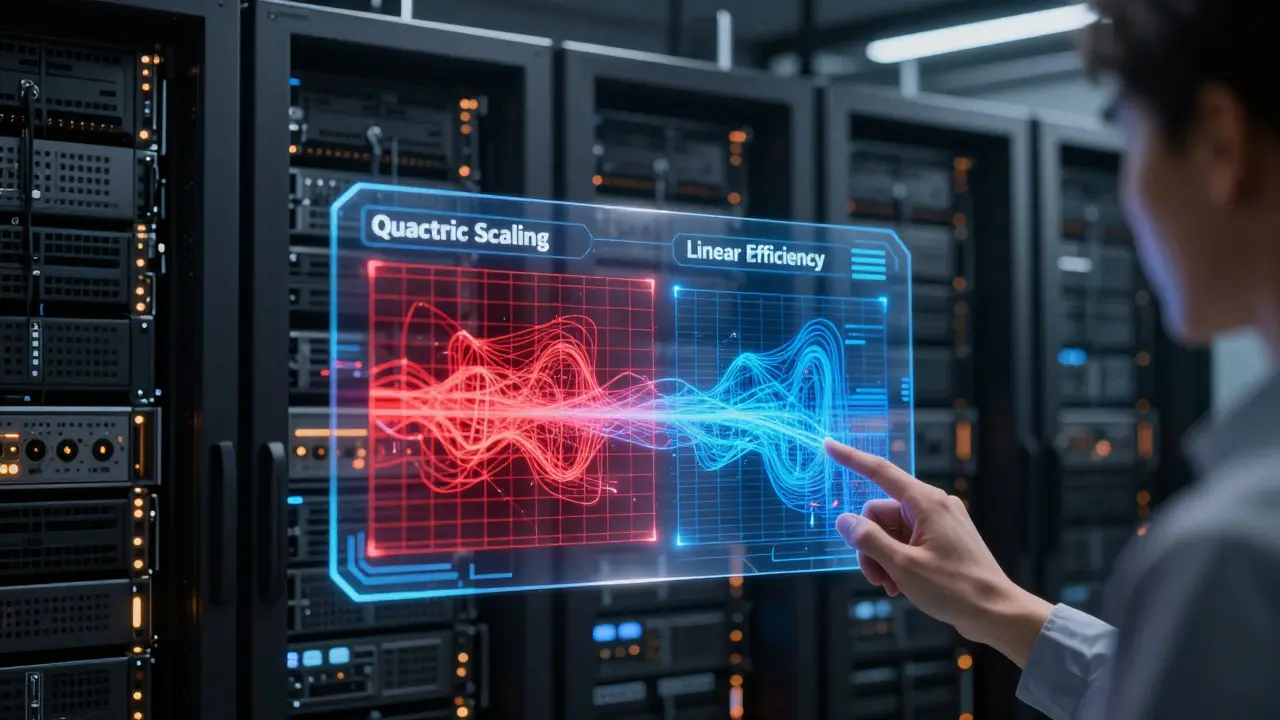
For years, the Transformer architecture has been the undisputed king of artificial intelligence. It powers ChatGPT, Gemini, and every other major large language model (LLM) you use today. But there is a catch. As these models grow larger and handle longer texts, they become incredibly expensive to run. The math behind standard Transformers means that doubling the text length roughly quadruples the computing power needed. This quadratic scaling is hitting a wall.
This is where hybrid recurrent-transformer designs are neural network architectures that combine the linear-time efficiency of recurrent models like Mamba with the long-range reasoning capabilities of Transformer attention mechanisms. These hybrid models attempt to get the best of both worlds: the speed of older recurrent neural networks (RNNs) and the smart context understanding of modern Transformers. But do they actually work better? Or are they just another academic trend?
The Core Problem: Why We Need Hybrids
To understand why hybrids matter, you have to look at what each component does alone. Standard Transformers use a mechanism called "self-attention." Imagine reading a book and being able to instantly look back at any sentence from chapter one while reading chapter ten. That is powerful for reasoning, but it is computationally heavy. Every word has to check against every previous word.
On the other side, you have State-Space Models (SSMs), specifically Mamba is a selective state-space model that processes data sequentially with linear time complexity, making it much faster than Transformers for long sequences. Mamba works more like human short-term memory. It processes tokens one by one, compressing past information into a hidden state. It is fast-linearly scalable-but it sometimes struggles to remember specific details from very far back in a long document.
Hybrid models merge these two approaches. The goal is simple: use Mamba for the heavy lifting of processing vast amounts of text quickly, and use Transformer attention for the complex reasoning tasks that require looking across long distances in the text. Recent research from 2024 and 2025 suggests this combination is not just theoretical; it is becoming a practical reality for enterprise-grade AI.
How Hybrid Architectures Are Built
Not all hybrids are created equal. Researchers have found that how you mix these components changes everything. There are two main ways to build these models: sequential and parallel.
Sequential Hybrids: In this setup, data flows through one component before moving to the next. For example, a "Mamba-to-Attention" (M→A) layer processes text with Mamba first, then passes that output to an Attention layer. Studies show that sequential hybrids create highly aligned representations. Because the second component sees exactly what the first produced, they work well together for common-sense reasoning and shorter contexts. However, they can struggle when the task requires remembering distinct facts from very different parts of a massive document.
Parallel Hybrids: Here, the input goes through both Mamba and Attention layers at the same time. The outputs are then merged using techniques like averaging or a more advanced "merge-attention" mechanism. Parallel hybrids produce more diverse internal representations. While this makes them harder to tune, they significantly outperform sequential models on complex long-context tasks. If you need an AI to read a 100-page legal contract and find a specific clause, a parallel hybrid with merge-attention is likely your best bet.
| Feature | Sequential Hybrid (e.g., M→A) | Parallel Hybrid (e.g., Merge-Attention) |
|---|---|---|
| Data Flow | One component feeds into the next | Both process input simultaneously |
| Representation Alignment | High (stable embeddings) | Low (diverse features) |
| Best Use Case | Commonsense reasoning, short contexts | Long-context recall, complex retrieval |
| Training Difficulty | Easier to stabilize | Requires careful aggregation tuning |
Real-World Giants: Hunyuan-TurboS and AMD-HybridLM
Theory is fine, but does it scale? Yes. Some of the largest AI models in production today are already using hybrid designs.
Take Hunyuan-TurboS, which is a massive 560-billion parameter hybrid model developed by Tencent, combining Transformer attention with Mamba2 and Mixture-of-Experts technology. This beast uses an interleaved pattern of Attention-Mamba-Feed-Forward layers across 128 layers. It activates only 56 billion parameters per inference step thanks to its Mixture-of-Experts (MoE) setup. This allows it to deliver high-quality responses without burning through GPU clusters as quickly as a pure Transformer would.
Then there is the AMD-HybridLM family, which includes open-weight hybrid models at 1B, 3B, and 8B scales that replace classical Transformer blocks with Multi-Latent Attention and Mamba2 layers to reduce memory usage. AMD’s approach is clever. Instead of training a new model from scratch, they use a "sensitivity scoring" method. They test how much replacing a specific Transformer layer with a Mamba layer affects the model's output distribution (measured by Kullback-Leibler divergence). Layers that are less sensitive to change get swapped for efficient Mamba blocks, while critical reasoning layers keep their precise Multi-Latent Attention. This lets developers convert existing models to hybrid versions without losing performance.
Performance Trade-offs: What You Gain and Lose
Switching to a hybrid model isn't a magic bullet. You have to accept certain trade-offs based on your specific needs.
The Gains:
- Linear Scaling: For long documents, inference costs drop dramatically compared to pure Transformers.
- Better Memory Recall: Parallel hybrids with merge-attention excel at retrieving specific information from long contexts.
- Hardware Efficiency: Lower memory bandwidth requirements mean cheaper hardware can run larger effective models.
The Risks:
- Complex Training: Balancing the learning rates of SSMs and Attention heads is tricky. Poorly tuned hybrids can underperform both parent architectures.
- Contextual Reasoning Limits: While good at retrieval, some studies suggest hybrids are slightly less optimal than pure attention for nuanced contextual reasoning tasks where subtle semantic links matter more than factual recall.
- Integration Overhead: Adding Feed-Forward (FF) layers incorrectly can hurt performance. Research shows that FF layers must augment both the Mamba and Attention components equally; adding them to only one degrades results in both sequential and parallel setups.
Skill Delegation: How Hybrids Think
One fascinating aspect of hybrid models is how they delegate tasks internally. Pretrained hybrid models naturally specialize. Analysis reveals that attention layers often take charge of "aggregate heads" functionality during reasoning tasks. Essentially, the recurrent part (Mamba) manages the sequential flow and state compression, while the attention part handles relational aggregation-connecting disparate ideas across the text.
This automatic specialization suggests that hybrids aren't just stacking modules; they are evolving a division of labor. The model learns to use the fast highway (Mamba) for getting information around and the detailed map (Attention) for figuring out where things connect.
Is It Time to Switch?
If you are building a consumer chatbot that answers short questions, a standard Transformer might still be simpler and sufficient. But if you are dealing with long-form content-like analyzing financial reports, coding large codebases, or processing medical records-hybrid recurrent-transformer designs offer a compelling advantage.
The evidence from 2024-2025 is clear: hybrids provide meaningful advantages in computational efficiency while maintaining strong reasoning capabilities. With implementations like Hunyuan-TurboS proving viability at enterprise scale, and tools like AMD-HybridLM offering paths to retrofit existing models, this technology is moving from research papers to real-world deployment. The future of LLMs likely isn't just Transformers or just RNNs-it's the intelligent fusion of both.
What is a hybrid recurrent-transformer model?
A hybrid recurrent-transformer model is an AI architecture that combines State-Space Models (like Mamba) for fast, linear-time sequence processing with Transformer self-attention mechanisms for capturing long-range dependencies. This design aims to reduce the computational cost of large language models while preserving their reasoning abilities.
Do hybrid models perform better than pure Transformers?
It depends on the task. For long-context processing and memory recall, parallel hybrid models often outperform pure Transformers due to more diverse internal representations. However, for short-context commonsense reasoning, sequential hybrids or pure Transformers may be equally effective or superior depending on the specific implementation.
What is the difference between sequential and parallel hybrid architectures?
In sequential hybrids, data flows through one component (e.g., Mamba) before entering the next (e.g., Attention). This creates aligned representations ideal for stable reasoning. In parallel hybrids, both components process the input simultaneously and merge outputs later. This creates diverse features that excel at complex long-context tasks but require careful tuning.
Can I convert my existing Transformer model to a hybrid?
Yes, methods like those used in AMD-HybridLM allow for partial conversion. By using sensitivity scoring to identify which layers contribute most to precision versus speed, you can replace specific Transformer blocks with Mamba layers without retraining the entire model from scratch, reducing memory usage while maintaining performance.
What are the biggest risks of using hybrid models?
The main risks include increased training complexity, potential degradation in nuanced contextual reasoning compared to pure attention, and the need for balanced integration of Feed-Forward layers. Improperly configured hybrids can underperform both parent architectures, so expert tuning is required.