Memory-Augmented Transformers: How External Stores Fix LLM Memory Limits
 May, 24 2026
Standard Large Language Models (LLMs) have a frustrating blind spot. They are brilliant at processing text within a fixed window, but they forget everything once that context limit is hit. If you chat with an AI for hours, it eventually loses track of the beginning of the conversation. If new facts emerge after its training cutoff, it remains ignorant unless you manually feed them in via prompts. This limitation creates a fragile system that cannot truly learn or retain knowledge over time.
This is where Memory-Augmented Transformers change the game. These advanced architectures integrate external memory systems directly into the model’s core operations. Instead of relying solely on static weights and limited context windows, these models access persistent, dynamic storage. They can read, write, and update knowledge continuously. This shift moves AI from being a stateless calculator to a system capable of long-term retention and adaptation.
The Core Problem with Standard Transformers
To understand why memory augmentation matters, you first need to see the bottleneck in traditional designs. A standard Transformer processes input tokens through self-attention mechanisms. The computational cost grows quadratically with sequence length. If you double the context, you quadruple the compute. More importantly, the model has no permanent place to store information between sessions.
When a standard LLM generates a response, it uses its pre-trained weights and the immediate prompt. Once the session ends, that interaction vanishes. There is no "memory" of what happened. Retrieval-Augmented Generation (RAG) attempts to fix this by fetching documents from a vector database before generating text. However, RAG is often a loose coupling. The model doesn't "own" the retrieved data; it just sees it as part of the prompt. It lacks the ability to actively manage, prioritize, or update that knowledge base during inference.
Memory-Augmented Transformers (MATs) solve this by making memory a first-class citizen in the architecture. The model doesn't just look up data; it interacts with a dedicated memory module that can be updated, queried, and organized dynamically. This allows for linear scaling of context handling and supports continual learning without catastrophic forgetting.
How Memory-Augmented Architectures Work
The technical design of MATs revolves around three key dimensions: functional objectives, memory representations, and integration mechanisms. Researchers classify these systems based on how they handle information flow.
| Memory Type | Storage Mechanism | Speed & Volatility | Primary Use Case |
|---|---|---|---|
| Parameter-Encoded | Model Weights | Slow to update, Permanent | Foundational knowledge, general patterns |
| State-Based | Activation States / Cache | Fast, Volatile (Session-only) | Immediate context, short-term reasoning |
| Explicit External | External Database / Dictionary | Variable, Persistent | Factual recall, long-term history, archival data |
| Hybrid | Combined Systems | Adaptive | Complex tasks requiring both speed and depth |
Integration happens through attention fusion, gated control, or associative retrieval. In attention fusion, specific attention heads are designed to query the external memory bank. The Query comes from the current input, while the Keys and Values come from the stored memory. Gated control uses learnable routers to decide when to write to memory or when to rely on internal weights. Associative retrieval allows the model to find relevant memories based on content similarity, much like human recollection.
Biological Inspiration: Mirroring the Brain
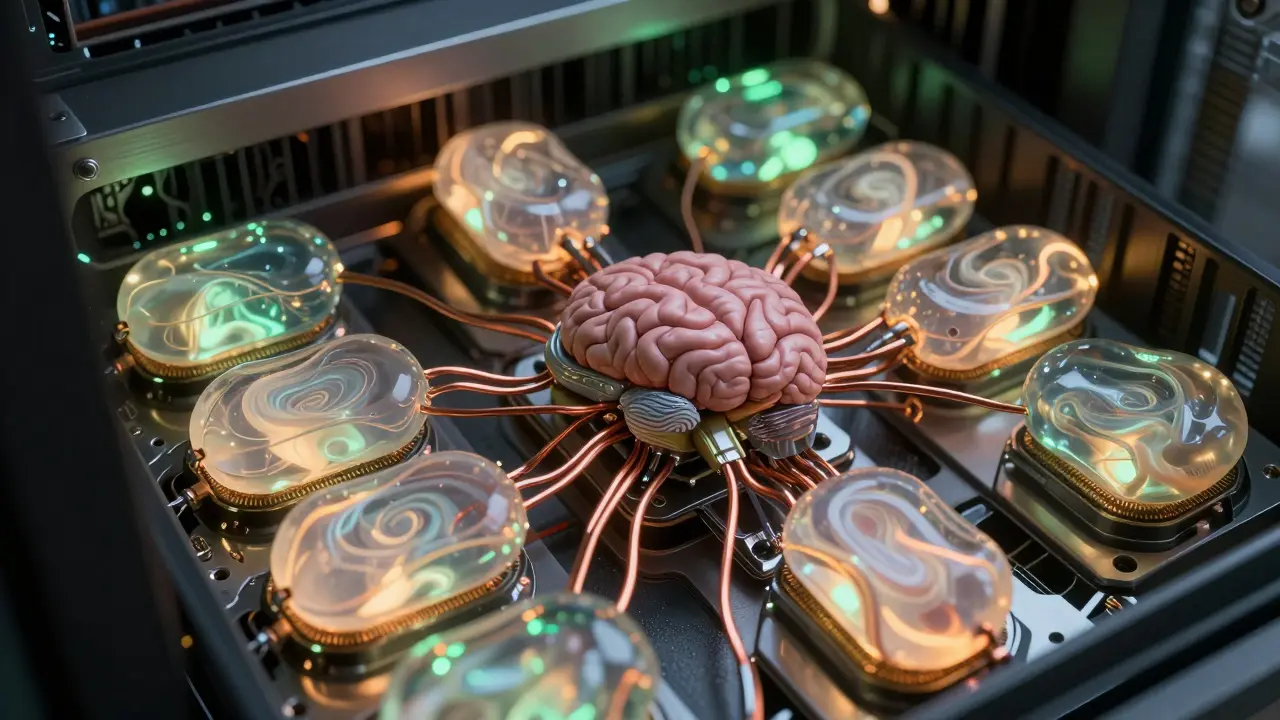
The most successful MAT designs draw heavily from cognitive neuroscience. Human brains don't store all memories in one place. We have working memory for immediate tasks, short-term memory for recent events, and long-term memory for consolidated knowledge. MATs replicate this hierarchy.
Global Workspace Theory, researched by Dehaene and Baars, suggests that consciousness focuses attention on salient inputs while ignoring noise. MATs apply this by using surprise-based gating. If new information is predictable, the model ignores it to save resources. If it's novel or surprising, the system allocates more memory capacity to encode it. This mimics the hippocampus's role in indexing new experiences before consolidating them into long-term storage.
This biological approach solves the stability-plasticity dilemma. Pure neural networks struggle to learn new things without overwriting old ones (catastrophic forgetting). By separating fast-changing state memory from slow-updating parameter memory, MATs maintain stability in core knowledge while remaining plastic enough to adapt to new contexts.
Leading Architectures: Titans, MemGPT, and LM2
Several prominent frameworks demonstrate how these principles work in practice. Each offers a different approach to managing external stores.
Titans introduces a revolutionary three-tier memory system. It combines state-based attention with parameter-encoded long-term modules. The standout feature is its linear scaling complexity O(n), compared to the quadratic O(n²) of standard Transformers. Titans uses entropy-based novelty detection to route information. It acts as a dynamic cache for frequent queries while offloading rare or complex retrievals to deeper layers. This achieves sub-linear latency for common tasks.
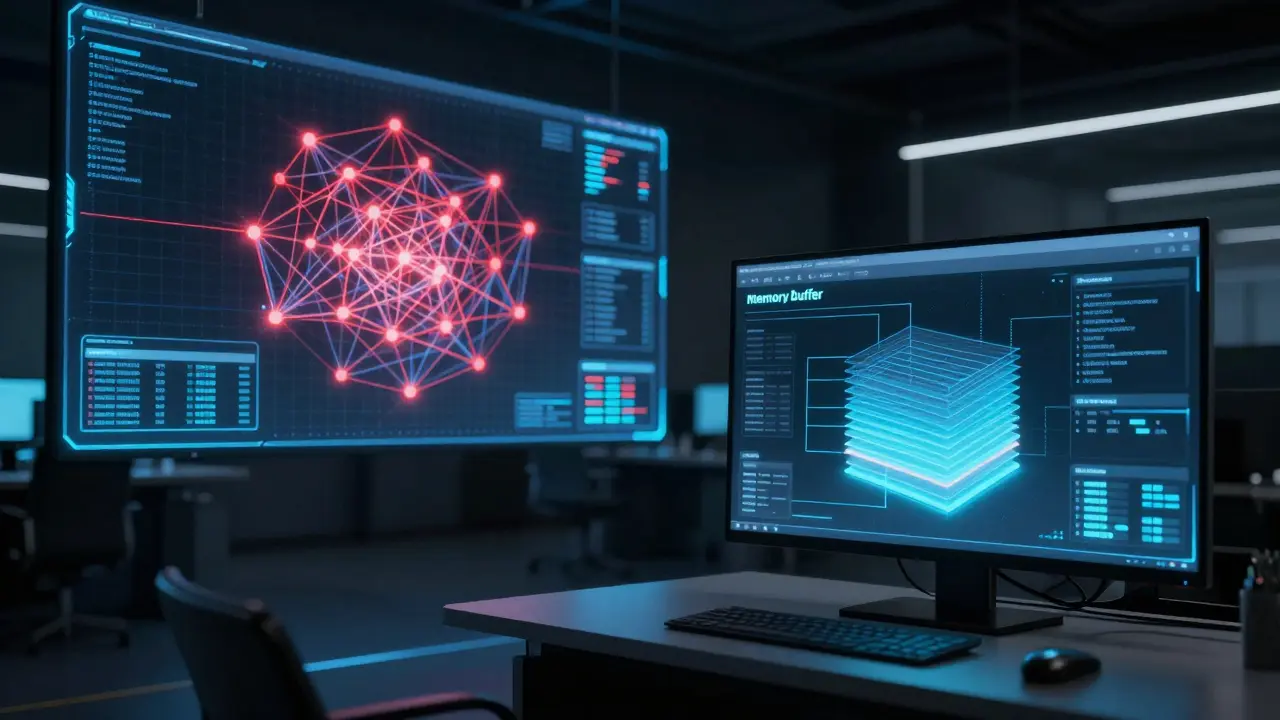
MemGPT takes an operating-system-inspired approach. It treats memory management like RAM and disk storage. Working context stays in volatile state-based memory, while older interactions are paged out to explicit archival storage. Learned paging policies determine what gets kept in active memory and what gets archived. This allows for extremely long-running agent sessions without hitting context limits.
LM2 integrates external memory modules directly into each decoder layer with learnable gates. This enables dynamic coordination between internal representations and external storage at every step of generation. It’s less about archiving and more about real-time knowledge integration during the reasoning process.
Practical Applications Beyond Chatbots
While better chatbots are the obvious use case, MATs unlock capabilities in domains that require persistence and continuity.
- Cybersecurity: Network monitoring systems can maintain long-term profiles of normal traffic behavior. When anomalies occur, the model references historical patterns stored in explicit memory to detect zero-day attacks that deviate from established baselines.
- Financial Trading: Algorithms can retain market sentiment trends across days or weeks. Instead of re-evaluating every tick from scratch, the model updates its state-based memory with daily summaries while keeping detailed transaction logs in external storage for audit trails.
- Multi-Object Tracking: In video analysis, tracking objects across occlusions requires remembering where an object was last seen. Long-term memory-augmented transformers decouple detection from tracking, resolving conflicts between temporal continuity and frame-by-frame accuracy.
- Dialogue Systems: Customer service agents can remember user preferences and past issues across months. This eliminates the frustration of repeating yourself to every new support rep (or bot instance).
Challenges and Future Directions
Despite the promise, MATs face significant hurdles. Scalability remains a concern. As external memory banks grow, searching them efficiently becomes computationally expensive. Interference is another issue; new memories can overwrite or distort existing ones if not managed carefully. Effective forgetting mechanisms are still an open research problem. You need to know not just what to keep, but what to discard to prevent clutter.
Emerging solutions include hierarchical buffering, which organizes memory in nested structures to reduce search complexity, and adaptive resource allocation algorithms that distribute compute based on task demands. The field is moving toward cognitively-inspired memory ecosystems rather than simple databases. The goal is a system where memory is the substrate for cognition, enabling prediction and priming based on prior experience.
What is the main difference between RAG and Memory-Augmented Transformers?
Retrieval-Augmented Generation (RAG) typically fetches documents from an external database and appends them to the prompt. The model treats this data as temporary context. Memory-Augmented Transformers (MATs) have integrated memory modules that the model can actively read from, write to, and update during inference. MATs allow for persistent, structured knowledge that evolves independently of the core model weights, supporting continual learning.
Do Memory-Augmented Transformers eliminate the need for retraining?
They significantly reduce it. While major architectural changes may still require fine-tuning, MATs can incorporate new information through their external memory stores without updating the entire model's weights. This enables test-time learning, where the model adapts to new facts or user preferences in real-time.
How does the Titans architecture achieve linear scaling?
Titans uses a hierarchical memory system with surprise-based attention routing. Instead of attending to every token in a long sequence (quadratic cost), it dynamically allocates resources based on information novelty. Common or predictable information is handled by efficient caching mechanisms, resulting in O(n) linear scaling rather than O(n²).
What is the stability-plasticity dilemma in AI?
It is the challenge of allowing a model to learn new information (plasticity) without forgetting previously learned knowledge (stability). Standard neural networks often suffer from catastrophic forgetting. MATs address this by separating fast-updating state memory from slow-updating parameter memory, mimicking biological consolidation processes.
Can Memory-Augmented Transformers be used for non-text data?
Yes. While initially developed for language models, the architecture is modality-agnostic. It is being applied to multi-object tracking in video, network monitoring in cybersecurity, and time-series analysis in finance, where persistent context and long-term pattern recognition are critical.