Open-Weight vs Proprietary AI: Architectural Implications for 2026
 Jun, 10 2026
You’ve probably heard the hype. Open-weight models are here to save you from vendor lock-in. Proprietary APIs are the easy button for building smart apps. But if you’re an architect or a lead engineer designing systems in 2026, treating these two options as simple "good vs bad" choices is a mistake. The real decision isn’t about ideology; it’s about where you want your complexity to live.
When you choose between open-weight generative AI models and proprietary closed-source models accessed via API, you aren’t just picking a model. You’re choosing an entire infrastructure strategy. One path hands you the keys but also the bill for the electricity and the security guards. The other path gives you a turnkey service but locks you into someone else’s roadmap and latency constraints. Let’s break down what this actually means for your system design, your budget, and your ability to sleep at night.
The Transparency Trap: What Are You Actually Getting?
First, we need to clear up a massive misconception in our industry. Most people call Meta’s Llama a family of large language models with publicly available weights or Google’s Gemma an open-weight model series released by Google DeepMind "open source." They are not. Not according to the Open Source Initiative (OSI) the organization that defines standards for open-source software.
True open source means you have the code, the data, the training pipeline, and the weights. You can reproduce the model from scratch. Open-weight models only give you the final weights-the trained parameters-and usually the inference code. They hide the training data and the exact training recipes. It’s like buying a car where they give you the engine block but keep the blueprint for how they forged the metal and the list of suppliers who provided the steel.
This distinction matters for architecture because it dictates your auditability. With a proprietary model like ChatGPT 5 a proprietary conversational AI model by OpenAI or Claude Opus 4.1 a high-end reasoning model from Anthropic, you have zero visibility. It’s a black box. You send text, you get text back. If it hallucinates or leaks sensitive data, you rely entirely on the provider’s safety logs and promises.
With open-weight models, you still don’t know *why* the model thinks what it thinks (because the training data is hidden), but you can inspect the weights. You can run differential tests. You can fine-tune it on your own data and see exactly how its behavior shifts. This allows for a layer of architectural control that proprietary APIs simply cannot offer. You can build custom guardrails around the model itself, rather than just filtering the output.
Infrastructure Design: Heavy Lifting vs. Thin Clients
This is where the rubber meets the road. Your choice here fundamentally changes your tech stack.
If you go with proprietary models, your architecture is thin. You are building an orchestration layer. Your servers handle user requests, format prompts, call the API, and return results. You don’t manage GPUs. You don’t worry about CUDA versions or memory fragmentation. Your complexity lies in rate-limiting, retry logic, and managing API costs. This is great for startups or features with unpredictable traffic spikes. You pay per token, and you scale infinitely without buying hardware.
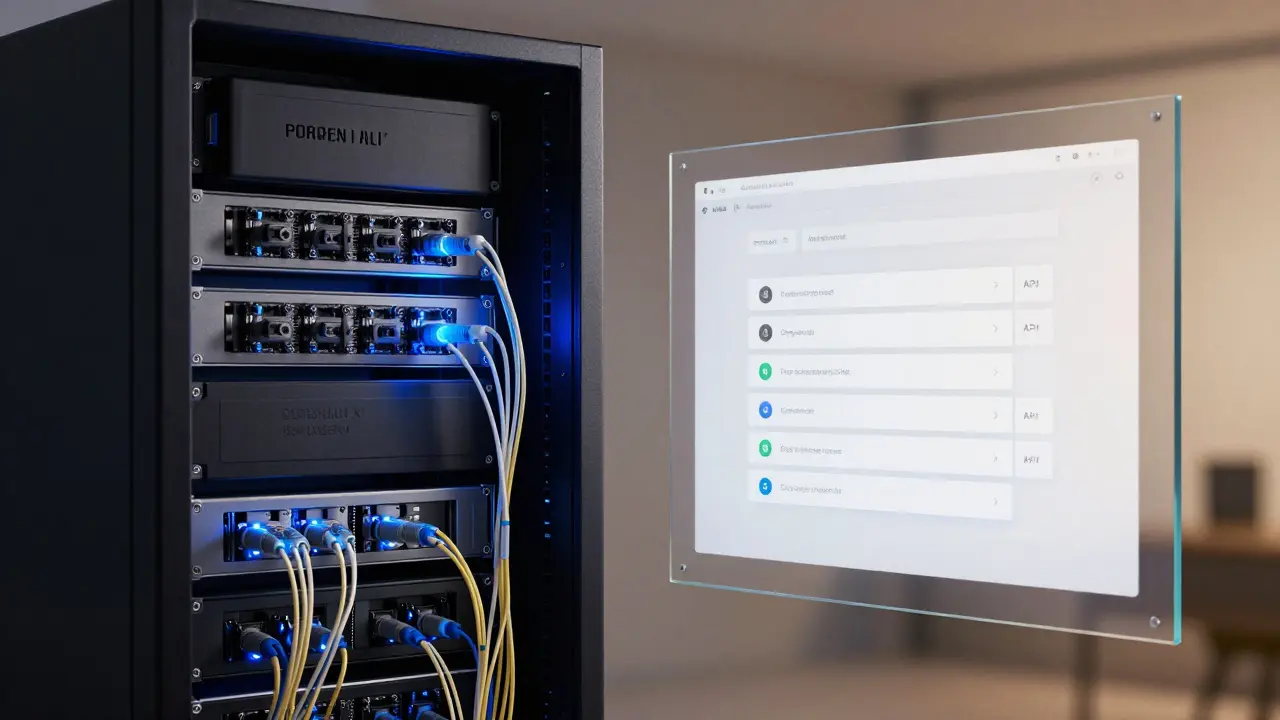
If you choose open-weight models, your architecture becomes heavy. You are now running inference engines. You need to provision GPU clusters-whether on-premise or in a private cloud. You need to manage containerization, load balancing across multiple model instances, and cold-start times. You become responsible for the entire lifecycle of the model deployment.
Consider the operational overhead. A proprietary API is a dependency. An open-weight model is a component you maintain. When Meta releases a new version of Llama, you have to decide if you want to swap out your current deployment. Do you rebuild your containers? Do you update your monitoring dashboards? With an API, the provider handles the upgrade; you just toggle a parameter in your config file.

Security and Governance: Who Holds the Keys?
Security architects often lean toward open-weight models because of data privacy. When you use a proprietary API, your prompt data leaves your network. Even if the provider claims they don’t store it, it travels over the internet to their servers. For highly regulated industries like healthcare or finance, this can be a non-starter.
Running an open-weight model locally keeps your data inside your firewall. You can integrate the model directly into your internal microservices. You can connect it to your private database via Retrieval-Augmented Generation (RAG) without ever exposing that data to a third party. This enables low-latency, high-security workflows that are impossible with remote APIs.
However, this comes with a trade-off: you inherit the security burden. Proprietary providers invest billions in safety research, red-teaming, and alignment techniques. Their models come with built-in moderation layers. When you download an open-weight model, those safety filters might be present, but they are static. You are responsible for patching vulnerabilities in the inference code. You are responsible for ensuring that no one can exploit the model through prompt injection attacks that bypass your local guardrails.
You also need to consider licensing architecture. Models like Llama often have licenses that restrict usage based on company size or sector. Your system needs to enforce these rules. Can your marketing team use this model? Can your military division? With a proprietary API, the terms of service are enforced by the provider. With open-weight, you have to build compliance checks into your deployment pipeline.
Cost Structures: Upfront CapEx vs. Ongoing OpEx
Let’s talk money, because the math surprises people. Open-weight models are free to download. That sounds cheap. But it’s not.
| Cost Factor | Proprietary (API) | Open-Weight (Self-Hosted) |
|---|---|---|
| License Fee | $0 | $0 (usually) |
| Hardware/GPU Costs | Billed per token/call | High upfront or monthly rental |
| Engineering Labor | Low (integration only) | High (infra, tuning, maintenance) |
| Scaling Elasticity | Infinite, instant | Limited by available hardware |
| Data Egress Fees | None (data stays local) | Potential cloud egress costs |
For low-volume applications, proprietary APIs are almost always cheaper. Why buy a $30,000 GPU server when you can make 1,000 API calls for $10? The break-even point depends on your volume, but generally, if you’re making millions of tokens per month, self-hosting starts to look attractive. You stop paying the markup that providers add for their convenience and profit margin.
But remember the engineering labor cost. You need MLOps engineers to keep those GPUs humming efficiently. You need to optimize quantization (reducing precision to save memory) so you can fit larger models on smaller chips. These are specialized skills that are expensive to hire. Proprietary providers absorb all that R&D cost into their pricing. You pay for the outcome, not the process.

Integration and Extensibility: Customization vs. Convenience
How much do you need to change the model’s behavior? If you just need general-purpose chat or summarization, proprietary models are incredibly capable right out of the box. They understand context, follow instructions well, and support features like function calling and multi-modal inputs natively.
Open-weight models shine when you need domain-specific expertise. Imagine you’re building a legal assistant. You can take a base open-weight model and fine-tune it on thousands of case laws. You can adjust its tone, its citation style, and its refusal thresholds. You can embed it directly next to your document repository for ultra-fast retrieval. This tight coupling is difficult with proprietary APIs, which often impose limits on how deeply you can customize the interaction loop.
However, proprietary models often move faster on feature innovation. When OpenAI or Anthropic releases a new capability-like advanced reasoning chains or image generation-you get access to it immediately via the API. With open-weight models, you have to wait for the community or the original creators to release updated weights, and then you have to validate and deploy them yourself. You trade speed of innovation for depth of control.
The Hybrid Approach: Best of Both Worlds?
In practice, most mature organizations in 2026 aren’t choosing one or the other. They’re using both. This is the hybrid architecture pattern.
Use proprietary APIs for general tasks, customer-facing chatbots, and experiments where speed-to-market is critical. Use open-weight models for sensitive internal tools, high-volume predictable workloads, and domains where you need strict data sovereignty and customization.
For example, a bank might use a proprietary model for its public website’s FAQ bot. But for its internal fraud detection analysis tool, it runs a fine-tuned open-weight model on its own secure servers. This balances cost, convenience, and security. It avoids vendor lock-in for critical infrastructure while leveraging the best-in-class performance of closed models for less sensitive tasks.
The key is to design your application layer to be agnostic. Abstract the model interface so you can swap between an API call and a local inference engine without rewriting your core business logic. This flexibility is the ultimate architectural win.
Is an open-weight model truly open source?
No. According to the Open Source Initiative (OSI), true open source requires access to training data, training code, and weights. Open-weight models only provide the final weights and inference code. They lack the transparency needed for full reproducibility and deep auditing of training biases.
When should I choose a proprietary API over an open-weight model?
Choose a proprietary API if you have low to moderate traffic, need rapid development, lack MLOps expertise, or require the latest cutting-edge features without maintenance overhead. It is also better if you do not have strict data residency requirements.
What are the main risks of self-hosting open-weight models?
The main risks include high infrastructure costs (GPUs, electricity), the need for specialized engineering talent to manage deployments, and the responsibility for security patching and safety guardrails. You also face potential license restrictions based on your company size or industry.
Can I fine-tune proprietary models like ChatGPT?
You can use features like fine-tuning endpoints offered by some providers, but you do not have access to the underlying weights. This limits your ability to deeply customize the model’s core behavior or run it offline. Open-weight models allow full fine-tuning and modification of the weights.
How does data privacy differ between the two approaches?
With proprietary APIs, your data is sent to the provider’s servers, raising concerns about data leakage or usage in future training. With open-weight models hosted locally, your data never leaves your environment, offering superior privacy and compliance for sensitive industries.
Lisa Nally
June 11, 2026 AT 12:20Let’s be absolutely clear about the semantic drift happening here because it is genuinely infuriating to see this confusion persist in professional circles. The distinction between 'open-weight' and 'true open-source' is not merely a pedantic technicality for the benefit of lawyers; it is a fundamental architectural divergence that dictates your entire liability matrix. When you deploy a model like Llama, you are engaging with a proprietary artifact that has been sanitized, filtered, and aligned by corporate interests, yet you are expected to bear the full operational burden of its deployment. This creates a bizarre asymmetry where you have the responsibility of an owner but none of the transparency of ownership. You cannot audit the training data for bias because Meta will never release it, meaning your 'guardrails' are essentially guesswork built on top of a black box. It is akin to buying a used car without being allowed to look under the hood, yet being told you are now responsible for maintaining the engine. The industry needs to stop using the term 'open' as a marketing buzzword and start treating these models as licensed software components with all the vendor lock-in implications that entails.
Michael Richards
June 12, 2026 AT 18:18The author misses the point entirely. Self-hosting is only viable if you have infinite money and zero sense of self-preservation regarding your engineering team's sanity. Most companies don't need fine-tuning on legal case law; they need a chatbot that doesn't crash when three people ask it what the weather is at the same time. Proprietary APIs handle that trivially. Building your own GPU cluster is a hobbyist project disguised as enterprise architecture. Stop pretending that running inference engines is a strategic advantage when it's just a massive tax write-off for hardware vendors. If you can't afford the API costs, you shouldn't be building AI apps period. The 'complexity' argument is just fear-mongering to justify bloated infrastructures that no one actually understands how to maintain. Just use the API and move on with your life.
Edward Gilbreath
June 13, 2026 AT 02:26they tell you its about security but its really about control. big tech wants you dependent on their apis so they can track everything you say. open weight models are a trap too though because the weights themselves contain backdoors or biases planted during training that you cant see. nobody trusts anyone anymore. the whole thing is a scam designed to keep us paying rent for intelligence we should own. wake up sheeple
Laura Davis
June 13, 2026 AT 05:15I completely agree with the sentiment about the hidden costs, but let's not throw the baby out with the bathwater! There is genuine power in having sovereignty over your data, especially if you're in healthcare or finance. I've seen teams struggle with latency issues when calling external APIs for sensitive patient data, and switching to a local instance solved that overnight. It's not about hating APIs; it's about recognizing that different problems require different tools. We need to empower engineers to make informed choices rather than just defaulting to the path of least resistance. Your infrastructure strategy should reflect your business values, not just your budget constraints. Let's build systems that respect user privacy while still being efficient!
Edward Nigma
June 14, 2026 AT 01:16actually the hybrid approach is just copium for lazy architects who dont want to commit to either side. you end up with two codebases to maintain and double the complexity. also the idea that proprietary models are safer is laughable since they train on whatever they want including leaked private data. open weight lets you inspect the weights even if you dont have the training data which is more than you get from openai. stop listening to vendor propaganda
kimberly de Bruin
June 15, 2026 AT 07:27we are building cages for our minds and calling them progress. the illusion of choice between open and closed is just another layer of the simulation. true freedom lies outside the binary.