Outcome-Driven Development: Managing Requirements in Vibe Coding Projects
 Jun, 7 2026
Have you ever asked an AI to build a feature and watched it generate code that looked perfect-until you tried to use it? That is the core problem with vibe coding. It feels magical at first. You type a natural language prompt, and the Large Language Model (LLM) spits out HTML, CSS, and backend logic. But as soon as your project grows beyond a simple "hello world" app, things fall apart. The database schema doesn't match the UI. The security rules are missing. The business logic is oversimplified.
This is where Outcome-Driven Development comes in. It is not about abandoning AI; it is about managing it. Instead of letting the AI guess what you want, you create a structured environment where the AI has no choice but to follow your specific requirements. By shifting from chaotic prompting to disciplined, outcome-focused workflows, you can keep the speed of vibe coding while gaining the reliability of traditional software engineering.
The Problem with Unstructured Vibe Coding
Vibe coding relies on conversational interactions with advanced AI systems like Google's Gemini 2.5 Pro or Claude. While these models are incredibly powerful, they lack context. When you ask an LLM to "build a login page," it gives you a generic solution. It does not know that your enterprise requires multi-factor authentication, role-based access controls, or integration with an existing LDAP server.
Without structure, vibe coding leads to three major failures:
- Architectural Incoherence: Prompt-generated designs often look correct initially but contain implicit logic gaps. Over time, this leads to inconsistent data states and fragile systems that break under real-world complexity.
- Security Vulnerabilities: AI tools frequently generate overly permissive configurations, such as wildcard CORS settings, because they prioritize functionality over safety. Human oversight is critical here.
- Integration Nightmares: Enterprise applications must respect established data schemas. AI-generated integration code often works for simple scenarios but fails when connecting to legacy systems or complex APIs.
Outcome-Driven Development solves this by treating the AI not as a magic wand, but as a junior developer who needs clear instructions, constraints, and a defined scope of work.
Establishing a Source of Truth
The foundation of any successful vibe coding project is a centralized "source of truth." You cannot rely on the LLM's general knowledge base alone. You need configuration-driven frameworks that abstract complexity and provide architectural transparency.
Consider using a full-stack framework like Wasp, which is a framework that allows developers to build full-stack web apps with minimal boilerplate. Wasp uses configuration files to define how backend operations, database schemas, and routes connect. This creates a constrained problem space for the AI.
When you define your application architecture in a main.wasp file and your database structure in schema.prisma, you give the LLM a map. Instead of guessing how data flows, the AI references your centralized definitions. This dramatically reduces hallucinations and ensures that every piece of generated code aligns with your overall system design.
The Rule System: Constraining the AI
If the source of truth is the map, then the rule system is the traffic law. In outcome-driven development, you establish explicit boundaries for the AI before writing a single line of code.
Create a .cursor/rules/ directory (or equivalent in your IDE) containing project-specific conventions. These files should include:
- Coding Style Preferences: Naming conventions, indentation styles, and component structures.
- Operational Guidelines: How errors should be handled, how API calls are formatted, and logging standards.
- Authentication Patterns: Specific rules for session management and token validation.
These rules evolve. Do not write them once and forget them. Actively request AI critique of your workflow documentation. Ask the model: "Based on these rules, identify potential conflicts or ambiguities." This meta-level collaboration helps you refine your constraints iteratively, ensuring the AI stays within intentional boundaries.

From PRDs to Vertical Slices
Traditional waterfall development defines all requirements upfront, which is rigid. Pure vibe coding defines nothing upfront, which is chaotic. Outcome-driven development sits in the middle using Product Requirements Documents (PRDs) and vertical slicing.
Start with a detailed PRD that outlines how the application should look, behave, and be implemented. Then, ask the LLM to generate a step-by-step implementation plan based on that PRD. This structured dialogue ensures alignment between human intent and AI execution before code generation begins.
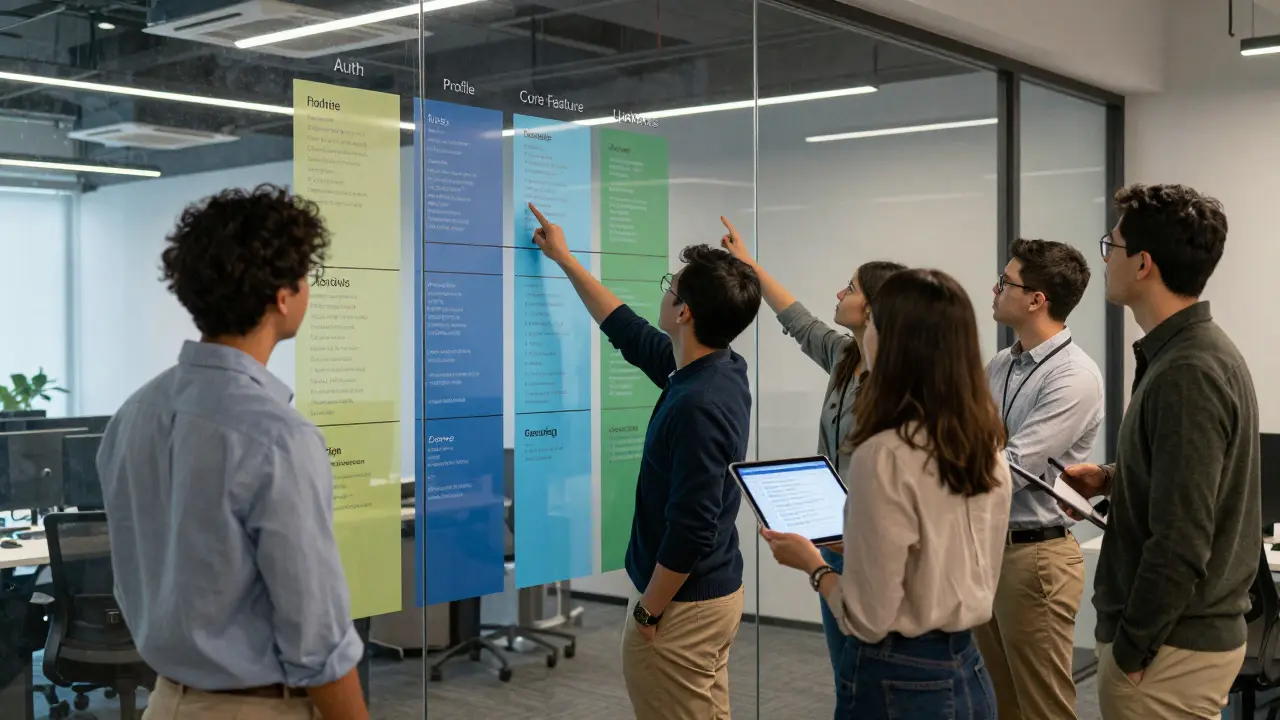
Here is where vertical slicing becomes crucial. Instead of building all database models, then all backend logic, then all UI components, implement complete end-to-end features in manageable phases.
- Phase 1: Authentication. Implement database entities for auth in
schema.prisma, corresponding operations inmain.wasp, server logic, and the login UI. Test it. Validate it. - Phase 2: User Profile. Add profile fields, update operations, and the edit UI.
- Phase 3: Core Feature. Build the main functionality your users care about.
This approach prevents the common failure pattern where generated code works for simple "happy-path" scenarios but breaks under real-world complexity. By validating requirements through working software early, you discover issues intentionally rather than during integration testing.
Documentation as a Requirement
In vibe coding projects, documentation is not an afterthought; it is a requirement. As you complete each vertical slice, you must document the work. Create an ai/docs/ directory where LLMs generate markdown documentation after completing significant feature phases.
The process is systematic:
- Gather relevant implementation files (UI components, server logic, schema definitions).
- Reference the PRD and implementation plan sections covering the completed feature.
- Request the AI to generate documentation focusing on core logic, component connections, and key architectural decisions.
This creates knowledge artifacts useful for both human collaborators and future AI assistance. Without this, feature implementations become opaque shortly after completion, making maintenance nearly impossible.
Governance and Security Controls
Enterprise applications require more than just working code. They need predictable lifecycles, audit trails, and robust security. Basic vibe coding tools often lack these controls, creating significant risks.
You must implement governance mechanisms outside the vibe coding tool itself. This includes separate review processes, security scans, and approval workflows. For example, never trust AI-generated CORS settings. Always verify that access is restricted to trusted domains only.
Platforms like Appfarm offer infrastructure that enterprises require, including multi-environment management and role-based access controls. Alternatively, organizations can deploy custom platforms like CloudFlare's VibeSDK, which provides unified LLM provider access and observability. These solutions maintain the accessibility of vibe coding while preserving the control and accountability that enterprises demand.
| Feature | Unstructured Vibe Coding | Outcome-Driven Development |
|---|---|---|
| Requirement Definition | Natural language prompts only | PRDs + Structured Implementation Plans |
| Architecture | Implicit, inferred by AI | Explicit, defined via config files (e.g., Wasp) |
| Implementation Strategy | Feature-by-feature, often incomplete | Vertical Slices (End-to-End) |
| Security | Often overlooked or permissive | Explicit rules + Human Verification |
| Documentation | Minimal or non-existent | Systematic AI-generated docs per phase |
Practical Workflow for Developers
To start applying outcome-driven development in your next project, follow this sequence for each vertical slice:
- Define Database Entities: Update
schema.prismawith necessary tables and relationships. - Define Operations: Specify API endpoints and functions in your configuration file (e.g.,
main.wasp). - Write Server Logic: Implement the backend operations, ensuring error handling and security checks are included.
- Implement UI Components: Build the frontend interfaces that interact with the defined operations.
- Document: Generate markdown documentation summarizing the logic and connections.
This structured sequence ensures that data model decisions flow naturally into operational definitions, which then inform UI requirements. It prevents the common mistake of designing UI components without understanding actual data availability.
FAQ
What is the difference between vibe coding and outcome-driven development?
Vibe coding is the act of using natural language prompts to generate code via AI. Outcome-driven development is a methodology that structures those prompts and workflows to ensure the resulting code meets specific business requirements, security standards, and architectural coherence. It adds discipline to the creativity of vibe coding.
Why do I need a source of truth in AI-assisted programming?
LLMs have limited context windows and no memory of your entire project unless provided. A source of truth, such as configuration files or schema definitions, gives the AI a consistent reference point. This prevents contradictory code generation and ensures that changes in one part of the app reflect correctly in others.
How do vertical slices improve vibe coding projects?
Vertical slices allow you to build complete, testable features from database to UI in small increments. This reveals hidden complexities and requirement gaps early, rather than discovering them late in the project when integration becomes difficult and costly.
Is vibe coding safe for enterprise applications?
Only if governed. Basic vibe coding lacks the security controls, audit trails, and role-based access required by enterprises. Outcome-driven development addresses this by enforcing explicit security rules, human verification steps, and integration with controlled deployment platforms.
What tools are best for outcome-driven vibe coding?
Frameworks like Wasp help define architecture explicitly. IDEs with rule systems (like Cursor) constrain AI behavior. Platforms like Appfarm or custom setups using CloudFlare's VibeSDK provide the necessary governance and infrastructure for larger teams.