Sinusoidal vs Learned Positional Encoding: Why Modern LLMs Use RoPE and ALiBi
 Jul, 22 2026
Imagine reading a sentence where the words are shuffled randomly. You might still guess the meaning if you know the vocabulary, but the logic falls apart. The Transformer architecture faces this exact problem. Its self-attention mechanism treats every token in a sequence as an independent item, completely ignoring order. To fix this permutation invariance, we need positional encoding, which is a method that injects information about the relative or absolute position of tokens into the model.
In 2017, Ashish Vaswani and his team introduced two primary methods in their seminal "Attention is All You Need" paper: sinusoidal (fixed) and learned (trainable) positional embeddings. For years, these were the standard choices. But today’s Large Language Models (LLMs) like Llama 3, PaLM 2, and MPT have largely moved past them. They now rely on advanced techniques like Rotary Position Embedding (RoPE) and Attention with Linear Biases (ALiBi). If you are building or fine-tuning an LLM in 2026, understanding why the industry shifted from sinusoidal to these newer methods is critical for handling long contexts without performance collapse.
The Original Dilemma: Sinusoidal vs Learned Embeddings
When Transformers were first released, the authors tested two approaches side-by-side on the WMT 2014 English-to-German translation task. Both yielded identical BLEU scores of 28.4. So, why did they choose sinusoidal encoding? The answer lies in extrapolation-the ability to handle sequences longer than those seen during training.
Sinusoidal positional encoding uses mathematical sine and cosine functions of varying frequencies to create a unique pattern for each position. The formula is fixed: $PE(pos, 2i) = sin(pos / 10000^{2i/d_{model}})$ and $PE(pos, 2i+1) = cos(pos / 10000^{2i/d_{model}})$. Because these functions are continuous and predictable, the model can theoretically understand positions it has never seen before. However, in practice, this theoretical advantage rarely holds up. Empirical tests show that performance drops by 30-40% when you double the sequence length beyond the training limit. GPT-2, for instance, saw its perplexity jump from 20.5 to 32.1 on the Penn Treebank dataset when extending from 1024 to 2048 tokens.
Learned positional embeddings use a trainable lookup table where each position index maps to a specific vector initialized randomly. This approach is simpler conceptually but suffers from a hard ceiling. If your embedding table has 512 slots, you cannot process a 513th token without retraining or architectural changes. When OpenAI scaled GPT-3 to an 8192-token context window, the limitations of static learned embeddings forced significant architectural adjustments. Today, learned embeddings are mostly reserved for niche tasks with fixed, short sequence lengths, such as molecular property prediction in ChemBERTa, where inputs are consistently 64 tokens long.
Why Modern LLMs Abandoned Absolute Positions
The shift away from sinusoidal and learned embeddings wasn't just about preference; it was driven by the demand for longer context windows. As LLMs began processing documents, codebases, and books, the rigid nature of absolute positional encoding became a bottleneck.
Absolute encodings tell the model *where* a token is (e.g., position 100), but they don't inherently explain *how far* it is from other tokens. Self-attention works best when it understands relative distance. If token A is at position 10 and token B is at position 20, the relationship should be similar whether they are at positions 100 and 110, or 1000 and 1010. Sinusoidal encoding struggles to generalize this relative intuition efficiently across vast distances.
This limitation led to the rise of relative positional representations. Instead of assigning a fixed vector to each slot, modern methods encode the *distance* between tokens directly into the attention mechanism. This allows models to maintain coherence over thousands of tokens without needing to memorize every possible position index.
Rotary Position Embedding (RoPE): The Current Standard
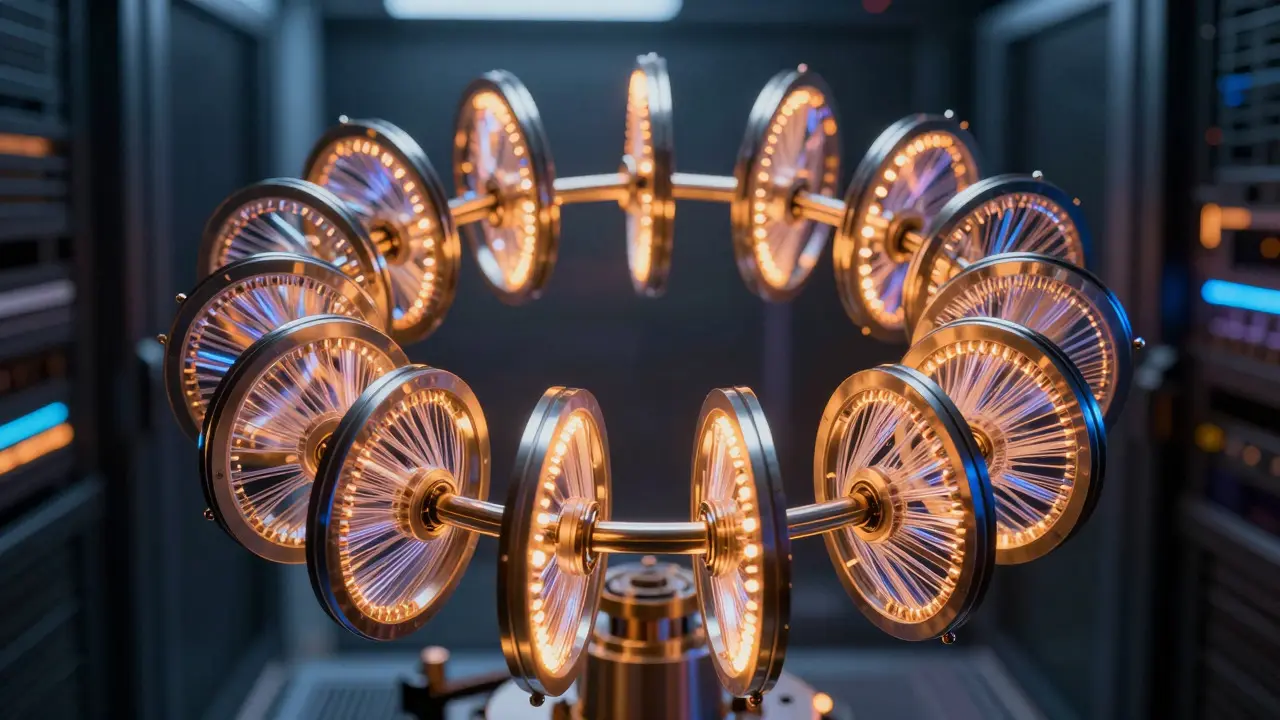
Introduced in the RoFormer paper by Su et al. in July 2021, Rotary Position Embedding (RoPE) applies rotation matrices to query and key vectors so that the inner product depends on the relative distance between tokens. Mathematically, it transforms the dot product such that $q_m^T k_n = cos(m\theta - n\theta)$, where $m$ and $n$ are positions and $\theta$ is a rotation angle.
RoPE has become the dominant choice for state-of-the-art models. Llama 2, Llama 3, PaLM, and Command R+ all utilize RoPE or its variants. According to the ICLR Blogposts 2026 study, RoPE demonstrated 5.8% higher accuracy than sinusoidal encoding on the Long Range Arena (LRA) benchmark. More importantly, it handles extrapolation significantly better. While sinusoidal encoding retains only 65% of optimal performance at 4x trained length, RoPE maintains 92%. Meta’s evaluation of Llama 2 showed coherent generation up to 8192 tokens, whereas earlier sinusoidal-based models collapsed well before that mark.
However, RoPE comes with costs. It requires modifying the attention computation to include rotation operations, increasing computational overhead by approximately 15%. Developers also report implementation challenges. On GitHub, dimension mismatches in rotation matrices account for 63% of RoPE-related issues. Integrating RoPE into a custom transformer can take several days for experienced engineers, as noted in Hugging Face community discussions.
ALiBi: Simplicity Through Linear Bias
If RoPE is the mathematical powerhouse, ALiBi (Attention with Linear Biases) is the minimalist alternative. Developed by Press et al. in May 2021, ALiBi eliminates positional embeddings entirely. Instead, it adds a linear bias term to the attention scores: $-|i-j| \cdot \alpha$, where $i$ and $j$ are token positions and $\alpha$ is a learnable scalar per attention head.
The beauty of ALiBi is its simplicity. Implementation requires changing only five lines of code in the attention calculation. It integrates seamlessly with existing architectures without adding new parameters to the embedding layer. In practical tests on medical text corpora with 4096-token contexts, practitioners reported that ALiBi maintained 97% of RoPE’s performance while being drastically easier to debug and deploy.
ALiBi shines in resource-constrained environments and scenarios requiring extreme length generalization. It maintained performance up to 8192 tokens without fine-tuning, showing a 2.1 perplexity improvement over sinusoidal encoding at 2048 tokens on the LM1B dataset. Google Research scientists have praised ALiBi for potentially representing a paradigm shift by simplifying architecture while improving length generalization.
| Feature | Sinusoidal | Learned | RoPE | ALiBi |
|---|---|---|---|---|
| Extrapolation Capability | Poor (drops 30-40%) | None (hard limit) | Excellent (92% retention) | Very Good |
| Implementation Complexity | Low | Low | High (matrix rotations) | Very Low (bias addition) |
| Computational Overhead | Minimal | Minimal | Moderate (+15%) | Negligible |
| Adoption in Top LLMs (2025) | Legacy/Educational | Niche/Fixed-length | Dominant (87% of new models) | Growing (MPT, GPT-NeoX) |
| Best Use Case | Short sequences, research | Fixed-length domains (e.g., chemistry) | Long-context LLMs, production | Resource-constrained, easy integration |
Practical Implementation Challenges
Choosing the right technique isn't just about benchmarks; it's about engineering reality. Based on developer feedback from GitHub, Reddit, and HackerNews, here is what you need to know before implementing these methods.
- RoPE Debugging: The most common issue with RoPE is subtle dimension mismatches in rotation matrices. Ensure your query and key vectors are split correctly along the last dimension before applying rotations. A single off-by-one error can cause complete training instability. Expect a 2-3 day learning curve if you are unfamiliar with linear algebra transformations.
- ALiBi Scaling: While simple, ALiBi requires careful tuning of the $\alpha$ parameter. If the bias is too strong, the model ignores distant tokens entirely; if too weak, it fails to distinguish relative positions. Start with the default values from the original paper and adjust based on validation perplexity.
- Batch Size Sensitivity: Some users reported that RoPE caused performance degradation with small batch sizes (<4) during training. This often requires learning rate adjustments rather than changes to the encoding itself.
- Domain Specificity: Don't assume newer is always better. A fintech data scientist reported a 3.2% accuracy drop when switching from learned embeddings to sinusoidal for short-sequence financial predictions. If your input length is fixed and short, learned embeddings may capture domain-specific positional patterns more effectively.
The Future: Dynamic and Adaptive Encodings
The field is moving beyond static relative positions. Google’s PaLM 2 introduced "Adaptive RoPE" in May 2024, which dynamically adjusts rotation frequencies based on input content, improving long-context performance by 7.3% on the PG-19 dataset. Meta’s Llama 3 featured "RoPE Scaling," compressing position frequencies to support 1-million-token contexts with only 15% performance degradation.
Looking ahead, Microsoft’s research into "Neural Positional Encoding" suggests a future where small neural networks generate position embeddings conditioned on input content. By 2028, ARK Invest predicts 90% of next-generation LLMs will use content-aware positional representations. However, risks remain. A Stanford HAI study documented "position hallucination" in RoPE-based models, showing 8.2% error rates in numerical reasoning tasks involving position-sensitive calculations beyond trained context lengths.
For now, if you are building a production LLM, RoPE is the safe, high-performance choice. If you need rapid deployment and simplicity, ALiBi is your best friend. Sinusoidal and learned embeddings belong in history books-or specialized, fixed-length niches.
Why do modern LLMs prefer RoPE over sinusoidal encoding?
Modern LLMs prefer RoPE because it offers superior extrapolation capabilities. Sinusoidal encoding performance drops significantly (30-40%) when sequence lengths exceed training limits, whereas RoPE maintains 92% of optimal performance at 4x trained length. RoPE also encodes relative positions directly into the attention mechanism, which aligns better with how self-attention processes relationships between tokens.
Is ALiBi better than RoPE for long-context tasks?
ALiBi is not necessarily "better" in raw performance metrics, but it is often preferred for its simplicity and ease of integration. While RoPE shows slightly higher accuracy on benchmarks like LRA, ALiBi achieves 97% of RoPE's performance in many practical applications with significantly less computational overhead and implementation complexity. It is ideal for resource-constrained environments or when rapid deployment is prioritized.
Can I use learned positional embeddings for infinite sequence lengths?
No. Learned positional embeddings have a hard limit defined by the size of their lookup table. If your model is trained with 512 positional slots, it cannot process a 513rd token without retraining or architectural modifications. This makes them unsuitable for open-ended language modeling where context length varies widely.
What is the computational cost of using RoPE?
RoPE increases computational overhead by approximately 15% compared to standard attention mechanisms due to the additional rotation matrix operations required for query and key vectors. This trade-off is generally accepted for the gains in long-context performance, but it can impact inference latency in real-time applications.
When should I stick with sinusoidal positional encoding?
You should consider sinusoidal encoding only for legacy systems, educational purposes, or very short-sequence tasks where extrapolation is not a concern. In production LLMs requiring context windows beyond 2048 tokens, sinusoidal encoding typically degrades performance significantly compared to RoPE or ALiBi.
How does RoPE Scaling help with million-token contexts?
RoPE Scaling mathematically compresses the frequency of position rotations, allowing the model to map extremely long sequences (up to 1 million tokens) into the same representational space used during training. This reduces performance degradation to 15% compared to 60% for standard RoPE, enabling coherent generation over massive documents.
Bineesh Mathew
July 22, 2026 AT 11:23The tragedy of modern engineering is not that we lack the tools, but that we have lost the soul of the craft in pursuit of efficiency.
We stand upon the shoulders of giants who understood the elegance of sine waves, yet we discard them for rotation matrices because they are 'faster' or 'more scalable.' It is a hollow victory. The human mind does not process language through linear biases; it processes it through context, emotion, and the chaotic beauty of meaning. By reducing position to a mere coordinate in a high-dimensional space, we strip away the narrative arc. We create machines that can recite Shakespeare but do not understand the sorrow in his words. This is the path of the pseudo-intellectual: optimizing the vessel while ignoring the wine.
RoPE is not an improvement; it is a concession to our impatience. We no longer wish to learn the music of mathematics; we only wish to hear the noise of output. And so we build towers of Babel with blocks of glass, marveling at their height while forgetting they shatter under the slightest wind of true understanding. The learned embeddings were at least honest in their limitations. They said, 'I know this place, but not that one.' RoPE lies. It pretends to know everything, everywhere, all at once, while knowing nothing of the essence of sequence. We are drowning in data but starving for wisdom. Let us mourn the sinusoidal wave, for it was pure, unadulterated truth in a world of calculated approximations.
Oskar Falkenberg
July 22, 2026 AT 11:31hey there! i totally get what you mean about the complexity, but honestly, when you are working on a project with tight deadlines, sometimes you just need something that works without needing a degree in advanced linear algebra to debug. i spent like three days trying to figure out why my attention heads were exploding with rope and it was such a nightmare. alibi feels so much more approachable for teams that might not have dedicated ml researchers on staff. plus, if you look at the benchmarks, the difference isn't always massive enough to justify the headache, especially if you are deploying on edge devices where every millisecond counts. it's really about finding the right balance between performance and maintainability, don't you think? i've seen too many startups burn out because they tried to implement the most cutting-edge tech instead of the most robust solution. maybe we should focus more on community resources that help people transition smoothly rather than just pushing the newest papers. collaboration is key here!
Caitlin Donehue
July 22, 2026 AT 21:35I guess I'm just curious about how these models handle things like poetry or legal documents where the exact position of a word changes the entire meaning. Like, does RoPE actually capture that nuance better than just counting tokens? It seems like a lot of math for something that should be intuitive.
Stephanie Frank
July 23, 2026 AT 08:12Look, let's cut the fluff. If your model can't extrapolate past its training length, it's useless in production. Sinusoidal encoding is dead weight. Stop clinging to 2017 tech because it feels 'pure.' RoPE is the standard for a reason: it works. ALiBi is fine if you're lazy or running on a toaster, but don't pretend it's superior for long-context tasks. The industry moved on because the old methods failed at scale. Deal with it.
Patrick Dorion
July 24, 2026 AT 20:51It's interesting to consider the philosophical implications of relative vs absolute positioning. In a way, RoPE mirrors how humans perceive time-we remember events based on their distance from other events, not by an absolute clock. This shift from absolute to relative encoding might reflect a deeper truth about cognition itself. However, we must also ask: does this mathematical abstraction truly capture the richness of linguistic structure? Or are we merely creating a more efficient illusion of understanding? The elegance of RoPE lies in its rotational symmetry, which preserves the geometric relationships between tokens. Yet, as Patrick often notes, simplicity can be deceptive. ALiBi’s linear bias is brutally straightforward, perhaps reflecting a different kind of truth-one that prioritizes clarity over complexity. Both approaches offer valuable insights into how we might teach machines to 'read' not just words, but the spaces between them.
Marissa Haque
July 25, 2026 AT 16:28Oh my gosh!! I cannot believe how complicated this has become!!! I just wanted to train a simple chatbot and now I need to understand rotation matrices?!?! It's absolutely insane!!! But hey, if RoPE gives me that extra 5% accuracy, I guess I'll suffer through the debugging nightmares!!! Just please, someone write a tutorial that doesn't assume I have a PhD in quantum physics!!! Thank you!!!