AI Code Is Guilty Until Proven Secure: A Policy Framework for Teams
 Jun, 29 2026
Imagine your team ships a feature built entirely by an AI coding assistant. It looks clean. It passes the unit tests. But hidden inside is a vulnerability that lets attackers bypass authentication. This isn’t a hypothetical nightmare; it’s a documented reality. Research from the Center for Security and Emerging Technology (CSET) found that nearly half of AI-generated code snippets contain exploitable bugs. The old assumption that "code is safe until proven otherwise" is dead. In 2026, the new standard is clear: AI code is guilty until proven secure.
This shift demands more than just installing a new scanner. It requires a fundamental change in how engineering teams govern, review, and deploy software. You cannot treat AI-generated code like human-written code because the risks are different. AI models hallucinate, they inherit biases from training data, and they optimize for functionality over security. To protect your organization, you need a policy framework that treats every line of AI-generated code as untrusted until it passes explicit verification.
The Three Layers of AI Code Risk
Before building a policy, you must understand what you are defending against. AI code security isn't just about syntax errors. The risks fall into three distinct categories that most traditional security tools miss.
- Insecure Code Generation: The model outputs code with missing input validation, weak cryptography, or unsafe memory handling. For example, an AI might suggest using a predictable random number generator for session tokens because it’s common in tutorial examples, not production systems.
- Model-Level Threats: The AI model itself can be manipulated through prompt injection or poisoned training data. If an attacker influences the model’s behavior, the code it generates becomes a vector for attack.
- Supply Chain Contamination: Insecure AI-generated code often gets copied into open-source libraries or internal utilities. When other developers reuse these components, the vulnerability spreads across the entire ecosystem, creating a feedback loop of insecurity.
Contrast Security notes that AI doesn’t necessarily make code less secure than human-written code, but it does increase the volume and speed of deployment. More code means a larger attack surface. Without specific controls, you are simply accelerating the introduction of vulnerabilities.
Building the Zero-Trust Policy Foundation
A "guilty until proven secure" stance is essentially a zero-trust architecture applied to code generation. You do not trust the source (the AI); you verify the output. Here is how to structure this policy within your team.
1. Define Explicit Usage Boundaries
Not all code is created equal. Your policy should classify where AI can and cannot be used. Checkmarx recommends prohibiting AI-generated code in high-risk areas such as:
- Authentication and authorization modules
- Cryptographic implementations
- Financial transaction logic
- Data privacy handling (PII/PHI)
For lower-risk areas, like UI components or boilerplate CRUD operations, AI can be permitted but still requires automated scanning. This risk-based approach prevents governance paralysis while protecting critical assets.
2. Mandate Identification and Attribution
You need to know which code was generated by AI. Require developers to tag AI-generated files or functions with specific comments or metadata. This allows security teams to prioritize reviews and apply stricter rules to those sections. Without visibility, you cannot enforce accountability.
3. Establish a Shared Responsibility Model
Security is no longer just the AppSec team’s job. Developers must own the security of the code they integrate, even if an AI wrote it. Contrast Security emphasizes that developers need training to critically evaluate AI suggestions. They should ask: "Does this handle edge cases? Is this input validated? Does this follow our least-privilege principles?" Peer reviews must include a specific checklist for AI-generated artifacts.
Technical Controls: Automating the Verification
Policies fail without enforcement. You need technical controls that automatically verify AI code before it reaches production. Manual review is impossible at the scale AI enables. Here is the stack you need.
| Control Type | Function | Key Tools/Approaches |
|---|---|---|
| Static Application Security Testing (SAST) | Scans source code for vulnerabilities before compilation. | Checkmarx, SonarQube, integrated IDE plugins. |
| Software Composition Analysis (SCA) | Detects vulnerable dependencies introduced by AI. | Snyk, Black Duck, GitHub Dependabot. |
| Policy Engines | Enforces custom business rules on code changes. | ZeroPath, OPA (Open Policy Agent). |
| Runtime Application Self-Protection (RASP) | Detects attacks in real-time during execution. | Contrast Security, F5 Advanced WAF. |
| Contextual Knowledge Graphs | Maps code to architecture to detect logic flaws. | Latio Tech, Cisco Project CodeGuard. |
Cisco Project CodeGuard is a notable open-source framework that builds secure-by-default rules directly into AI coding workflows. It uses validators to enforce security rules automatically as code is generated. Similarly, ZeroPath allows organizations to define security rules in natural language, which are then translated into machine-enforceable policies. These tools bridge the gap between high-level policy and low-level code enforcement.
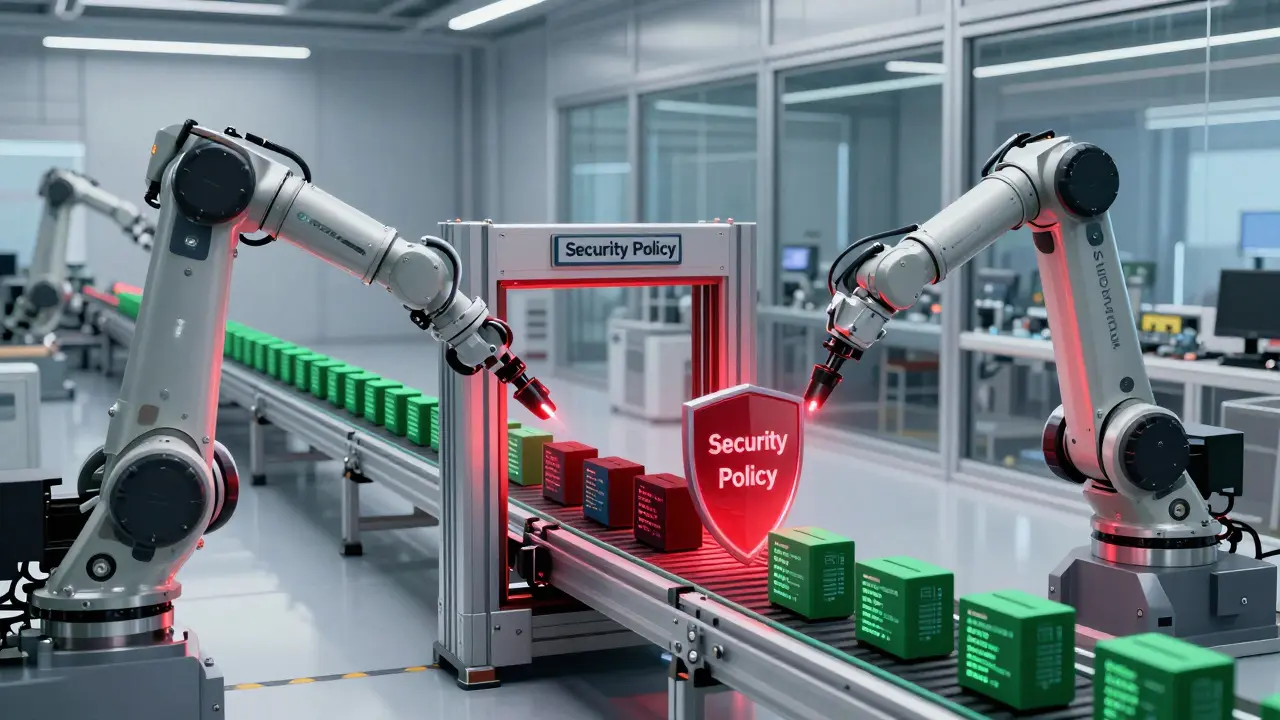
Integrate these tools into your CI/CD pipeline. If AI-generated code fails a security scan, the build should break automatically. Do not allow exceptions. This creates a hard gate that ensures only verified code moves forward.

Governance and the NIST AI RMF Alignment
To make this framework sustainable, align it with established standards. The NIST AI Risk Management Framework (AI RMF) provides a robust scaffold for managing AI risks. It is structured around four functions: Govern, Map, Measure, and Manage. Here is how to apply it to AI code:
- Govern: Establish clear roles. Who approves AI tool usage? Who defines the security thresholds? Create an AI Code Usage Policy document that is accessible to all engineers.
- Map: Inventory your AI footprint. Use automated discovery tools to identify where AI is being used in your repositories. Understand the flow of AI-generated code from ideation to production.
- Measure: Track metrics like vulnerability density in AI-generated code vs. human code, time-to-remediation, and the percentage of code covered by security scans. Data drives improvement.
- Manage: Implement controls. Select the right tools, train developers, and continuously update policies based on new threat intelligence.
ArmorCode suggests starting small. Don’t try to govern every line of code on day one. Begin with automated discovery, prioritize high-risk findings, and iteratively expand coverage. This incremental approach reduces friction and builds organizational maturity.
Cultural Shift: Training and Accountability
Technology alone won’t save you. You need a cultural shift. Developers often over-trust AI assistants, assuming the output is correct because it looks professional. You must retrain them to be skeptical.
Conduct workshops that show real examples of insecure AI-generated code. Demonstrate how easy it is to introduce SQL injection or hardcoded credentials when relying solely on AI suggestions. Emphasize that AI is a copilot, not an autopilot. The developer remains the pilot responsible for safety.
Create a blame-free environment where reporting AI-induced vulnerabilities is encouraged. If a developer finds a flaw in AI-generated code, celebrate the catch. This reinforces the value of scrutiny and strengthens the team’s security mindset.
Implementation Roadmap for Teams
Ready to start? Here is a practical roadmap to implement a guilty-until-proven-secure framework.
- Month 1: Discovery and Policy Drafting. Identify current AI tool usage. Draft a basic AI Code Usage Policy defining prohibited areas (e.g., auth, crypto). Assign ownership to AppSec and Engineering leads.
- Month 2: Tool Integration. Integrate SAST and SCA scanners into your CI/CD pipeline. Configure them to flag AI-generated code specifically if possible. Set up automated blocking for critical vulnerabilities.
- Month 3: Training and Pilot. Train developers on AI security risks. Run a pilot program with one team, enforcing strict review processes for AI-generated code. Gather feedback and adjust policies.
- Month 4-6: Scale and Refine. Roll out policies organization-wide. Implement runtime monitoring (RASP) for early detection of escaped vulnerabilities. Review metrics and refine risk-based prioritization.
Expect resistance. Developers will complain about slowed velocity. Counter this by showing data: faster remediation times and fewer production incidents justify the upfront cost. As automation improves, the friction will decrease.
Future Outlook: Context-Aware Security
The field is evolving rapidly. Latio Tech predicts that AI code security will move toward contextual knowledge graphs that understand your specific architecture. Instead of generic rules, future tools will generate threat models tailored to your product. This means higher accuracy and fewer false positives.
Additionally, benchmarks for AI models are shifting. CSET calls for evaluating models on security metrics, not just functional correctness. As model providers compete on security, the baseline risk of AI-generated code may decrease. However, until then, your responsibility remains unchanged: verify everything.
Adopting a "guilty until proven secure" stance is not about slowing down innovation. It’s about enabling safe innovation. By embedding security into the AI workflow, you protect your reputation, your customers, and your bottom line. The question is no longer if you should secure AI code, but how quickly you can implement the framework.
What does "AI code is guilty until proven secure" mean?
It is a zero-trust policy stance where all AI-generated code is treated as untrusted by default. It must pass explicit security verification, including automated scanning and peer review, before it can be deployed to production. This approach assumes vulnerabilities exist until proven otherwise.
Why is AI-generated code considered risky?
Research shows AI models frequently generate code with bugs, missing input validation, and insecure patterns. They optimize for functionality, not security. Additionally, AI can introduce supply chain risks by propagating insecure code across projects and is susceptible to manipulation via prompt injection or poisoned training data.
How do I start implementing this framework in my team?
Start by discovering where AI is currently used in your codebase. Draft a policy that prohibits AI in high-risk areas like authentication and cryptography. Integrate static analysis (SAST) and software composition analysis (SCA) tools into your CI/CD pipeline to automatically scan AI-generated code. Train developers to critically review AI output.
Which tools help enforce AI code security policies?
Tools like Checkmarx and SonarQube provide static analysis. ZeroPath and Open Policy Agent (OPA) offer policy engines to enforce custom rules. Cisco Project CodeGuard provides open-source rulesets for AI agents. Runtime protection tools like Contrast Security detect issues that escape pre-deployment checks.
How does the NIST AI RMF relate to AI code security?
The NIST AI Risk Management Framework provides a governance structure for managing AI risks. Its four functions-Govern, Map, Measure, and Manage-help organizations establish policies, inventory AI usage, track security metrics, and implement controls for AI-generated code, ensuring alignment with broader security standards.
Should I ban AI coding assistants entirely?
No, banning them ignores their productivity benefits. Instead, adopt a risk-based approach. Allow AI in low-risk areas like boilerplate code but prohibit it in sensitive components like authentication. Enforce strict verification and review processes for all AI-generated code to mitigate risks while capturing efficiency gains.
Lisa Puster
July 1, 2026 AT 04:36another day another corporate panic attack about ai because some junior dev cant write basic auth logic without a prompt
you guys are so obsessed with blaming the tool instead of fixing your broken hiring pipeline its pathetic
half these 'vulnerabilities' are just lazy coding habits that existed before llms and will exist after
stop pretending this is a new problem when it is just old incompetence scaled up
Joe Walters
July 3, 2026 AT 01:28honestly i think the real issue is that nobody actually reads code anymore
we just trust the green checkmarks in github actions like some kind of cult
if you dont understand what the ai generated then you have no business merging it period
its not about the tech its about the sheer laziness of modern engineers who treat security as an afterthought
i mean come on we used to have actual code reviews now we just click approve and pray
its embarrassing really
Robert Barakat
July 4, 2026 AT 02:37the concept of guilt implies a moral failing which software does not possess
yet we project human judgment onto deterministic outputs creating a paradox of accountability
perhaps the framework should focus on epistemological humility rather than punitive verification protocols
we must ask whether the observer defines the security or if security exists independently of observation
this shift from functional correctness to existential risk is profound yet underexamined in current discourse
Michael Richards
July 4, 2026 AT 05:48listen up because i am only going to say this once
if you are shipping ai code without manual review you are negligent
period
end of story
there is no excuse for treating automated output as trusted source material
your job is to verify every single line or get out of the industry
security is not a feature it is a discipline and most of you lack it completely
stop making excuses and start doing the work required to protect your users
anything less is professional malpractice
Laura Davis
July 4, 2026 AT 13:51i feel like we are missing the human element here entirely
developers are stressed and overwhelmed trying to keep up with velocity demands
instead of shaming them we need better support systems and realistic expectations
let us create safe spaces where admitting mistakes with ai tools is encouraged rather than punished
we can do better by supporting each other through this transition rather than tearing people down
empathy builds stronger teams than fear ever could
Lisa Nally
July 6, 2026 AT 13:33from a technical standpoint the integration of sast and sca into ci cd pipelines is non negotiable
the latency introduced by comprehensive static analysis is negligible compared to the cost of a breach
organizations must implement zero trust architectures at the code generation layer utilizing policy engines like opa
without granular visibility into ai provenance the entire supply chain remains opaque and vulnerable
we need rigorous benchmarking of model outputs against known vulnerability databases continuously
this is not optional for enterprise grade applications