Attention Mechanisms in Generative AI: From Self-Attention to Flash Attention
 Sep, 13 2026
Why can a modern AI model read a 200-page book and answer questions about it instantly, while older models struggled with just a few sentences? The secret isn't magic; it's math. Specifically, it's the Attention Mechanism, a neural network component that allows models to assign different weights to different parts of the input data based on relevance. Before this breakthrough, AI treated every word equally or forgot early context entirely. Today, from GPT-4 to LLaMA 3, attention is the engine driving generative intelligence. But as context windows exploded from thousands to millions of tokens, standard attention hit a wall-memory limits. Enter Flash Attention, an IO-aware algorithm that optimizes memory usage without sacrificing mathematical exactness. This article breaks down how we got here, why standard attention is expensive, and how Flash Attention changed the game for developers and researchers.
The Problem With Early Sequence Models
To appreciate attention, you have to look at what came before. In the early 2010s, Recurrent Neural Networks (RNNs) were the standard for processing sequences like text. RNNs process data step-by-step, carrying a hidden state forward. Think of it like reading a sentence by only remembering the last word you saw. If a sentence is long, the model forgets the beginning by the time it reaches the end. This "vanishing gradient" problem made learning long-range dependencies nearly impossible.
In 2014, Dzmitry Bahdanau and colleagues introduced a fix for machine translation. They proposed Additive Attention, which allowed the decoder to look back at all previous encoder states and decide which ones mattered most for the current word. Instead of compressing an entire sentence into one fixed vector, the model learned to align source words with target words dynamically. This wasn't just a tweak; it was a paradigm shift. It proved that explicitly modeling relationships between distant tokens improved performance significantly, boosting BLEU scores in translation tasks by several points.
The Transformer Revolution: Self-Attention
If Bahdanau lit the fuse, Ashish Vaswani and his team at Google blew the doors off in 2017 with the paper "Attention Is All You Need." They removed recurrence entirely. Why process sequentially when you can look at everything at once? The result was the Transformer Architecture, built almost exclusively on self-attention layers.
Self-Attention works by creating three vectors for each token: Query (Q), Key (K), and Value (V). Imagine you're searching for information in a library. Your search query is Q. Each book has a label (K) and content (V). The model calculates how well your query matches each book's label using a dot product. High similarity means high weight. The final output is a weighted sum of the values (V).
This parallelization is key. Unlike RNNs, Transformers don't wait for the previous word to be processed. They compute relationships for all words simultaneously. This mapped perfectly onto GPUs, which thrive on parallel matrix operations. The original Transformer base model used 8 attention heads, meaning it ran 8 separate attention calculations in parallel to capture different types of relationships-syntax, semantics, position, etc.
| Model | Release Year | Context Window (Tokens) | Architecture Type |
|---|---|---|---|
| GPT-2 | 2019 | 1,024 | Decoder-only |
| GPT-3 | 2020 | 2,048 | Decoder-only |
| GPT-4 | 2023 | 8,192 - 32,768 | Decoder-only |
| Claude 2 | 2023 | 100,000 - 200,000 | Decoder-only |
| LLaMA 3 | 2024 | 8,192+ | Decoder-only |
The Quadratic Bottleneck
So, if self-attention is so powerful, why isn't it free? Because it scales poorly. To calculate attention for a sequence of length $n$, the model must compute a score between every token and every other token. This creates an $n \times n$ attention matrix.
For short texts, this is fine. But as we moved toward longer contexts, the cost exploded. If you double the sequence length, you quadruple the computation and memory requirements. This is known as quadratic complexity ($O(n^2)$).
Consider a 4,096-token context. The attention matrix contains over 16 million elements per head. For a model with 96 heads like GPT-3, storing these intermediate scores in GPU memory became a massive bottleneck. Modern GPUs like the NVIDIA A100 have fast processors but limited high-bandwidth memory (HBM). Standard implementations would load Q, K, and V from HBM, compute the huge matrix, write it back to HBM, read it again for softmax, and then multiply by V. These repeated reads and writes slowed everything down, leaving the GPU cores idle while waiting for data.
Flash Attention: Speed Without Sacrifice
In 2022, Tri Dao and colleagues published "FlashAttention," addressing the hardware reality rather than changing the math. Previous attempts to speed up attention, like Reformer or Linformer, approximated the calculation to reduce complexity. They made the model faster but slightly less accurate.
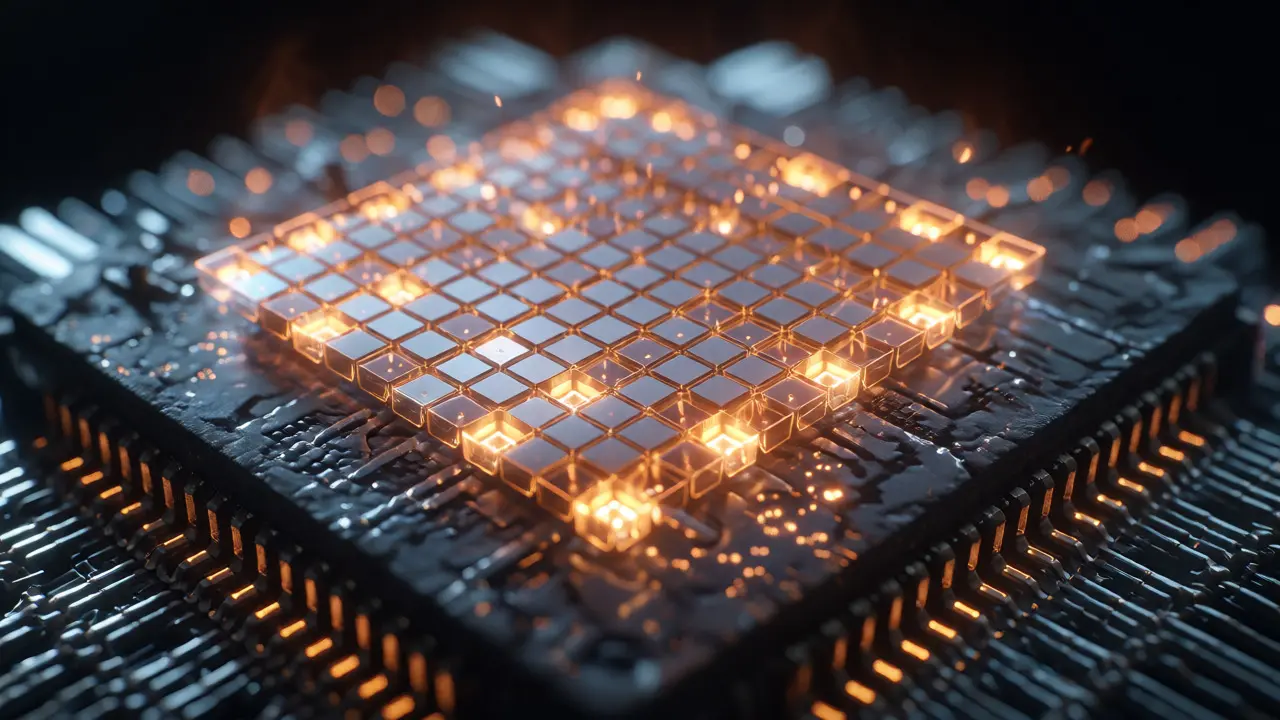
Flash Attention is different. It is an exact implementation of standard softmax attention, optimized for Input/Output (IO) efficiency. The core idea is simple: don't store the full $n \times n$ matrix in slow HBM. Instead, break the computation into small tiles that fit into the GPU's super-fast on-chip SRAM.
Here’s how it works:
- Tiling: The algorithm loads small blocks of Q, K, and V into SRAM.
- Fused Operations: It computes the partial attention scores, applies softmax, and multiplies by V-all within the fast SRAM.
- Online Softmax: Since softmax requires knowing the maximum value across the entire row, Flash Attention uses a clever numerical trick to update running maximums and sums incrementally. This avoids needing to see the whole row at once.
- Accumulation: Results are accumulated in registers and written back to HBM only once at the end.
By minimizing trips to the slow main memory, Flash Attention achieved 2-4x speedups and reduced memory usage by 10-20x for long sequences. Crucially, the output is mathematically identical to standard attention, so accuracy doesn't drop.
From Theory to Practice: Flash Attention 2 and Beyond
The initial FlashAttention paper was a proof of concept. By July 2023, Dao released FlashAttention-2, which further optimized the kernel for newer hardware like the NVIDIA H100. It improved parallelism and reduced non-matmul FLOPs, pushing effective throughput closer to the theoretical peak of the GPU.
Integration has become seamless. PyTorch 2.0 introduced `torch.nn.functional.scaled_dot_product_attention`, which automatically dispatches to Flash Attention kernels when available. Hugging Face’s libraries also support it out of the box. For developers, enabling Flash Attention often means adding a single flag or updating a library version.
The impact on real-world applications is tangible. Teams training models like LLaMA 2 or Mistral report 2x-3x faster training times. During inference, serving costs drop because you can fit larger batches into GPU memory. Some benchmarks suggest that combining Flash Attention with quantized KV caches allows a single server to handle hundreds of concurrent users, making large-scale AI services economically viable.
Common Pitfalls and Misconceptions
Despite its benefits, Flash Attention isn't a silver bullet for every scenario. Here are a few things to watch out for:
- Hardware Compatibility: Flash Attention relies on specific CUDA features. Older GPUs (pre-Ampere architecture, e.g., V100) may not support the latest versions efficiently or at all.
- Short Sequences: For very short inputs (e.g., under 512 tokens), the overhead of tiling might make standard attention slightly faster or comparable. The gains shine with long contexts.
- Debugging Difficulty: Because the operations are fused into custom CUDA kernels, debugging intermediate values is harder than with standard PyTorch modules. You can't easily inspect the attention matrix during execution.
- Interpretability: While attention weights are useful, remember that high attention doesn't always mean causality. Research by Jain and Wallace showed that attention maps can be manipulated without changing predictions, so treat them as hints, not definitive explanations.
Future Outlook: Where Does Attention Go Next?
We are currently in the era of scaling context. Models are moving toward 1-million-token windows. Standard attention struggles here even with Flash optimizations. Researchers are exploring hybrid approaches, mixing attention with State Space Models (SSMs) like Mamba, which offer linear complexity. Others are looking at sparse patterns that ignore irrelevant tokens entirely.
However, attention remains central. Its ability to dynamically re-weight information is too valuable to discard. We will likely see more co-design between algorithms and hardware, where future GPUs include specialized instructions for attention-like operations. For now, mastering Flash Attention is essential for anyone building production-grade generative AI systems.
What is the difference between self-attention and cross-attention?
Self-attention occurs within a single sequence, where queries, keys, and values all come from the same input (e.g., a sentence attending to itself). Cross-attention involves two different sequences, typically in encoder-decoder architectures. The decoder generates queries, while the encoder provides keys and values, allowing the decoder to focus on relevant parts of the input prompt while generating output.
Does Flash Attention change the model's accuracy?
No, Flash Attention is designed to be mathematically exact. It produces the same results as standard scaled dot-product attention, within floating-point precision limits. Unlike approximate methods like Performer or Linformer, Flash Attention does not sacrifice accuracy for speed; it achieves speed through better memory management and hardware utilization.
Why is attention considered O(n²) complexity?
In standard attention, every token in a sequence of length $n$ must interact with every other token. This requires computing an $n \times n$ matrix of attention scores. As $n$ increases, the number of computations grows quadratically. Doubling the sequence length quadruples the computational work and memory required to store the intermediate scores.
Can I use Flash Attention on any GPU?
Not exactly. Flash Attention requires specific hardware features found in NVIDIA Ampere (A100) and later architectures (H100, B200). Older GPUs like the V100 or consumer cards like the RTX 30 series may have limited or no support depending on the software stack version. Always check the compatibility table for the specific flash-attn library version you are using.
How does multi-head attention improve performance?
Multi-head attention runs multiple attention mechanisms in parallel with different learned projections. This allows the model to attend to different subspaces of the representation simultaneously. One head might focus on syntactic structure, another on semantic similarity, and another on positional proximity. Concatenating these outputs gives the model a richer understanding of the context.
Onyinyechi Nwosu
September 15, 2026 AT 02:07this is exactly what i needed to hear today, thanks for breaking it down so simply
Chandan Singh
September 15, 2026 AT 13:29Technically speaking, the article glosses over the specific memory bandwidth bottlenecks of HBM3 vs HBM2e which are critical when discussing Flash Attention 2 on H100s. While the explanation of tiling is accurate, one must consider that the reduction in non-matmul FLOPs is only beneficial if the kernel launch overhead is minimized, which requires careful CUDA stream management. Furthermore, the claim about "mathematical exactness" ignores the floating-point rounding errors introduced by the online softmax algorithm, which can diverge slightly from standard implementations depending on the precision level (FP16 vs BF16). It is also worth noting that the integration with PyTorch's scaled_dot_product_attention does not always guarantee Flash Attention usage unless the head dimensions and sequence lengths meet specific divisibility constraints, a detail often overlooked by junior developers.
Brannen Hall
September 16, 2026 AT 14:33Overhyped.
Everyone acts like Flash Attention is some magic wand but honestly standard attention is fine for 90% of use cases. If you aren't training a model on a supercomputer or running inference on massive contexts you don't need this complexity. Plus debugging fused kernels is a nightmare. I'd rather have slower code I can actually understand than fast code that breaks silently. The quadratic bottleneck is real but so is the cost of maintaining custom CUDA kernels. Just use a smaller context window and save yourself the headache. This whole field is obsessed with optimization metrics that don't translate to actual user experience improvements for most apps.
tiffany King
September 16, 2026 AT 18:49I love how this explains the evolution from RNNs! It really helps to see why we moved away from sequential processing. The part about the library analogy for QKV vectors was super helpful for visualizing it. Great read!
Brenna Gonedrman
September 17, 2026 AT 10:15OMG THE MATH IS SO BEAUTIFUL AND TERRIFYING AT THE SAME TIME
Like seriously seeing those O(n^2) graphs makes my heart race because it's just so dramatic how fast things blow up. But then Flash Attention comes in like a superhero saving the day with SRAM tiles and I literally gasped out loud. It's insane how much faster we get without losing accuracy. The fact that we can now process huge books instantly is just mind-blowing. We are living in the future guys. The way they optimized the memory access patterns is just pure genius. I feel like I learned more in five minutes here than in weeks of struggling with tutorials. This is amazing content.
Courtney Wagstaff
September 18, 2026 AT 06:50Hey y'all! 🌟 Really digging the vibe of this breakdown. It's cool to see how the tech evolved from forgetting everything to remembering it all at once. The bit about the GPU cores sitting idle while waiting for data? Super relatable. It's like trying to cook a feast but your ingredients are stuck in traffic. Glad to know we fixed the traffic jam with Flash Attention. Keep spreading the knowledge, fam! ✨
Elisabeth Ballet
September 20, 2026 AT 00:59This is solid foundational knowledge for anyone entering the field. However, I want to push back gently on the idea that mastering Flash Attention is "essential" for everyone right now. For many students and early-career engineers, understanding the conceptual framework of self-attention is far more critical than optimizing kernel calls. Don't let the tooling distract you from the core concepts. Build intuition first, optimize later. You will hit walls regardless of whether you use Flash Attention or not if your fundamental understanding of transformers is shaky. Focus on learning how to design good prompts and evaluate outputs before worrying about HBM bandwidth.
Joanna Mucha
September 21, 2026 AT 00:21We are witnessing the commoditization of intelligence through the reduction of cognitive processes to mere matrix multiplications. It is fascinating, yet somewhat melancholic, to observe how the organic chaos of human language is forced into the rigid geometry of tensors. The attention mechanism is not merely a computational trick; it is a mirror reflecting our own selective perception, stripped of its poetic ambiguity and reduced to cold, hard weights. As we scale these windows to millions of tokens, do we truly gain understanding, or do we merely simulate the appearance of comprehension? The efficiency gains are undeniable, but there is a spiritual void in the seamless dispatch of kernels that haunts me. We optimize for speed, but at what cost to the soul of the machine?
Kim Edwards
September 21, 2026 AT 22:45OH MY GOD THIS ARTICLE CHANGED MY LIFE!!! 😱😱😱
I was struggling so hard with my LLM project thinking my GPU was broken because everything was so slow. Then I read this and realized I wasn't using Flash Attention. I switched it on and BAM!! My training time dropped by half. I literally screamed in my office. Everyone looked at me. I didn't care. It's like I unlocked a cheat code. The difference between standard attention and this is night and day. I feel so powerful now. Like I can train anything. Anything at all. The future is bright and shiny and fast. Thank you whoever wrote this. You are a legend. A true hero of the digital age. I am forever grateful. 🙏🔥⚡️