Confidential Computing for LLM Inference: TEEs and Encryption-in-Use Explained
 Jun, 15 2026
Imagine handing your most sensitive patient records or proprietary financial models to a public cloud provider for analysis. You trust the software, but do you trust the hardware? Do you trust the system administrators with root access? For years, this was the gamble enterprises took when deploying Large Language Models (LLMs) is advanced artificial intelligence systems capable of understanding and generating human-like text. But in 2026, that gamble is becoming too expensive. The rise of confidential computing changes the game entirely by keeping data encrypted even while it is being processed.
This technology solves what experts call the 'AI privacy paradox.' It allows companies to run powerful AI on highly sensitive data without exposing either the user's input or the company's proprietary model weights. If you are an IT leader, a security engineer, or a developer looking to deploy secure AI, understanding how Trusted Execution Environments (TEEs) is hardware-based isolated areas within a processor that protect code and data from unauthorized access work is no longer optional-it is essential.
What Is Confidential Computing for AI?
Traditional encryption protects data at rest (on disk) and in transit (over networks). But once data enters the CPU or GPU memory for processing, it must be decrypted. This creates a vulnerable window where hackers or malicious insiders could steal information. Confidential computing eliminates this window.
It uses Encryption-in-Use is a security technique that keeps data encrypted while it is being processed by the CPU or GPU technologies to create a secure vault inside the processor itself. This vault is called a Trusted Execution Environment (TEE). When you send a prompt to an LLM running inside a TEE, the data remains encrypted until it hits the secure boundary. The model processes it, generates a response, and re-encrypts it immediately. Even if someone physically accesses the server or compromises the hypervisor, they see only scrambled noise.
The core value here is verifiable assurance. Before any private data enters the TEE, cryptographic attestation proves that the environment is authentic and untampered. As noted by Red Hat in late 2025, this provides the confidence IT leaders need to move forward with sensitive AI projects. You aren't just trusting a vendor’s word; you are verifying the security mathematically.
How TEEs Protect LLM Inference
To understand why this matters for LLMs, we need to look at the two things you need to protect:
- User Data Privacy: The prompts sent to the model often contain personally identifiable information (PII), protected health information (PHI), or trade secrets.
- Model Intellectual Property: Proprietary LLMs represent millions of dollars in R&D. Model weights are easily stolen if exposed in plaintext memory.
In a standard setup, both are vulnerable. In a confidential computing setup, the architecture follows a strict chain:
- Client-Side Encryption: The user encrypts their prompt using a public key generated by the TEE.
- Attested Transmission: The data travels through load balancers and networks. Azure’s Attested Oblivious HTTP approach ensures that even untrusted frontend layers cannot read the payload.
- Decryption Inside the Vault: Only inside the TEE boundary does the data decrypt. The LLM performs inference in encrypted memory.
- Re-Encryption: The output is encrypted again before leaving the secure environment.
This process ensures that not a single byte of sensitive information exists in plaintext outside the hardware-enforced boundary.
Performance vs. Security: The Hardware Reality
The biggest question developers ask is: "How much slower does this make my AI?" The answer depends heavily on the hardware you choose.
CPU-based TEEs, like Intel SGX, have been around since 2016. They are reliable but struggle with the massive memory requirements of modern LLMs. Benchmarks show that running LLM inference on CPU-based TEEs can incur 15-25% performance overhead. For real-time applications, this lag can be unacceptable.
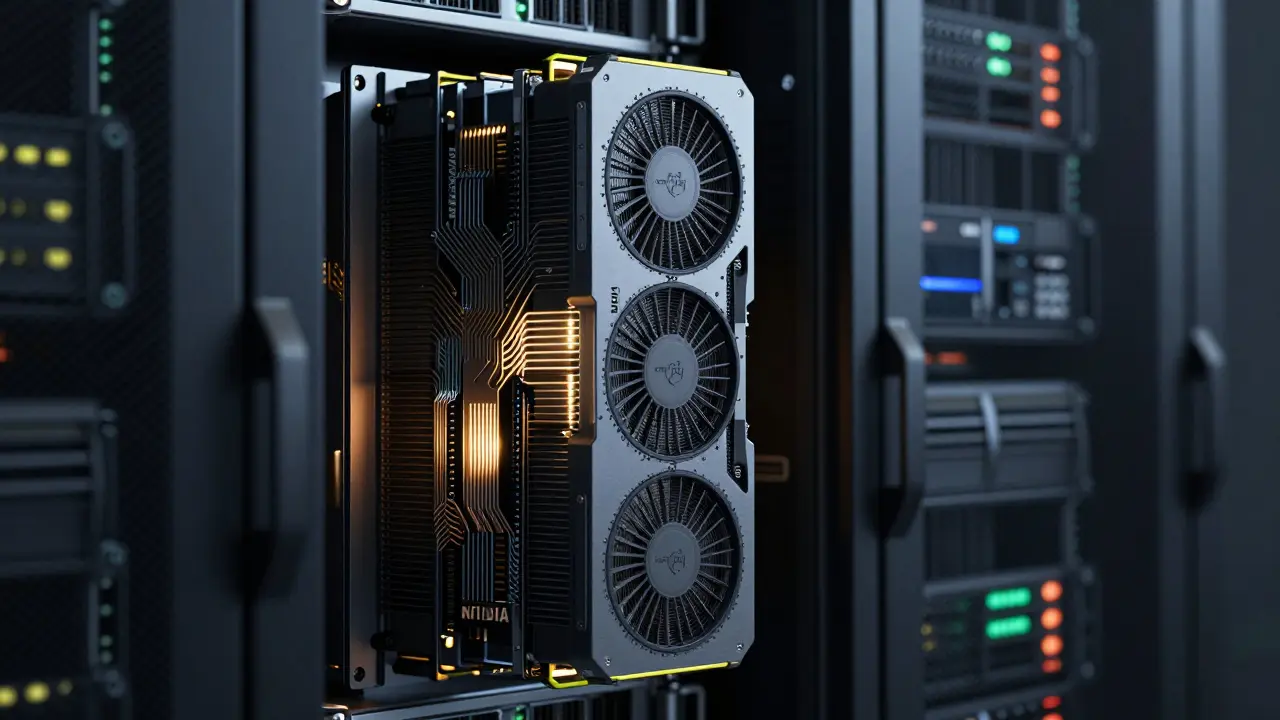
GPU-accelerated confidential computing changes the equation. NVIDIA introduced Confidential Computing capabilities for its H100 GPUs in late 2023. By moving the secure enclave to the GPU memory, they reduced overhead to just 1-5%. This means you get 95-99% of native performance while protecting model weights and inputs. With the launch of Blackwell B200 GPUs in December 2025, support for 200B+ parameter models now comes with less than 3% overhead. This is a game-changer for enterprise deployments that require speed and security simultaneously.
| Provider/Hardware | Technology | Performance Overhead | Best For |
|---|---|---|---|
| NVIDIA H100/B200 | GPU TEE | 1-5% | High-performance inference, large models |
| AWS Nitro Enclaves | Lightweight VMs | Varies (no native GPU TEE) | Isolated workloads, healthcare PHI |
| Azure Confidential VMs | Application-level encryption + TEE | Moderate | End-to-end pipeline security |
| Intel SGX/TDX | CPU TEE | 15-25% | Legacy systems, smaller models |
Cloud Provider Approaches Compared
No two providers implement confidential computing the same way. Your choice will depend on your existing infrastructure and specific security needs.
AWS Nitro Enclaves provide isolation through lightweight virtual machines. While they don’t have native GPU TEE support yet, they are widely used for isolating LLM inference workloads from the host OS. Leidos successfully deployed Nitro Enclaves for healthcare data processing in late 2024, achieving 98.7% accuracy matching non-confidential baselines. However, expect a steep learning curve; one engineer reported spending 3.5 person-months on initial security engineering.
Microsoft Azure takes a hybrid approach. Their Confidential Inferencing service, released in Q2 2024, combines application-level encryption to protect prompts as they pass through untrusted frontends with hardware-backed TEEs for the actual inference. This is ideal if you want to secure the entire data journey from client to model.
Red Hat OpenShift offers a Kubernetes-native solution. Announced in October 2025, it integrates sandboxed containers with Confidential Virtual Machines (CVMs). This is the best fit for teams already deep into container orchestration who need flexible, cloud-agnostic deployment options. It requires additional components like Tinfoil Security’s mutual attestation framework to handle secure model loading.
The Challenge of Secure Model Loading
Protecting the inference is only half the battle. How do you get a 70-billion-parameter model into the TEE without exposing it? This is known as the 'chicken-and-egg' problem.
If you load the model from an untrusted source, it’s compromised. If you keep it encrypted, the TEE can’t use it. The solution lies in Mutual Attestation is a cryptographic process where both the client and server verify each other's identity before exchanging sensitive keys.
In a robust setup, the enclave proves its authorization to pull the encrypted OCI image. Simultaneously, the LLM provider’s private key is securely transferred to the enclave. The model weights are decrypted only inside the TEE’s encrypted memory region. Companies like Phala Network and Tinfoil Security have pioneered these frameworks. Without them, loading a large model into a TEE can take 47 minutes instead of 8, rendering real-time inference non-viable.
Who Needs This Technology Now?
You might wonder if this level of security is overkill for your business. Consider these scenarios:
- Healthcare: HIPAA mandates protection of electronic protected health information. Processing patient records with LLMs requires confidentiality to avoid massive fines and reputational damage.
- Financial Services: Trading algorithms and customer financial data are prime targets for theft. Protecting model IP prevents competitors from reverse-engineering your strategies.
- Government: Classified documents and national security data cannot leave secure boundaries. TEEs allow government agencies to leverage commercial AI without compromising sovereignty.
According to Gartner’s AI Infrastructure Security Forecast, by Q4 2026, 65% of enterprise LLM deployments handling sensitive data will incorporate confidential computing. We are currently seeing rapid adoption in regulated industries, with healthcare leading at 42% of implementations.
Getting Started: A Practical Checklist
If you are ready to explore confidential computing for your LLM projects, follow these steps:
- Audit Your Data Sensitivity: Identify which datasets contain PII, PHI, or trade secrets. Not all AI workloads need TEEs.
- Choose Your Hardware Trust Root: Decide between Intel TDX, AMD SEV-SNP, or NVIDIA GPU TEEs based on your performance requirements and budget.
- Design the Attestation Chain: Plan how clients will verify the TEE before sending data. Use established libraries like Intel’s DCAP or AWS KMS integration.
- Implement Secure Model Loading: Integrate mutual attestation protocols to ensure model weights are never exposed during transfer.
- Test Performance Overhead: Benchmark your specific model size. Remember, larger models (70B+) may face higher latency on CPU-based TEEs.
- Train Your Team: Expect an 8-12 week learning curve for security engineers new to AI workloads. Invest in training early.
Confidential computing is not just a buzzword; it is the emerging standard for enterprise AI security. As regulations tighten and AI models become more valuable, the ability to prove that your data and models are safe in use will be your competitive advantage.
What is the difference between traditional encryption and confidential computing?
Traditional encryption protects data at rest and in transit but requires decryption for processing, creating a vulnerability window. Confidential computing uses hardware-based Trusted Execution Environments (TEEs) to keep data encrypted even while it is being processed by the CPU or GPU, eliminating that exposure.
Does confidential computing significantly slow down LLM inference?
It depends on the hardware. CPU-based TEEs like Intel SGX can add 15-25% overhead. However, GPU-accelerated solutions like NVIDIA’s H100 and B200 with Confidential Computing capabilities reduce this overhead to just 1-5%, making them viable for high-performance, real-time applications.
Which cloud providers offer confidential computing for AI?
Major providers include AWS (Nitro Enclaves), Microsoft Azure (Confidential VMs and Inferencing), and Google Cloud. Additionally, hardware vendors like NVIDIA provide direct GPU-level confidential computing features, while Red Hat offers Kubernetes-native solutions via OpenShift.
How do I securely load a large LLM into a TEE?
You need a mutual attestation process. The TEE proves its authenticity to the model provider, and the provider securely transfers decryption keys only after verification. The model weights are then decrypted directly inside the TEE’s encrypted memory, never appearing in plaintext on the host system.
Is confidential computing required by law?
While not explicitly named in laws, regulations like GDPR Article 32 and HIPAA mandate 'appropriate technical measures' to protect sensitive data. Confidential computing is increasingly viewed as the gold standard for meeting these requirements for AI workloads involving PII or PHI.
What is the 'AI privacy paradox'?
The AI privacy paradox refers to the conflict between the need to feed vast amounts of sensitive data into AI models to achieve accuracy and the legal/ethical requirement to keep that data private. Confidential computing resolves this by allowing the AI to process the data without ever exposing it in plaintext.