Event-Driven Architectures with Vibe Coding: Patterns and Prompt Templates
 Jul, 31 2026
Imagine telling your computer exactly what business problem you need to solve, and having it write the complex, asynchronous code required to handle thousands of concurrent events without you touching a single line of boilerplate. This is the promise of vibe coding, defined as a development approach where developers set the architectural direction while AI produces the implementation details. When applied to Event-Driven Architecture (EDA), a paradigm focused on creating, detecting, and consuming events for decoupled systems, this combination creates a powerful workflow. However, simply asking an AI to "build an app" often leads to messy, unmaintainable code. The key lies in using specific patterns and structured prompt templates that guide the AI toward robust, enterprise-grade solutions.
What Is Vibe Coding in Event-Driven Systems?
Vibe coding isn't just about chatting with a bot; it's a disciplined partnership. According to analysis from AIM Consulting, successful vibe coding requires developers to define the architecture, choose the tech stack, and clarify requirements before the AI generates code. In the context of EDA, this means you aren't just asking for code; you are describing how data moves through your system via events.
Event-Driven Architecture relies on loose coupling between services. Instead of Service A calling Service B directly, Service A publishes an event (like "OrderPlaced"), and Service B listens for it. This is crucial for microservices but notoriously difficult to implement correctly due to complexity in state management and async flows. Vibe coding accelerates this by allowing developers to describe these flows in natural language, provided they use the right constraints. Without constraints, AI tends to produce synchronous, tightly coupled code because that pattern dominates its training data.
Core Architectural Patterns for AI Generation
To get high-quality output from AI, you must anchor your prompts in proven architectural patterns. Two stand out for event-driven systems:
- CQRS (Command Query Responsibility Segregation): Separates the read and write operations. You tell the AI to create commands that change state and queries that retrieve data. This prevents race conditions and simplifies scaling.
- Event Sourcing: Stores changes to application state as a sequence of events. Instead of storing just the current state, you store the history. This allows for easy debugging and replaying of states.
- Sagas: Manages long-running transactions across multiple services. If one step fails, the saga orchestrates compensating actions to roll back changes.
Frameworks like Ecotone for PHP demonstrate how enforcing these patterns helps AI. By designing frameworks where "all applications communicate through Messages," the AI is forced into correct patterns. For instance, if the framework dictates that commands have single handlers and events are published, not returned, the AI has fewer wrong paths to take.
Structuring Your Prompt Templates
The difference between a broken prototype and production-ready code often comes down to the structure of your prompt. Unstructured prompts lead to hallucinations and inconsistent naming. Structured prompts reduce token usage by up to 37% and cut revision cycles significantly. Here is a template structure based on best practices from tools like Augment Code:
| Component | Purpose | Example Value |
|---|---|---|
| Context | Defines the existing system landscape | Microservices architecture with Node.js/PostgreSQL |
| Language & Stack | Specifies technical constraints | TypeScript, Express.js, Prisma ORM, Redis Pub/Sub |
| Expected Functionality | Describes the user-facing outcome | Real-time dashboard updating when orders are placed |
| Architecture Constraints | Enforces design patterns | Event-driven, CQRS, JWT authentication |
| Quantitative Requirements | Performance metrics | Handle 10k concurrent users, <200ms response time |
When you provide this level of detail, the AI doesn't guess. It builds within the guardrails you've set. For example, specifying "Redis Pub/Sub" tells the AI exactly which messaging broker to use, avoiding generic placeholders.

Modular Prompting: Feature by Feature
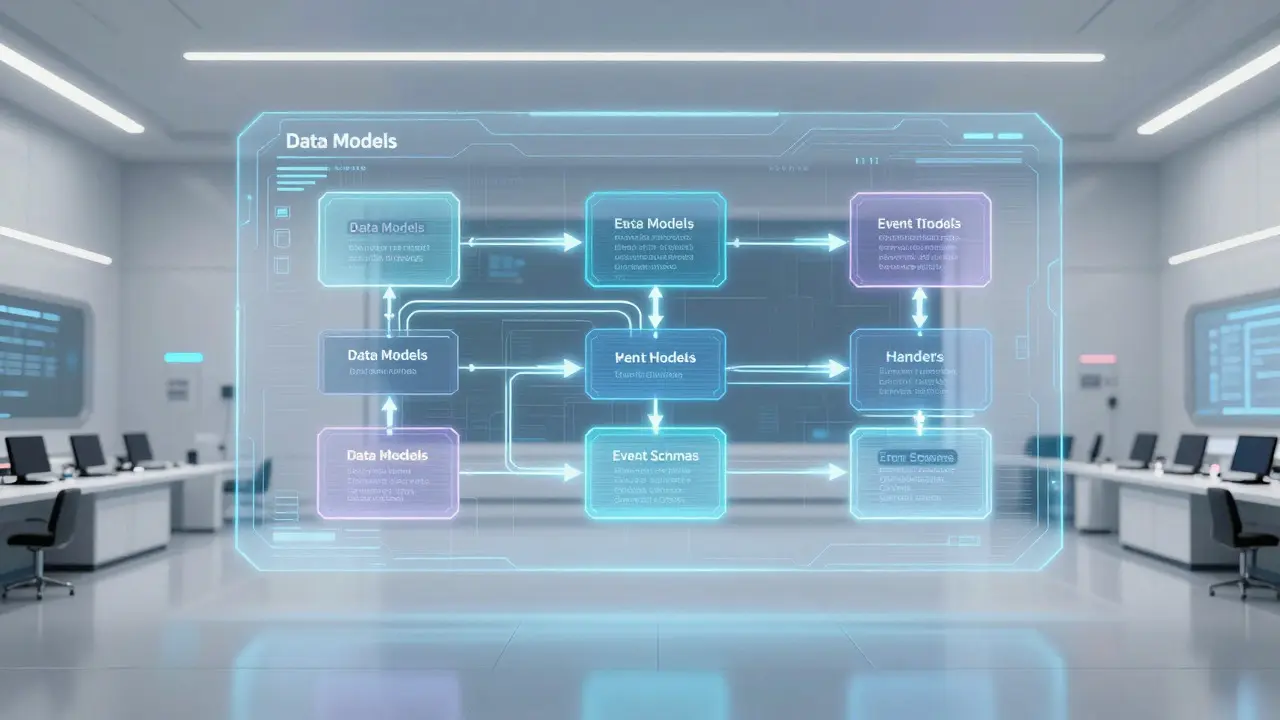
Don't try to generate an entire event-driven system in one go. AIM Consulting research shows that modular prompting yields 34% fewer errors. Break your request into phases:
- Data Models: Ask the AI to define the entities and their relationships first.
- Event Schemas: Generate the JSON schemas for each event type. Consistency here is critical to avoid "42 event types with inconsistent naming" disasters.
- Handlers: Request the code for processing specific events, ensuring they are idempotent.
- Producers: Generate the code that triggers these events.
This step-by-step approach allows you to validate each layer before moving on. It also makes debugging easier. If the event schema is wrong, you catch it before writing the handler logic.
Avoiding Common Pitfalls
Vibe coding without proper specifications creates significant technical debt. Here are three common traps:
- Architectural Drift: Over time, small deviations in AI-generated code can accumulate, leading to a system that no longer follows its original design. Use context-aware tools that analyze your existing codebase before generating new code to maintain consistency.
- Ignoring Async Testing: Testing asynchronous flows is hard. Many developers skip it. Look for frameworks or patterns that allow async handlers to execute synchronously during tests, eliminating the need for complex queue setups in your test environment.
- Schema Versioning Neglect: Events evolve. If you don't version your event schemas, changing a field name can break downstream consumers. Always include versioning strategies in your prompt constraints.
Tools and Frameworks That Help
Not all AI coding assistants are created equal for EDA. Tools that incorporate "context engines" perform better. For instance, Augment Code’s Context Engine analyzes your repository before generating code, achieving 89% architectural consistency compared to 62% for non-contextual tools. Similarly, specialized frameworks like Ecotone provide built-in attributes (e.g., `#[Asynchronous]`) that simplify configuration and testing.
If you are starting out, consider using a framework that enforces messaging paradigms. This reduces the cognitive load on both you and the AI. The AI reaches for CQRS and event-sourcing patterns because those are the only valid options within the framework's design.
Next Steps for Implementation
To start using vibe coding for event-driven architectures effectively:
- Create a Prompt Library: Save successful prompt templates for common tasks like creating sagas or defining event schemas. Reuse and refine them.
- Invest Time Upfront: Spending 15-20 hours creating proper templates and understanding your domain model pays off with 5-7x faster implementation later.
- Validate Output Rigorously: Treat AI-generated code as a draft. Review it against your architectural principles. Does it follow CQRS? Are events immutable?
The future of software development involves close collaboration between human architects and AI implementers. By mastering these patterns and templates, you ensure that the speed of AI doesn't compromise the integrity of your system.
What is vibe coding in the context of event-driven architecture?
Vibe coding is a development methodology where developers define the architectural direction, tech stack, and requirements using natural language, while AI generates the detailed implementation code. In EDA, this means describing event flows, schemas, and handlers rather than writing every line of boilerplate code manually.
Why are prompt templates important for AI-generated code?
Prompt templates provide necessary constraints and context to the AI. Without them, AI may generate generic, synchronous, or poorly structured code. Structured templates reduce token usage by up to 37% and improve architectural consistency by guiding the AI toward specific patterns like CQRS or Event Sourcing.
How does modular prompting reduce errors?
Modular prompting breaks down complex tasks into smaller steps, such as defining data models, then event schemas, then handlers. Research shows this approach yields 34% fewer implementation errors because it allows for validation at each stage and prevents the AI from making assumptions about unrelated parts of the system.
What are the risks of unstructured vibe coding?
Unstructured vibe coding can lead to significant technical debt, including inconsistent event naming, lack of schema versioning, and architectural drift. Studies show it results in 63% more code revisions compared to structured approaches, as the AI lacks the context to make sound architectural decisions.
Which frameworks support AI-friendly event-driven development?
Frameworks like Ecotone for PHP are designed with messaging as a core paradigm, enforcing patterns like single-purpose command handlers and published events. This structure guides AI to generate correct code by limiting the solution space to proven, well-documented patterns.