Long-Context AI in 2026: Memory, Recall, and Persistent State Explained
 Jul, 9 2026
Remember when hitting the token limit felt like an insurmountable wall? In early 2024, feeding a large language model more than 128,000 tokens was a luxury few could afford, and even then, the model would often forget the beginning of the document by the time it reached the end. That era is over. As we move through July 2026, the industry has shifted from simply extending context windows to solving the harder problems: memory retention, recall accuracy, and persistent state across sessions.
The "context wall" that plagued traditional transformers-where computational costs grew linearly with every added word-is crumbling. New architectures are emerging that treat context not just as input, but as a first-class resource. This isn't just about reading longer books; it's about building AI agents that remember your preferences, understand months of project history, and maintain a coherent state without re-reading everything from scratch every time you open a chat window.
From Attention Walls to Neural Memory
To understand where we are, we have to look at why the old way broke. The standard transformer architecture, introduced in 2017, relies on self-attention mechanisms that calculate relationships between all tokens in a sequence. While powerful, this approach suffers from quadratic complexity. Processing the 10-millionth token used to take roughly one million times longer than processing the 10th token. It was computationally expensive and memory-intensive, leading to GPU stalls or evictions when the Key-Value (KV) cache filled up.
In 2026, two major breakthroughs have changed this landscape. First, NVIDIA TTT-E2E (Test-Time Training End-to-End) treats the input context as training data during inference. Instead of storing every token in memory, it compresses the context on the fly. According to NVIDIA's February 2026 benchmarks, this method achieves constant latency regardless of context length. For a 2 million token context, TTT-E2E runs 35x faster than full attention models on H100 GPUs while maintaining low loss metrics. It essentially solves the trade-off that previously forced engineers to choose between speed (like RNNs) and accuracy (like Transformers).
Second, Google Titans (a neural long-term memory architecture) introduces a different approach. Rather than using fixed-size vectors for memory, Titans uses a multi-layer perceptron (MLP) module. This allows for higher expressive power in summarizing information. The key innovation here is the "surprise" mechanism. The system calculates gradients to determine storage priority. If the input is predictable (low surprise), it gets minimal storage. If it’s unexpected (high surprise)-like finding a banana peel image in a financial report-it triggers permanent storage in long-term memory. This mimics human cognitive filtering, ensuring that only significant details consume precious resources.
| Architecture | Key Mechanism | Latency Scaling | Recall Accuracy | Best Use Case |
|---|---|---|---|---|
| Full Attention (Traditional) | Self-Attention Matrix | Poor (O(n²)) | High (Lossless) | Short documents, high precision tasks |
| Approximate Attention (Mamba-2) | Sliding Window / SSM | Good (Constant) | Moderate (Degrades >128K) | Streaming data, real-time chat |
| NVIDIA TTT-E2E | Context Compression via Test-Time Training | Excellent (Constant) | High (Balanced Loss) | Massive document analysis, legal contracts |
| Google Titans | Neural MLP Memory + Surprise Signal | Good | High (Selective) | Agentic workflows, persistent state |
The Infrastructure Shift: Context as a Resource
You can’t run these new models on yesterday’s hardware setups. The bottleneck has shifted from compute power to memory bandwidth. WEKA’s CTO, Liran Zvibel, noted in January 2026 that inference didn't hit a compute wall; it hit a context memory wall. This realization has driven a new category of infrastructure focused on "context throughput" rather than just FLOPS.
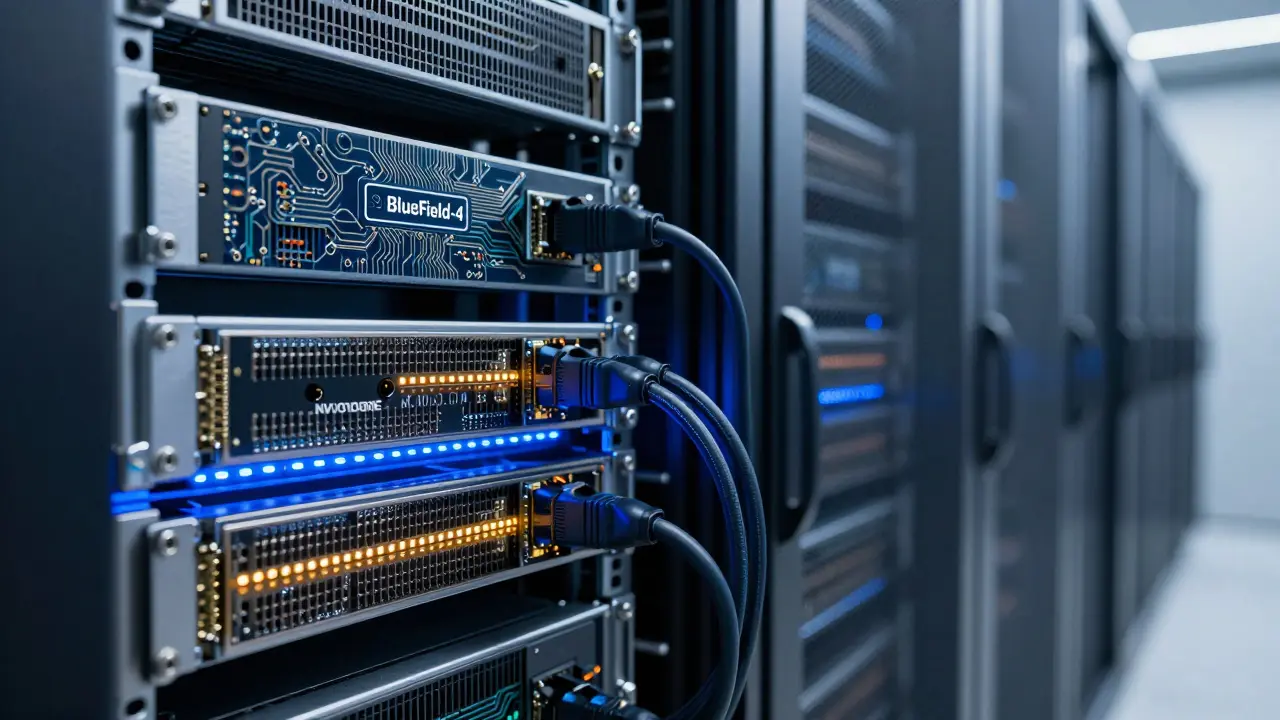
NVIDIA’s CES 2026 announcement highlighted the need for BlueField-4 Data Processing Units (DPUs) to accelerate context memory management. These systems use RDMA-connected, NVMe-backed fabrics with GPUDirect Storage to extend GPU memory capacity effectively. The goal is to keep the KV cache accessible without slowing down the main processor. For enterprises, this means that deploying long-context AI requires upgrading not just the GPUs, but the entire storage and interconnect layer. Minimum interconnect speeds of 400GB/s are now recommended for seamless context sharing across distributed nodes.
This shift also impacts how we think about data readiness. Sphere Partners’ February 2026 guide emphasizes that "context-first architecture" involves more than just picking a model. It requires robust knowledge graphs, Retrieval-Augmented Generation (RAG) pipelines, and strict governance. If your data isn't structured correctly, even the best long-context model will struggle to retrieve the right information from millions of tokens.
Enterprise Adoption and Real-World Challenges
The market response has been swift. IDC projects the enterprise AI market to reach $1.2 trillion by the end of 2026, with context management infrastructure accounting for roughly 23% ($276 billion) of that spend. Legal and healthcare sectors are leading adoption, with usage rates of 78% and 65% respectively, according to Clarifai’s January 2026 survey. These industries deal with massive, complex documents where missing a single detail can be catastrophic.
However, it’s not all smooth sailing. A persistent issue known as "beginning-end bias" remains. VirtusLab’s February 2026 study documented that even advanced LLMs tend to recall the start and end of extremely long contexts better than the middle. Users on Reddit’s r/MachineLearning forum reported instances where models missed critical details in the middle sections of 200K-token technical documents. Engineers are spending 15-20% of their implementation time calibrating "surprise thresholds" in systems like Titans to mitigate this.
Another challenge is the learning curve. Mastering context-optimized architectures takes experienced ML engineers 3-6 weeks. Teams need to develop expertise in distributed memory management and context lifecycle management, moving beyond simple prompt engineering. Tools like Hindsight, LangMem, and Memobase have gained traction in late 2025 to help manage long-term recall across months of operation, but integrating them into existing stacks requires careful planning.

Persistent State and the Rise of Agentic AI
The ultimate goal of long-context AI isn't just reading longer texts; it's enabling persistent state. This is what transforms a chatbot into an agent. An agent needs to remember decisions made hours, days, or weeks ago. Traditional models reset after each session, forcing users to repeat themselves. With persistent state, the AI maintains a continuous narrative.
Google’s upcoming Titans 2.0, scheduled for June 2026, aims to introduce cross-agent memory sharing. This means multiple AI agents working on a project can share a common memory pool, reducing redundancy and improving coordination. NVIDIA’s roadmap includes integrating TTT-E2E into all future GPU architectures starting with Blackwell Ultra in Q3 2026, making efficient long-context processing a hardware standard rather than a software workaround.
For developers, this means designing applications with memory in mind from day one. You need to define what constitutes "important" information for your specific domain. Is it customer feedback? Code changes? Financial transactions? Defining these priorities helps tune the surprise mechanisms and compression algorithms to retain what matters and discard noise.
Looking Ahead: Beyond 2 Million Tokens
Where do we go from here? Forrester predicts context windows will exceed 10 million tokens by 2027. At that scale, the distinction between "context" and "database" blurs. Models will likely interact with external memory stores seamlessly, treating vast repositories of unstructured data as part of their immediate working memory.
However, researchers caution that scaling trends require continuous validation. Just because a model *can* process 10 million tokens doesn't mean it *should* for every task. Efficiency remains key. The focus will shift toward smarter retrieval and selective attention, ensuring that AI systems don't just read everything, but understand what is relevant in real-time.
The transition from the "Prompt Era" to the "Context Era" is fundamental. It reshapes how we build, deploy, and utilize generative AI. Companies that invest in context-first architectures and skilled teams capable of managing persistent state will lead the next wave of AI innovation. Those who cling to legacy approaches will find themselves limited by walls that no longer exist for their competitors.
What is the difference between TTT-E2E and Google Titans?
NVIDIA's TTT-E2E focuses on compressing context during inference to maintain constant latency, treating input as training data. Google Titans uses a neural memory module with a "surprise" mechanism to selectively store important information in long-term memory, prioritizing expressive power and selective recall.
Why is "beginning-end bias" still a problem in 2026?
Despite architectural advances, many models still prioritize the start and end of sequences due to how attention mechanisms and memory buffers are structured. This leads to weaker recall for information located in the middle of extremely long documents, requiring manual calibration of surprise thresholds to mitigate.
What hardware is needed for long-context AI in 2026?
Modern deployments require high-bandwidth memory and fast interconnects. NVIDIA recommends BlueField-4 DPUs for context acceleration, minimum 400GB/s interconnect speeds, and NVMe storage optimized for KV cache patterns to prevent GPU stalls.
How does persistent state improve agentic AI?
Persistent state allows AI agents to retain memory across sessions and interactions. This enables them to maintain context over weeks or months, remember user preferences, and coordinate with other agents without needing to re-process historical data from scratch.
Is it worth upgrading to long-context models for small businesses?
If your business deals with large documents (legal, medical, technical manuals) or requires long-term customer interaction history, yes. However, for simple chatbots or short-form content generation, standard 128K context models may still be sufficient and more cost-effective.