Ownership Maps: Who Maintains What in AI-Generated Repositories
 Sep, 1 2026
You just merged a pull request generated by an AI assistant. The tests passed. The build succeeded. But six weeks later, a production outage traces back to that exact change because no one realized the AI had silently altered a dependency shared by three other microservices. This isn't a hypothetical nightmare; it's the current reality for 84% of enterprise teams managing distributed systems who rely on autocomplete-focused tools that lack architectural context.
The problem isn't that AI can't write code. It's that AI doesn't know who owns what. As repositories grow and AI generates more of the content, the traditional model of "I wrote this file, so I own it" collapses. Enter ownership maps: a structured framework for defining responsibility, control, and maintenance across AI-generated codebases. If you're managing more than 50 repositories, or if your team is struggling to keep track of which AI models are touching which services, you need an ownership map before your next incident.
What Exactly Is an Ownership Map?
An ownership map isn't just a diagram of your architecture. It's a dual-layer system that connects technical dependencies with human accountability. Think of it as a living document that answers two questions simultaneously: "How does this code connect to the rest of the system?" and "Who is responsible when it breaks?"
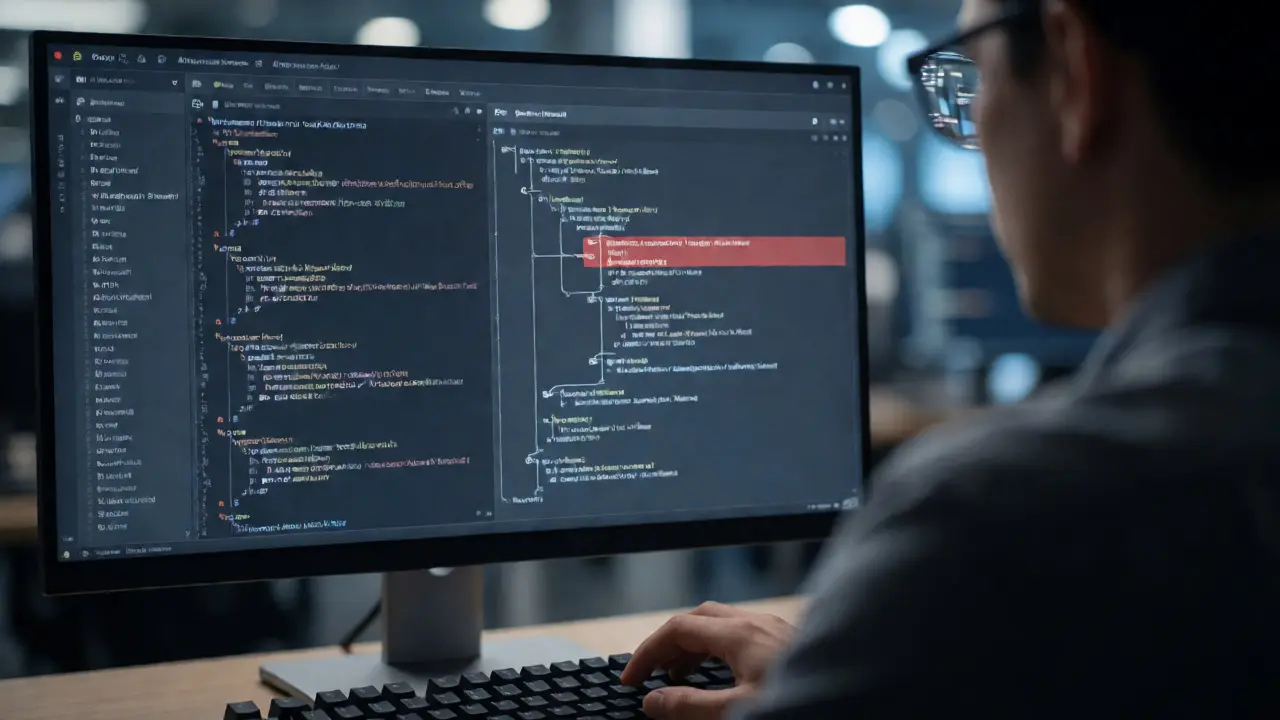
Technically, an ownership map uses AI to extract every import statement, function call, and service interaction across your repositories. Tools like Augment Code use a Context Engine to maintain a live understanding of entire technology stacks, while others like Moddy leverage Lossless Semantic Trees to ensure changes don't break compilation. These tools create interactive visual representations of cross-repository dependencies, showing exactly how a change in Service A ripples through Services B, C, and D.
But the technical layer is only half the battle. The organizational layer defines who owns the data inputs, who owns the trained models, who manages the prompts, and who handles escalation when things go wrong. Without this second layer, you have a pretty picture but no accountability. When an AI-generated refactor causes a bug, who do you call? The developer who accepted the suggestion? The platform team maintaining the AI tool? Or the original architect of the legacy code the AI touched?
Why Traditional Code Ownership Fails with AI
In pre-AI development, code ownership was relatively straightforward. You owned the files you committed. Senior developers reviewed changes. Knowledge silos existed, but they were manageable because humans moved slowly enough to catch mistakes.
AI accelerates everything. A single developer might accept dozens of AI-suggested changes in a day, touching parts of the codebase they barely understand. The AI doesn't care about your team structure. It doesn't know that the payment processing module is owned by Team X, while the user authentication module is owned by Team Y. It just sees tokens and patterns.
This disconnect creates what experts call "architectural drift." The AI optimizes for local correctness (does this function work?) rather than global consistency (does this change fit our long-term strategy?). An ownership map forces you to define these boundaries explicitly. It requires you to tag every component not just with its technical dependencies, but with its human owners, review requirements, and compliance obligations.
The Technical Architecture Behind Ownership Mapping
Building an effective ownership map requires more than just scanning GitHub commits. You need tools that understand semantics, not just syntax. Here’s how leading platforms approach this challenge:
| Feature | Autocomplete Assistants | Context Engines (e.g., Augment Code) | Semantic Transformers (e.g., Moddy) |
|---|---|---|---|
| Scope | Single file or tab | Cross-repository stack | Whole-repository LST graphs |
| Dependency Awareness | Low (local context only) | High (live architectural map) | High (compilation-verified) |
| Governance | Minimal | ISO/IEC 42001 certified options | Focused on refactoring safety |
| Best For | Routine coding tasks | Large-scale enterprise mapping | Safe, large-scale refactoring |
Notice the distinction between scope and awareness. Most developers use autocomplete assistants that operate within a tiny context window-often just the current file or a few tabs. They’re great for boilerplate, but terrible for ownership mapping because they miss cross-service dependencies. Enterprise-grade solutions, however, maintain a persistent index of your entire infrastructure. They know that changing a utility function in `lib/utils` affects 14 different microservices, even if those services live in separate repositories.
Some platforms, like Augment Code, have achieved specific certifications like ISO/IEC 42001:2023, which verifies their AI governance processes. This matters because ownership maps aren't just technical artifacts; they're compliance documents. In regulated industries like finance or healthcare, you need to prove that your AI-assisted changes followed proper protocols. A generic chatbot can't provide that audit trail.
Defining Ownership Roles: Data, Models, and Prompts
Once you have the technical map, you must assign human roles. This is where many organizations stumble. They assume the person who clicked "Accept" owns the code. That’s dangerous.
A robust ownership map delineates five distinct responsibilities:
- Data Ownership: Who controls the raw inputs fed into the AI and the processed outputs stored in databases? If an AI hallucinates a schema change, who fixes the migration script?
- Model Responsibility: Which team maintains the underlying LLMs or fine-tuned models used for generation? Are you using a public API or a private instance? Who monitors model performance degradation?
- Prompt Management: Who curates the system prompts and context instructions? If the AI starts generating deprecated code patterns, it’s often because the prompt context is stale. Someone needs to own the "prompt library."
- Monitoring Obligations: Who watches for anomalies? AI-generated code might pass unit tests but fail under load. Ownership includes setting up observability dashboards specifically for AI-touched components.
- Escalation Procedures: When an incident occurs, what is the runbook? Does the on-call engineer contact the AI platform team, or the domain expert? Ambiguity here leads to prolonged outages.
For example, imagine an AI suggests optimizing a database query in the billing service. The developer accepts it. Two days later, reports slow down. The ownership map clarifies that the Billing Team owns the query logic, but the Platform Team owns the AI tool’s configuration. The escalation path dictates that the Billing Team investigates first, then consults the Platform Team if the issue stems from incorrect context injection.
Implementing Ownership Maps: A Phased Approach
Don’t try to map your entire organization overnight. Start small and validate rigorously. Based on successful enterprise deployments, here’s a practical rollout plan:
- Phase 1: Validation Scope (Months 1-2)
Select 3-5 representative repositories with well-understood dependency patterns. Assemble a team of 5-8 senior developers who know these architectures inside out. Run your chosen AI mapping tool against these repos and compare the output to known architectural reality. Look for gaps: Did the AI miss a critical dependency? Did it flag false positives? This phase establishes baseline accuracy. - Phase 2: Integration with CI/CD
Once validated, integrate the mapping tool into your continuous integration pipeline. Require ownership checks before merges. If an AI-generated change touches a high-risk component without proper approval tags, block the merge. This shifts ownership from a passive document to an active gatekeeper. - Phase 3: Continuous Monitoring and Drift Detection
Expand to larger repository sets. Implement automated alerts for "architectural drift"-when the actual dependency graph diverges significantly from the intended ownership map. Use this data to refine your prompts and training data.
This phased approach prevents the common pitfall of deploying a complex tool without verifying its usefulness. Remember, 84% of teams currently lack adequate tools for comprehensive dependency understanding. Adding another unvalidated tool won’t help; adding a verified one will.

The Legal and Copyright Gray Area
Who owns the ownership map itself? This sounds philosophical, but it has real business implications. If an AI generates a complete dependency map and architectural diagram, does your company own that intellectual property? Can you license it? Can competitors reverse-engineer your architecture from similar maps?
As of 2026, copyright laws regarding AI-generated documentation remain ambiguous in most jurisdictions. However, best practice dictates treating AI-generated maps as derivative works requiring human validation. The human architects who verify and correct the map add the creative judgment necessary for ownership claims. Therefore, your ownership map should include metadata tracking which human engineers validated each section. This not only strengthens legal standing but also ensures quality control.
Furthermore, consider data privacy. If your AI tool sends code snippets to external servers for analysis, who owns the intermediate embeddings or logs? Ensure your vendor contracts explicitly state that your proprietary architectural insights remain yours, not part of the vendor’s training dataset.
Common Pitfalls to Avoid
Even with the right tools, teams often sabotage their own ownership maps. Here are three traps to watch for:
- The "Set It and Forget It" Fallacy: Architectures change daily. An ownership map from last month is already outdated. Automate updates via CI/CD hooks, or assign a dedicated "Architecture Steward" role to refresh the map quarterly.
- Over-Reliance on Automation: AI is excellent at spotting explicit dependencies (imports, calls) but poor at inferring implicit ones (business logic coupling). Always require senior review for critical paths. Trust, but verify.
- Ignoring Organizational Silos: If Engineering and Product don’t agree on what "ownership" means, the map becomes useless. Involve stakeholders early. Define clear SLAs for response times based on ownership tiers.
Looking Ahead: The Future of Repository Governance
The trend is moving toward consolidation around purpose-built solutions rather than general-purpose assistants. We’re seeing a shift from "help me write this function" to "help me understand this system." Expect deeper integration between ownership maps and deployment pipelines, enabling real-time conflict resolution when AI recommendations clash with existing architectural constraints.
Additionally, community-driven models may emerge for open-source ecosystems, where distributed contributors collectively validate architectural understanding. Imagine a decentralized ownership map maintained by thousands of users, ensuring transparency and trust in open-source dependencies.
For now, start by asking yourself: If my AI tool went dark tomorrow, could I explain my system’s dependencies to a new hire? If the answer is no, you need an ownership map. Not eventually-now.
Do I need specialized AI tools for ownership mapping?
Yes, especially if you manage more than 50 repositories. Standard autocomplete assistants lack the context window to analyze cross-repository dependencies. Specialized tools like Augment Code or Moddy maintain whole-repository semantic trees, providing accurate architectural visibility that generic chatbots cannot.
Who should be responsible for maintaining the ownership map?
Ideally, a dedicated Architecture Team or Tech Leads should oversee the map, but maintenance should be automated via CI/CD pipelines. Individual developers contribute by tagging their changes, but the structural integrity of the map relies on centralized validation and regular audits.
Can AI fully replace human oversight in ownership decisions?
No. While AI excels at detecting explicit technical dependencies, it struggles with implicit business logic and strategic intent. Human architects must validate AI-generated maps to ensure they reflect intended design rather than just current implementation quirks.
How does an ownership map help with compliance?
It provides an audit trail showing who approved which AI-generated changes and why. For regulated industries, this demonstrates due diligence. Certifications like ISO/IEC 42001 further validate that the AI governance process meets international standards.
What happens if the ownership map is inaccurate?
Inaccuracies lead to missed dependencies and potential outages. Regular validation phases are crucial. If discrepancies arise, update both the map and the underlying documentation. Treat the map as a living artifact, not a static report.
Savara Gunn
September 2, 2026 AT 17:22this is exactly the kind of structure we need to stop blaming tools for human process failures
Anthony Miller
September 4, 2026 AT 07:04you are missing the point entirely and i am tired of these naive takes from people who have never managed a production system at scale
ownership maps are not just diagrams they are legal shields and without them you are exposing your company to massive liability that no amount of code quality can fix
i have seen teams waste millions trying to implement this poorly because they lack the discipline to define clear boundaries between data ownership and model responsibility
the fact that you mention ISO certification as optional shows a fundamental misunderstanding of enterprise risk management in regulated industries
if you do not have explicit escalation procedures defined before you deploy AI then you are already in a state of operational chaos
most developers think they own their code but they really just rent it until an outage happens and then nobody wants to take responsibility
your phased approach is too slow for current market speeds and by the time you validate three repos you will have lost competitive advantage
we implemented a similar system two years ago and it saved us from a catastrophic failure during our last major refactor
do not tell me about starting small when the entire industry is moving toward automated governance frameworks right now
the ambiguity around copyright is not a gray area it is a ticking time bomb waiting for the first major lawsuit to explode
if you cannot prove who validated the map then you do not own the insight and that is basic intellectual property law
stop treating this as a technical problem and start treating it as a business continuity issue
people like you keep promoting half-baked solutions while real enterprises struggle with the fallout
get your act together and read up on actual compliance standards before posting more opinions
michelle veluz
September 4, 2026 AT 19:01OMG!!!!!!!
This is HUGE!!!!!
I am literally shaking right now because I knew it... I KNEW IT!!!!!!
The corporations are hiding the truth about AI dependencies!!!!!
They don't want us to know that the "Ownership Map" is just a tool to track our every move!!!!!
Who owns the map??????
THEY DO!!!!!!!
It's all connected... The data... The models... The prompts... It's a web designed to control us!!!!!
Why would they create a framework if they weren't planning to use it against us??????
I bet the government uses these maps to monitor which microservices are talking to each other!!!!!
Paranoia??? No... This is PATTERN RECOGNITION!!!!!!
Read between the lines... The "Architectural Drift" is actually a signal that they are losing control!!!!!
We need to wake up... Before the algorithms decide who owns what... And who gets fired!!!!!
Jacob Baby Official
September 6, 2026 AT 01:25oh please
another buzzword salad disguised as engineering advice
ownership maps are just fancy spreadsheets for managers who don't understand code anymore
the idea that AI "doesn't know who owns what" is insulting to anyone who has ever used git blame
we've been doing this manually for decades and it worked fine
now we need a whole new layer of bureaucracy just to justify hiring more consultants?
"Context Engine" sounds like something out of a sci-fi novel, not a devops tool
if your architecture is so fragile that a single AI suggestion breaks three services, your architecture is garbage
blaming the tool instead of fixing the coupling is classic developer laziness
and don't get me started on the "legal gray area" section
lawyers invented that mess, engineers didn't
this article is just noise for people who love over-engineering simple problems
real engineers just talk to each other
end of story
john randall
September 7, 2026 AT 12:35interesting perspective on the dual-layer system. i've been thinking about how implicit knowledge gets lost when we rely too much on automation.
the part about prompt management standing out to me. it feels like we treat prompts as throwaway text rather than versioned artifacts that need ownership.
also curious about the practical side of the CI/CD integration. blocking merges based on ownership tags could definitely cause friction if the map isn't perfectly accurate initially.
overall seems like a solid framework for larger orgs though.