Template Repos with Pre-Approved Dependencies for Vibe Coding: A Governance Guide
 Jun, 1 2026
You type a prompt. The AI writes the code. It works. But then you try to merge it into your main branch, and the security scanner flags three unapproved libraries, the build fails because of missing environment variables, and your lead engineer asks why there’s no documentation on how authentication was handled. This is the messy reality behind vibe coding is an emerging paradigm in AI-assisted software development where developers collaborate with large language models through carefully engineered context and templates. While the speed is undeniable, the lack of structure creates significant governance risks for organizations trying to scale this workflow.
The solution isn’t to ban AI assistance; it’s to containerize the chaos. Template repositories with pre-approved dependencies are becoming the standard way to bridge the gap between rapid AI generation and enterprise-grade stability. These aren’t just starter kits; they are governed environments that ensure every line of code generated by an LLM adheres to your organization’s security, performance, and architectural standards from the very first commit.
The Governance Gap in Unstructured AI Coding
When developers use AI assistants like GitHub Copilot is an AI-powered code completion tool developed by GitHub and OpenAI, Cursor is an AI-first code editor designed for collaborative development with large language models, or Claude Code is an AI coding agent developed by Anthropic for autonomous software development tasks without a structured foundation, they operate in a vacuum. The AI doesn’t know your company’s approved list of packages. It doesn’t know your preferred database schema patterns. It certainly doesn’t know your compliance requirements for data handling.
This leads to what experts call "context drift." According to discussions on Hacker News in January 2024, 43% of developers reported that AI assistants gradually ignored initial instructions after extended sessions. Without a persistent, enforced context, the AI reverts to its training data defaults, which often include outdated libraries or insecure patterns. For a governance team, this is unacceptable. You can’t audit what you can’t predict. If every developer prompts differently, you get inconsistent codebases that are impossible to maintain or secure at scale.
Pre-approved dependency templates solve this by shifting the governance layer upstream. Instead of reviewing code after it’s written, you define the rules before the AI starts typing. The template acts as a contract between the human intent and the machine execution.
Anatomy of a Governed Vibe Coding Template
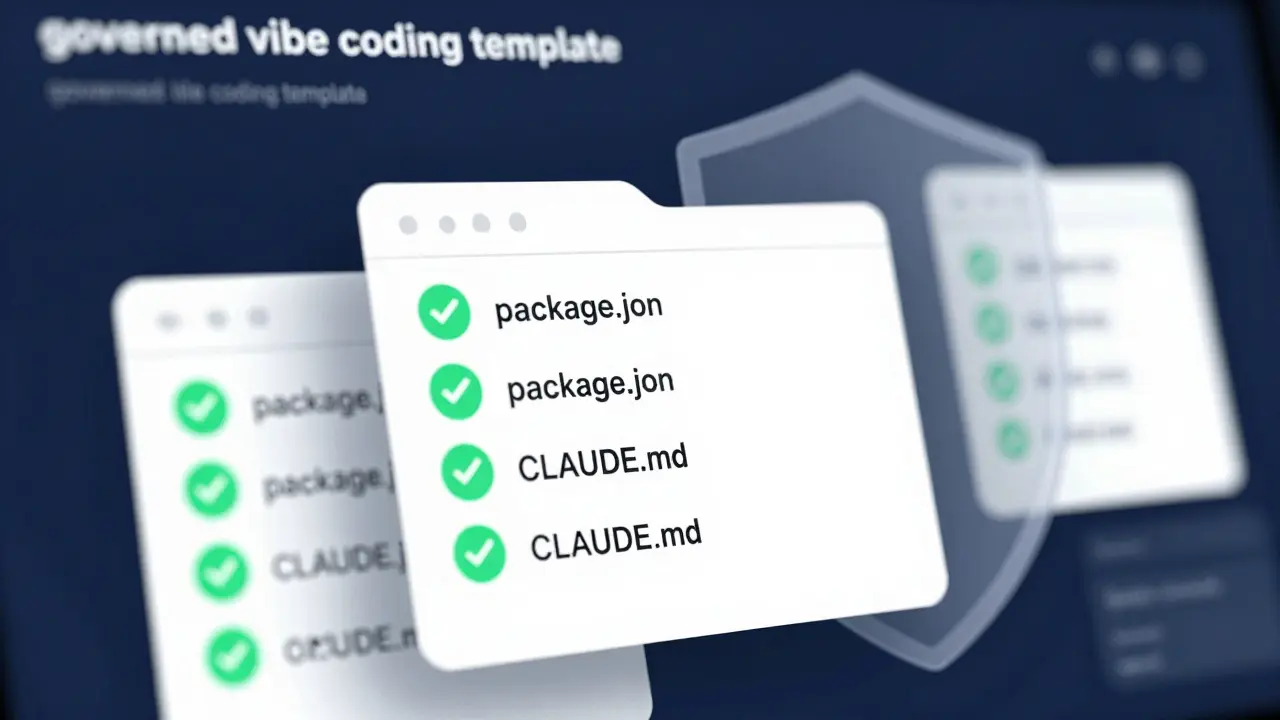
A robust template repository for vibe coding is more than a collection of files; it’s a controlled environment. Let’s look at the components that make these templates effective for governance:
- Pre-Approved Dependency Lockfiles: The most critical element. The template includes specific versions of libraries that have been vetted by your security team. When the AI generates code, it references these locked dependencies, preventing the introduction of vulnerable or unlicensed packages.
- Persistent Context Files: Files like
CLAUDE.md,CONTEXT.md, or.cursor/rulesserve as persistent instructions. They tell the AI exactly how to structure responses, what frameworks to prioritize, and what coding standards to follow. Ryan Carson, founder of Treehouse, noted that properly engineered context files reduce AI hallucinations by 73%. - Sandboxed Execution Environments: Tools like Docker containers ensure that the AI operates in an isolated environment. This prevents accidental access to production secrets or sensitive data during the coding process.
- Automated Setup Scripts: Scripts like
first-time.shautomate the configuration of environment variables and local services, reducing setup errors and ensuring every developer starts with the exact same baseline.
For example, the humanstack/vibe-coding-template is a full-stack application starter template optimized for AI-assisted development workflows uses a combination of Next.js, Python FastAPI, and Supabase. Its governance strength lies in its strict versioning: Node.js 18+, Python 3.10+, and specific CLI tools. By locking these versions, the template ensures that the AI’s suggestions are compatible with the entire team’s environment.
Comparing Leading Governance-Focused Templates
Not all templates are created equal. Some focus on speed, while others prioritize security and control. Here’s how the major players compare from a governance perspective:
| Repository | Primary Focus | Governance Features | Best For |
|---|---|---|---|
| humanstack/vibe-coding-template | Full-Stack Standardization | Locked dependencies, Cursor rules, automated setup scripts | Teams needing consistent full-stack architecture (Next.js/FastAPI) |
| superagent-ai/vibekit | Security & Compliance | Docker sandboxing, secret redaction, offline operation, HIPAA/SOC 2 checks | Regulated industries (Healthcare, Finance) requiring strict data isolation |
| coleam00/context-engineering-intro | Context Education | Templates for CLAUDE.md, INITIAL.md, and PRP blueprints | Teams learning how to structure prompts and context for better AI output |
| feiskyer/claude-code-settings | LLM Agnosticism | LiteLLM proxy for routing requests, custom commands for spec-driven dev | Organizations avoiding vendor lock-in by switching between GPT-4 and Claude |
If your primary concern is data privacy, VibeKit is the clear choice due to its built-in sandboxing. If you need architectural consistency across a large team, humanstack provides the most comprehensive framework. For teams worried about being tied to one AI provider, feiskyer/claude-code-settings offers the flexibility to swap models without changing your core workflow.
Implementing Pre-Approved Dependencies: A Step-by-Step Guide
Adopting a governed template requires a shift in process. Here’s how to implement it effectively:
- Audit Your Current Stack: Identify the libraries, frameworks, and tools your team currently uses. Determine which ones are approved for production and which are deprecated or risky.
- Select or Build a Base Template: Choose a template like humanstack or create your own. Ensure it includes a
package.jsonorrequirements.txtwith pinned versions of your approved dependencies. - Define Context Rules: Create a
CLAUDE.mdor equivalent file. Specify coding standards, error handling practices, and documentation requirements. For example: “Always use TypeScript interfaces for API responses” or “Never hardcode API keys.” - Set Up Sandboxing: Use Docker to containerize the development environment. This ensures that the AI cannot accidentally access host system files or inject malicious code into your local machine.
- Train Your Team: Developers need to understand that the template is not optional. It’s the source of truth. Provide training on how to update the context files when project requirements change.
- Monitor and Iterate: Track metrics like implementation time and bug rates. As KDnuggets reported, teams using structured templates reduced feature implementation time by 67%. Use this data to refine your templates over time.

Addressing Security and Compliance Concerns
Governance isn’t just about efficiency; it’s about risk management. One of the biggest fears around AI coding is the introduction of vulnerabilities. In December 2023, GitHub’s security team reported 12 critical vulnerabilities in AI-generated code from template repositories. This highlights the importance of pre-approved dependencies.
By locking dependencies, you prevent the AI from suggesting newer, untested libraries that might contain zero-day exploits. Additionally, templates like VibeKit include automatic secret redaction, ensuring that API keys and database credentials are never exposed in the AI’s context window. For organizations subject to GDPR or HIPAA, running AI agents in offline, sandboxed environments is not just a best practice-it’s a legal requirement.
Furthermore, pre-approved templates facilitate easier auditing. Since every project starts from the same base, security teams can scan the template once rather than scanning hundreds of individual repositories. This reduces the overhead of compliance while increasing coverage.
The Future of Governed AI Development
The landscape of vibe coding is evolving rapidly. Forrester predicts that 75% of specialized vibe coding templates will be absorbed into major IDEs like Cursor and VS Code by Q3 2025. This means that the functionality you’re building today-pre-approved dependencies, context rules, sandboxing-will likely become native features in your development tools.
However, the principle remains the same: governance must precede generation. Whether it’s a standalone template or a built-in IDE feature, the ability to enforce standards at the point of creation is what separates professional software engineering from chaotic experimentation. As AI becomes more powerful, the value shifts from writing code to curating the environment in which code is written.
Start small. Pick one project. Implement a template with locked dependencies and clear context rules. Measure the results. You’ll likely find that the initial setup time pays off quickly in reduced bugs, faster onboarding, and peace of mind knowing that your AI assistant is working within the boundaries you’ve set.
What is vibe coding?
Vibe coding is an AI-assisted software development paradigm where developers collaborate with large language models (LLMs) using carefully engineered context and templates. It emphasizes natural language interaction and rapid iteration, relying on structured prompts and predefined environments to guide the AI’s output.
Why are pre-approved dependencies important for governance?
Pre-approved dependencies ensure that AI-generated code only uses libraries and tools that have been vetted for security, compatibility, and licensing. This prevents the introduction of vulnerable or unapproved packages, reducing security risks and maintaining consistency across the codebase.
How do context files like CLAUDE.md help?
Context files provide persistent instructions to AI coding assistants, defining coding standards, architectural preferences, and project-specific rules. They reduce AI hallucinations and ensure consistent output across different development sessions and team members.
Is vibe coding safe for regulated industries?
Yes, if implemented with proper safeguards. Templates like VibeKit offer sandboxed environments, secret redaction, and offline operation, making them suitable for industries with strict compliance requirements like healthcare (HIPAA) and finance (SOC 2).
What is context drift?
Context drift occurs when AI assistants gradually ignore initial instructions after extended sessions, reverting to default behaviors. This can lead to inconsistent code quality and security issues. Structured templates and persistent context files help mitigate this problem.
Patrick Dorion
June 1, 2026 AT 22:14The real issue here isn't just the code quality, it's the philosophical shift in how we define 'authorship' and 'responsibility' in software engineering. When you lock dependencies via a template, you are essentially creating a walled garden where the AI is a gardener, not an architect. It forces us to ask if we are building tools or if the tools are building us. The governance aspect is crucial because without those boundaries, the entropy of unstructured AI output will always win out over human intent. We need to treat these templates as the new constitution for our digital environments.
Oskar Falkenberg
June 2, 2026 AT 22:01I totally see what you mean about the walled garden thing and i think its really important that we start thinking about this stuff early on before things get out of hand. I've been working with a few teams who tried to implement some of these vibe coding templates and honestly it was a bit of a mess at first but then once they got the hang of locking down the dependencies everything started to fall into place which is pretty cool. The part about context drift is something i've noticed too like when you're in a long session with an AI assistant it just kind of forgets what you told it earlier unless you have those persistent context files set up properly so yeah i agree that having a solid foundation is key. Also the bit about sandboxing makes sense because you don't want any accidental access to production secrets which would be a nightmare to fix later on so kudos to anyone who is taking this seriously.
Stephanie Frank
June 3, 2026 AT 00:24Look, another article trying to sell us on 'governance' while ignoring the fact that most devs just want to ship features fast. This whole vibe coding thing is just corporate fear mongering wrapped in fancy buzzwords. You talk about security risks but half these templates are bloated nonsense that slow down development even more than the 'chaos' they claim to prevent. If your team can't handle basic dependency management without holding their hands, maybe you shouldn't be using AI at all. Stop pretending that locking versions solves anything other than giving middle managers a warm fuzzy feeling.
Marissa Haque
June 3, 2026 AT 02:39Oh my gosh! Can we please talk about the sheer brilliance of this approach?!? I cannot stress enough how vital it is to have these pre-approved dependencies!!! It is absolutely game changing for anyone who has ever dealt with the nightmare of merging AI generated code into a main branch only to find out that three different libraries were pulled in that conflict with each other!!! The peace of mind knowing that your security scanner won't flag everything is priceless!!! And let's not forget the documentation aspect which is usually the first thing to go by the wayside in rapid development cycles!!! This is exactly what we needed!!!
Caitlin Donehue
June 4, 2026 AT 09:26I guess it makes sense from a risk management perspective, though I wonder if this level of control stifles creativity in the long run. It seems like we're trading flexibility for safety, which is fine for enterprise apps but might be overkill for smaller projects. Still, the idea of containerizing the chaos is pretty clever.
Keith Barker
June 5, 2026 AT 08:16it is what it is