Why High LLM Benchmark Scores Fail in Production: The Offline vs. Real-World Gap
 Jul, 16 2026
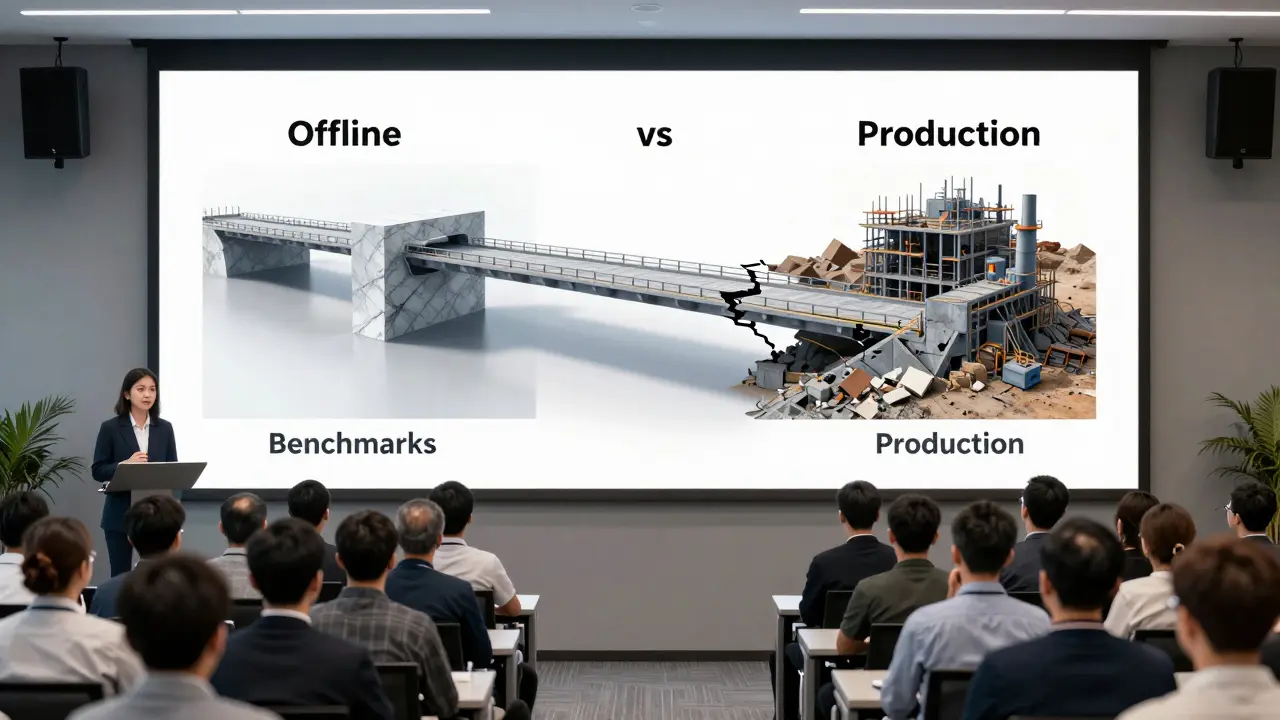
Imagine spending months optimizing a large language model to achieve state-of-the-art scores on MMLU or HumanEval. You celebrate the victory, deploy it to your enterprise application, and watch as users complain about hallucinations, slow responses, and irrelevant answers. This scenario is not an anomaly; it is the new normal in AI development. The correlation between offline scores and real-world LLM performance is significantly weaker than most engineers assume, creating a dangerous illusion of competence that only shatters when models hit production.
The disconnect isn't just a minor statistical noise. It represents a fundamental structural flaw in how we evaluate intelligence today. Academic benchmarks are designed to measure potential under ideal conditions, while production environments demand robustness under constraints. Understanding this gap is no longer optional for AI practitioners; it is the difference between building a tool that works and one that fails silently in critical business processes.
The Illusion of Competence: Quantifying the Drop-Off
To grasp the severity of the issue, we need to look at hard data rather than marketing claims. Research into class-level code generation reveals a startling reality. Models often score between 84% and 89% correctness on synthetic benchmarks like HumanEval or MBPP. These numbers suggest near-perfect reliability. However, when the same models are tested on real-world code repositories-messy, undocumented, and context-heavy-their correctness plummets to between 24% and 35%. That is a drop of nearly 60 percentage points.
This degradation occurs even when the model has seen similar data types before. The issue is not overfitting to specific test questions. Instead, it highlights that the benchmark environment itself is artificial. In academic settings, inputs are clean, prompts are engineered, and success is binary. In the real world, inputs are noisy, prompts are vague natural language queries, and success depends on nuanced utility. A model might get the syntax right in a benchmark but fail to integrate with the existing codebase structure in production.
Why do LLMs perform worse in production than on benchmarks?
The primary reason is the difference in prompting and context. Benchmarks use highly engineered, multi-step prompts with scaffolding, while production uses simple, zero-shot natural language prompts with minimal context. Additionally, benchmarks ignore operational constraints like latency and cost, which force different architectural choices in real applications.
Root Causes: Why the Correlation Breaks Down
Several interconnected factors drive this divergence. The first is the disparity in prompting strategies. Academic evaluations rely on "prompt engineering" as a crutch. They use chain-of-thought reasoning, few-shot examples, and iterative refinement loops to coax the best answer from a model. In contrast, enterprise applications typically operate on single-pass, zero-shot interactions. A user does not have the time or expertise to craft a complex prompt with three examples and a step-by-step instruction set. They type a question and expect an answer immediately. When you remove the scaffolding, the model's raw capability is exposed, and it often falls short.
Second, the handling of low-resource and regional languages exposes another crack in the foundation. Multilingual models may show strong benchmark scores across dozens of languages because the test sets are curated and balanced. In production, however, these models struggle significantly when prompt engineering is removed. The performance gap widens drastically for underrepresented languages, indicating that benchmark scores often represent an unrealistic upper bound rather than a reliable baseline for global deployment.
Third, there is a misalignment in what we measure versus what matters. In alignment training, for instance, researchers focus on reward model accuracy. Studies show that while online algorithms achieve higher preference classification accuracy than offline policies, this metric has little to no positive correlation with actual model performance in downstream tasks. In some cases, the correlation is slightly negative. This means a model can be "better aligned" according to the math but still produce worse outputs for the end-user.
The Alignment Trap: Online vs. Offline Training
The gap extends beyond evaluation into the very process of training models. Reinforcement Learning from Human Feedback (RLHF) and its derivatives like Direct Preference Optimization (DPO) highlight a critical distinction between online and offline approaches. Online alignment algorithms, which perform inference during training and maintain explicit reward models, consistently outperform offline methods. This is because online methods sample from the current policy, ensuring that the training data remains relevant to the model's evolving behavior.
Offline methods, by contrast, rely on static datasets generated by earlier versions of the model or supervised fine-tuning (SFT) policies. This leads to distribution shift, where the model learns from data that no longer reflects its current capabilities. Research indicates that on-policy sampling provides a clear performance advantage. However, fully online RL is computationally expensive. A promising middle ground is semi-online algorithms, such as semi-online DPO, which incorporate recent on-policy data into offline optimization. These approaches nearly match the performance of full online DPO while being easier to implement and less resource-intensive.
Negative gradients also play a surprising role. Algorithms that utilize negative gradients-explicitly penalizing rejected responses-show faster convergence and better performance margins, especially in difficult alignment cases. Interestingly, while the margin between chosen and rejected responses increases, the absolute probability of both decreases. This counterintuitive phenomenon suggests that robust alignment requires careful calibration of loss functions, something that standard offline benchmarks rarely capture.

Metric Selection: Choosing What Actually Matters
If benchmark scores are misleading, what should we measure? The answer lies in selecting metrics that map to human perception and business utility. For example, in coaching or feedback workflows where LLMs generate ordinal scores (1-5), exact score matching is often less important than ±1 accuracy. A score of 4 versus 5 usually yields similar actionable feedback for a manager. If your evaluation pipeline demands exact matches, you will discard many useful model outputs and keep many poor ones, leading to downstream damage.
When evaluation metrics are wrong, trust erodes. Managers stop using AI tools and revert to manual reviews. Employees feel unfairly graded by opaque algorithms. Promising features get rolled back because they appear inaccurate in testing, even if they were practically useful. Therefore, offline evaluation must be treated as a necessary but insufficient condition. It provides repeatability and fast iteration speed, which are valuable for debugging. But it cannot replace online evaluation, which provides the ground truth of whether improvements generalize to real outcomes.
| Feature | Offline Benchmarks | Real-World Production |
|---|---|---|
| Prompting Style | Engineered, multi-step, few-shot | Natural language, zero-shot, single-pass |
| Context Window | Optimized, clean, relevant | Noisy, messy, variable length |
| Latency Constraint | Ignored or secondary | Critical (sub-second response expected) |
| Error Tolerance | Binary (correct/incorrect) | Utility-based (helpful/harmful/neutral) |
| Cost Consideration | Rarely factored in | Primary constraint for scaling |
Operational Realities: Latency and Edge Computing
Beyond accuracy, operational characteristics define real-world success. Offline models, once downloaded to local devices, offer minimal latency because they bypass network traffic and server queues. This makes them ideal for edge computing scenarios like mobile apps, robotics, and wearables where autonomous decisions must happen instantly. Online models, hosted on remote servers, suffer from network instability and load balancing delays. Even a second-level delay can degrade user experience significantly.
This creates a trade-off. Online models are more powerful and up-to-date but slower and dependent on connectivity. Offline models are faster and private but limited by hardware constraints. Your evaluation strategy must account for this. A model that scores high on a cloud-hosted benchmark may be unusable on a smartphone due to memory footprint and inference speed. Therefore, real-world evaluation must include tests for latency, throughput, and resource consumption, not just semantic correctness.
Building a Robust Evaluation Framework
To bridge the gap, organizations must move beyond generic academic benchmarks. Start by creating custom test sets that mirror your actual application scenarios. Include multilingual and multicultural inputs to capture linguistic diversity. Define domain-specific scoring standards that align with business objectives, not just linguistic fluency. Incorporate human-reviewed evaluations to surface nuances that automated metrics miss. Finally, implement continuous quality assessments to track model drift over time. Bias and accessibility checks should be routine, ensuring fair performance across all user groups.
The strongest evaluation programs treat offline results as a starting point, not the finish line. Use offline tests for rapid iteration and debugging. Then, validate every significant change through online evaluation in a controlled production environment. This dual approach ensures that improvements in the lab translate to value in the field.
Next Steps for Practitioners
If you are currently relying solely on public benchmarks, start auditing your production logs today. Identify the top ten failure modes reported by users. Create a private benchmark dataset based on these real-world failures. Test your model against this dataset using zero-shot prompting. Compare these results with your public benchmark scores. The discrepancy will likely reveal areas for improvement that standard metrics hide. Prioritize fixes that improve real-world utility, even if they slightly lower academic scores. In the end, your users care about solving their problems, not winning awards on Hugging Face.
How can I create a realistic internal benchmark?
Collect anonymized real user queries and ideal responses from your production system. Ensure the dataset covers edge cases, errors, and diverse languages. Evaluate using zero-shot prompts to mimic real user behavior. Include metrics for latency and cost alongside accuracy.
Is offline evaluation useless?
No, offline evaluation is essential for repeatability and fast iteration. It helps catch regressions quickly. However, it should never be the sole criterion for deployment. Always pair it with online testing to validate real-world generalization.
What is the impact of prompt engineering on benchmark scores?
Prompt engineering can artificially inflate scores by providing scaffolding that real users do not provide. Benchmarks that allow heavy prompt engineering often overestimate a model's standalone capability, leading to poor performance in zero-shot production environments.
How does latency affect LLM selection for production?
Latency is a critical constraint. High-latency models degrade user experience, especially in interactive applications. Offline or edge-deployed models offer lower latency but may have lower capability. Choose based on whether speed or raw intelligence is the priority for your specific use case.
Why do multilingual models fail in production despite good benchmark scores?
Benchmarks often use curated, balanced datasets. Production involves noisy, unstructured input and lacks prompt scaffolding. Low-resource languages suffer most from this gap, as models rely heavily on context and examples that are absent in real-world zero-shot interactions.